Website Chat vs Chatbot for a Plastic Surgery Practice: Which One Fits?
Website chat vs chatbot for a plastic surgery practice: compare staffed live chat, AI chatbots and hybrids on coverage, cost,...


The latest news and expert insights for aesthetic practices.
Published on: November 12, 2026
Go Back
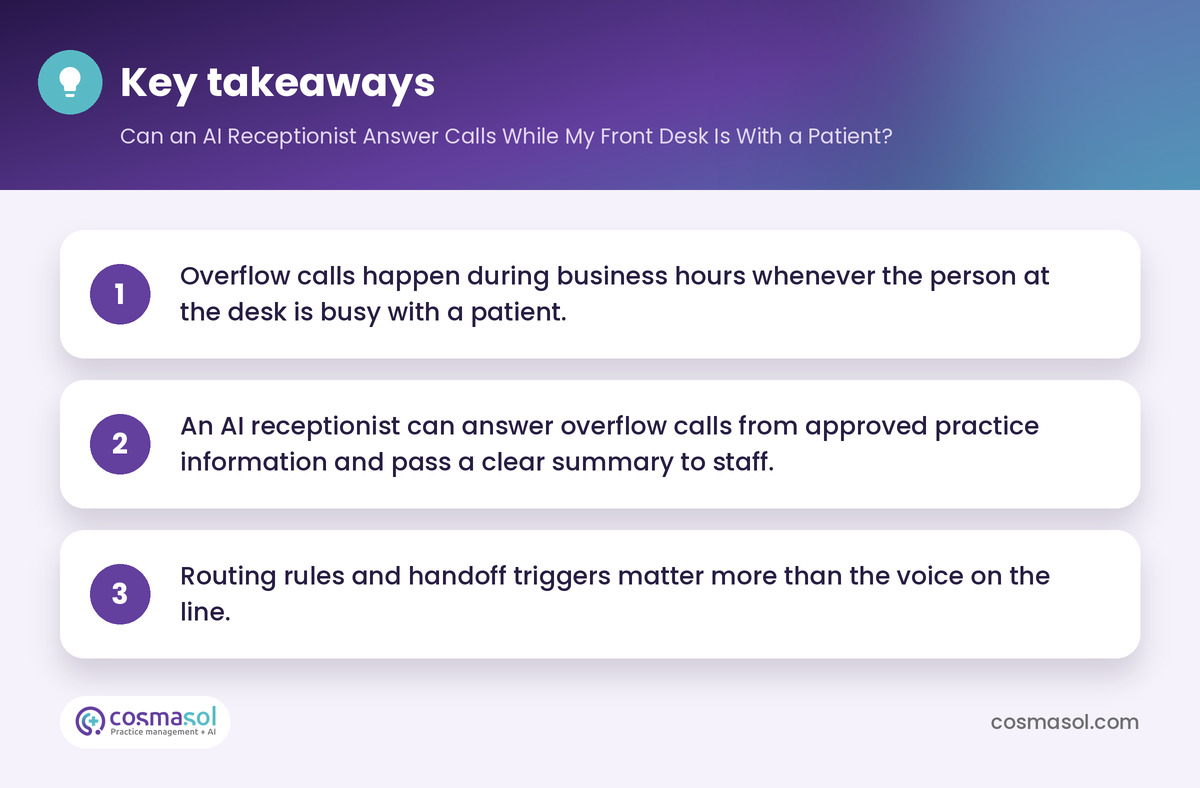
Yes. An AI receptionist can answer overflow calls – the calls that ring while your front desk is checking in a patient, taking a payment, or walking someone back to a room. It answers from your practice’s approved information, collects the caller’s name, number and reason for calling, and helps new patients take the next step toward a consultation. Your team stays focused on the person standing in front of them, and the caller gets a real answer instead of voicemail.
Most practices already think about phone coverage after hours. The harder gap is often in the middle of a busy Tuesday, when one coordinator is doing three jobs at once. This guide explains why overflow calls happen during business hours, what they cost, how an AI receptionist should handle them, and the routing and handoff rules that keep patients with your team when it matters.
Overflow calls are the calls that arrive when everyone who could answer the phone is already busy. In a plastic surgery practice or med spa, that is rarely because no one is at the desk. It is usually because the person at the desk is doing something that should not be interrupted. If your main concern is the evening and weekend gap, our guide to after-hours patient calls compares those options. This article is about the daytime version of the same problem.
The role itself explains why. The Bureau of Labor Statistics lists answering the phone, scheduling and confirming appointments, greeting visitors and checking them in as core receptionist duties, and notes that receptionists in doctors’ offices may also collect personal information and handle billing and insurance payments (BLS Occupational Outlook Handbook). BLS also notes that some receptionists face stressful situations because they may have to answer numerous phone calls or deal with difficult visitors. In an aesthetic practice, all of that often lands on one or two people.
In each of these moments, overflow calls compete with a patient who is physically present. Staff almost always choose the person in front of them, and they should. The problem is what happens to the caller: a long ring, a hold, or a voicemail greeting, and no way to know whether the caller will leave a message or wait for a callback.
The obvious fix is more people at the desk. In practice, that is harder than it sounds. In a November 3, 2026 MGMA Stat poll of 186 medical practice leaders, about four in five reported an open administrative position. Among jobs that had been open for one to three months, nearly half involved reception, scheduling or phone work, although MGMA cautions that the follow-up sample was small (MGMA).
Turnover adds to the strain. In a May 26, 2026 MGMA Stat poll with 303 responses, 29% of medical group leaders said staff turnover was higher than in 2025, with front-desk and administrative roles among the most common churn points. MGMA describes the downstream effect plainly: when front-desk and patient access staff turn over, call abandonment rises, scheduling accuracy falls and check-in slows (MGMA Stat). New hires also need time to learn your procedures well enough to answer callers with confidence.
Cost matters too. BLS reports a median hourly wage of $18.27 for receptionists in May 2025, and $19.00 for receptionists in healthcare and social assistance, the industry group that employs 42% of them (BLS). MGMA, citing its 2026 DataDive staff compensation data, reported that median receptionist pay rose 4.8% in 2025. A second full-time hire just to catch overflow calls is a real line item, and it still does not cover lunch, sick days or the rush when both people are with patients.
There is also a privacy angle. The HHS Office for Civil Rights says the HIPAA Privacy Rule allows incidental disclosures that happen despite reasonable precautions, such as using lowered voices or talking apart from others (HHS). A coordinator discussing a caller’s procedure interest while the waiting room listens, or checking a patient in while a caller waits on the line, makes those precautions harder. Moving some overflow calls away from the front counter can reduce how much is said within earshot. Your compliance lead should set the specific rules for your practice.
Patients still pick up the phone. In a research letter published in Health Affairs Scholar in April 2025, Haeder and Xu surveyed U.S. adults between October and November 2024, with 3,661 completed surveys. They found 72.1% had used a phone call to schedule a medical appointment in the past year, and 56.4% said the phone was their primary scheduling method (Health Affairs Scholar).
Age shapes that preference. A 2024 national consumer survey by Chartis and Jarrard found that about four in ten consumers prefer to schedule online, but two-thirds of those 65 and older prefer a phone call, compared with just over one-third of those aged 18 to 34 (Chartis).
That matters for aesthetic practices right now. The American Society of Plastic Surgeons’ 2025 Procedural Statistics Report, released September 1, 2026, found cosmetic surgical procedures rose 7% compared with the previous year, and patients 66 and older recorded a 24% rise in procedure volume, the largest gain of any age group (ASPS). These are different studies measuring different things, but together they suggest a growing share of cosmetic patients belongs to the group most likely to call rather than book online. Overflow calls from those patients deserve a real answer.
To see what this could mean for your practice, here is an illustration. Every number in the table is an assumption, not a benchmark and not a client result. Replace each one with figures from your own call reports and practice data.
| Assumption | Hypothetical value | Running result |
|---|---|---|
| Unanswered overflow calls per business day | 4 | 4 calls |
| Business days per month | 21 | 84 calls per month |
| Share that are new-patient inquiries | 25% | 21 inquiries |
| Share that would have booked a consultation | 20% | About 4 consultations |
| Share of consultations that become procedures | 30% | About 1.3 procedures |
| Average procedure value | $6,000 | About $7,560 per month |
In this scenario, four unanswered overflow calls a day add up to about $7,560 in potential monthly revenue that never had a chance to start. Your numbers may be higher or lower. The point is that small daily gaps compound, and they become measurable once you pull call data by hour.
An AI receptionist is software that answers the phone in natural conversation, using information your practice approves. For overflow calls, the flow usually looks like this:
The value is in the last step as much as the first. A voicemail tells your team that someone called. A structured summary tells them who called, what they wanted, how urgent it is and what the caller was told, so the follow-up starts in the right place.
Write these limits down before launch. They protect patients, and they protect your practice’s reputation on every call the AI takes.
The routing rule decides which calls your team gets first and which go to the AI. Most business phone systems offer more than one forwarding option, so ask your phone provider which of these your setup supports.
| Routing rule | How it works | Best for | Watch out for |
|---|---|---|---|
| Ring, then forward | The desk phone rings a set number of times, then overflow calls go to AI | Practices with one or two front-desk staff | Too many rings before forwarding frustrates callers |
| Busy-line forward | Calls go to AI only when every line is in use | Practices with steady, high call volume | Depends on your phone system’s features |
| Scheduled windows | AI answers during known busy periods, such as morning check-in or lunch | Practices with predictable daily peaks | Windows need updating when hours change |
| AI answers first | AI answers every call and flags the ones that need staff follow-up | Multi-location or very busy practices | Needs clear handoff rules and fast callbacks |
Ring-then-forward is a sensible starting point. It keeps the familiar experience for callers who reach a person quickly and only sends true overflow calls to the AI. After a few weeks of call data, you will know whether a scheduled window or another rule fits your traffic better.
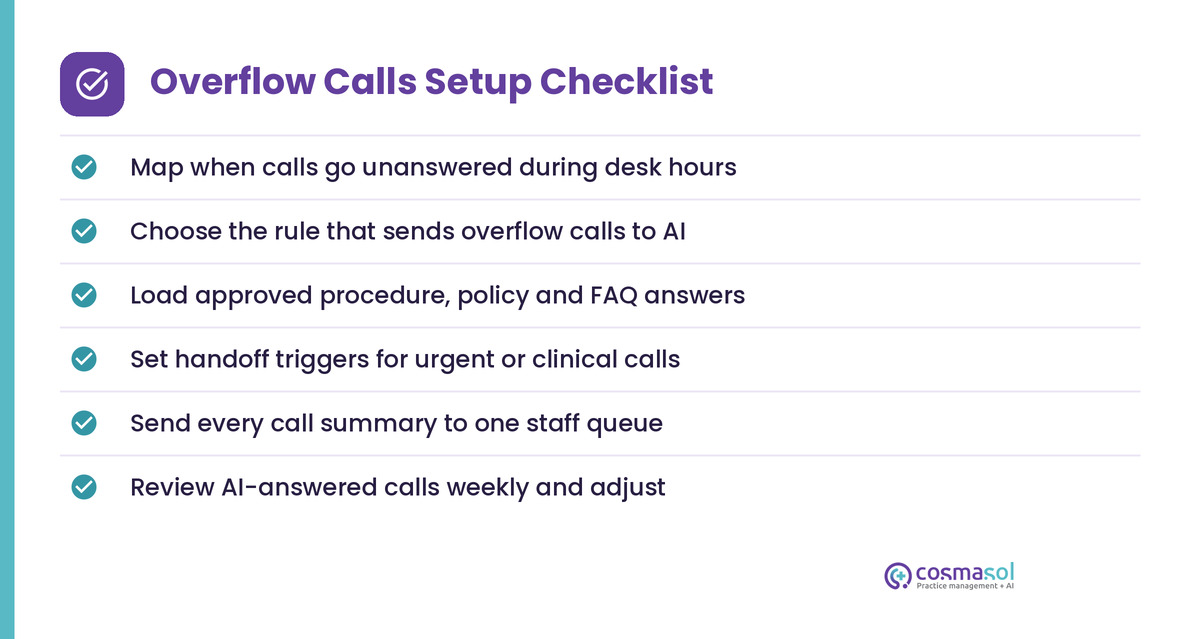
Answering overflow calls with AI is not about keeping patients away from your staff. It is about making sure no caller is left without a response while your staff are busy. That only works if the AI knows when a call belongs with a person.
Each handoff should carry the call summary with it, so a coordinator does not have to start over. MGMA’s research points the same way. In its June 2, 2026 poll of 260 practice leaders, 68% said they had not redesigned a role or adjusted staffing with AI in the past year, and those who had described small, practical changes, including putting AI agents on the phones. MGMA also cited a February 2026 poll in which calls ranked second (27%) behind scheduling (31%) as a front-office target for AI investment, and it advised pairing every automated workflow with a defined human review point (MGMA Stat).
For overflow calls, that review point is simple. One person on your team owns the queue of AI-answered calls, checks it at set times during the day and closes the loop with every caller who needs a person.
Pull call reports from your phone system for the last 30 to 60 days. Look for unanswered and abandoned calls by hour and day, then lay them next to your desk schedule. Check whether your overflow calls cluster around predictable moments, such as morning check-in, lunch or late-afternoon checkouts.
Gather approved answers for your procedures, policies and FAQs: the consultation process, consultation fees if you share them, location and parking, the financing options you offer, what to bring to a first visit and what callers should expect next. Decide in writing what the AI may say about pricing and what it should leave to a coordinator.
Have staff call in as new patients, existing patients, price shoppers and post-op patients. Check that answers are accurate, that the AI collects the right details and that every handoff trigger works. Fix the wording before patients hear it.
Turn on a single rule, such as ring-then-forward during business hours, and review the AI-answered calls every week. Track a short list of measures:
If you are also rethinking the rest of the desk workflow, our guide to automating a med spa front desk covers which tasks to hand off and which to keep personal, and our AI receptionist buyer’s guide lists what to verify before you choose a vendor.
Cosmasol builds AI tools for plastic surgery, cosmetic surgery, med spa and aesthetic practices. Our AI Calling Agent, also called the AI Front Desk, answers practice phone calls, including overflow calls when your team is busy with patients. It is trained on each clinic’s procedures, policies and FAQs, captures and qualifies leads, and supports appointment scheduling.
Leads from those calls are managed in Cosmasol’s CRM and patient management, where automated follow-up and nurture can continue the conversation, and practices on 4D EMR can use our two-way 4D EMR integration. The same approach extends to the AI Website Chatbot and to Instagram and Facebook DMs through the AI Social Media Chatbot. It is built to support your front desk, not replace it.
Overflow calls are not a sign that your team is doing a poor job. They are a sign that one person cannot greet a patient, take a payment and answer the phone at the same moment. The front desk should never have to choose between the patient in front of them and the patient on the line.
An AI receptionist, set up with clear routing rules, approved answers and firm handoff triggers, lets your team give full attention to the person at the desk while every caller still gets a response. For a broader look at how many calls practices miss and what that can cost, see our analysis of missed patient calls in plastic surgery.
Yes. With a ring-then-forward or busy-line rule, overflow calls go to the AI receptionist when your team cannot pick up. It answers from your approved information, collects the caller’s details and helps new patients toward a consultation or flags the call for staff follow-up.
Overflow calls are calls that arrive while everyone who could answer is busy, for example checking in a patient, handling a payment or helping someone at the desk. They happen during business hours, not only after the office closes.
Being upfront is good practice. Agree on a clear greeting with your compliance lead, check your state’s rules on automated and AI interactions, and make sure callers can always ask for a person.
Only if your practice approves the exact wording. Some practices share consultation fees or general ranges and leave detailed pricing to a coordinator or the consultation itself. Write the rule down before launch.
There is no single right number. Start with a short ring window your team can realistically answer within, then use call reports to adjust. The goal is to give staff a fair chance without making callers wait.
It does not have to. The goal is to cover calls your team cannot reach in the moment. MGMA’s June 2026 poll found most practices had not redesigned roles with AI, and those that had made small, practical changes. Your front desk still owns consultations, follow-up and the in-person experience.
If you want to see how overflow calls would route in your practice, book a short demo. Bring a week of call reports, and we will walk through when the AI would answer, what it would say and how each call would reach your team.
Comments are closed.
Website chat vs chatbot for a plastic surgery practice: compare staffed live chat, AI chatbots and hybrids on coverage, cost,...
Does a med spa chatbot actually convert? See what the research shows, why many setups fail, and how to test...
After-hours coverage for dermatology practices has two jobs: clinical calls for the on-call clinician and new-patient inquiries. Here is how...
After-Hours Coverage for Dermatology: 6 Smart, Safe Steps
November 13, 2026[…] to follow up. Daytime overflow is a separate problem from after-hours coverage, and our post on AI receptionists and overflow calls covers […]