Website Chat vs Chatbot for a Plastic Surgery Practice: Which One Fits?
Website chat vs chatbot for a plastic surgery practice: compare staffed live chat, AI chatbots and hybrids on coverage, cost,...


The latest news and expert insights for aesthetic practices.
Published on: November 13, 2026
Go Back
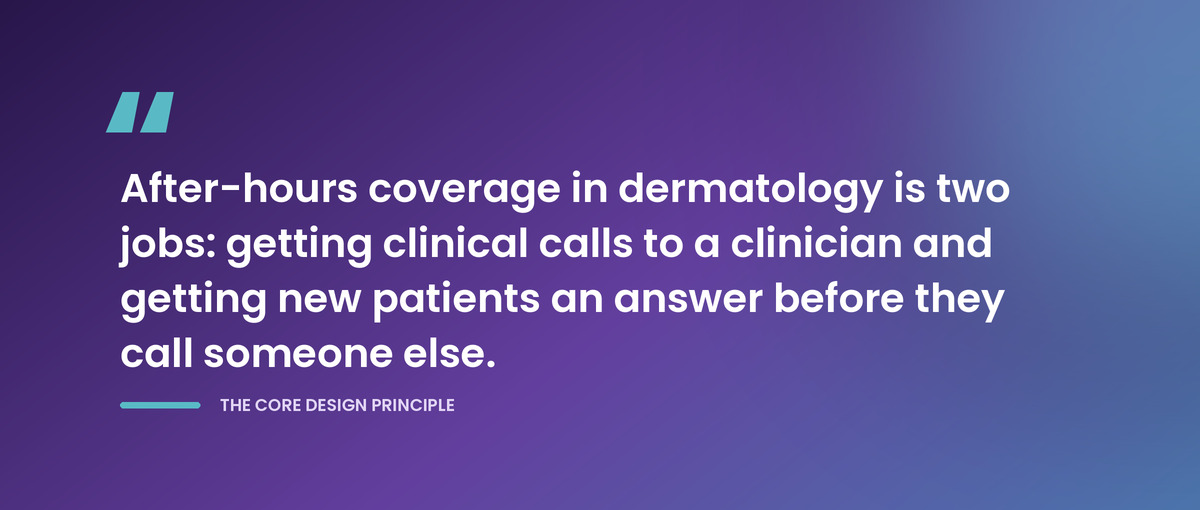
After-hours coverage for a dermatology practice has two jobs, not one. Clinical calls from existing patients, such as a question about bleeding after Mohs surgery or a reaction to a new prescription, need to reach a clinician who can make a decision. New-patient and cosmetic inquiries, such as a request for a skin check or a question about laser hair removal, need a useful answer before the caller moves on to another practice. Good after-hours coverage separates the two and gives each one a clear owner.
Treating every evening call the same way is where the trouble starts. A single voicemail box or a single message script cannot serve a worried post-operative patient and a cosmetic shopper equally well. This guide breaks dermatology after-hours calls down by type, uses published data on dermatology access and post-procedure calls, and shows what in-house cover would cost at current wage rates, so you can design after-hours coverage around how your own phones actually behave.
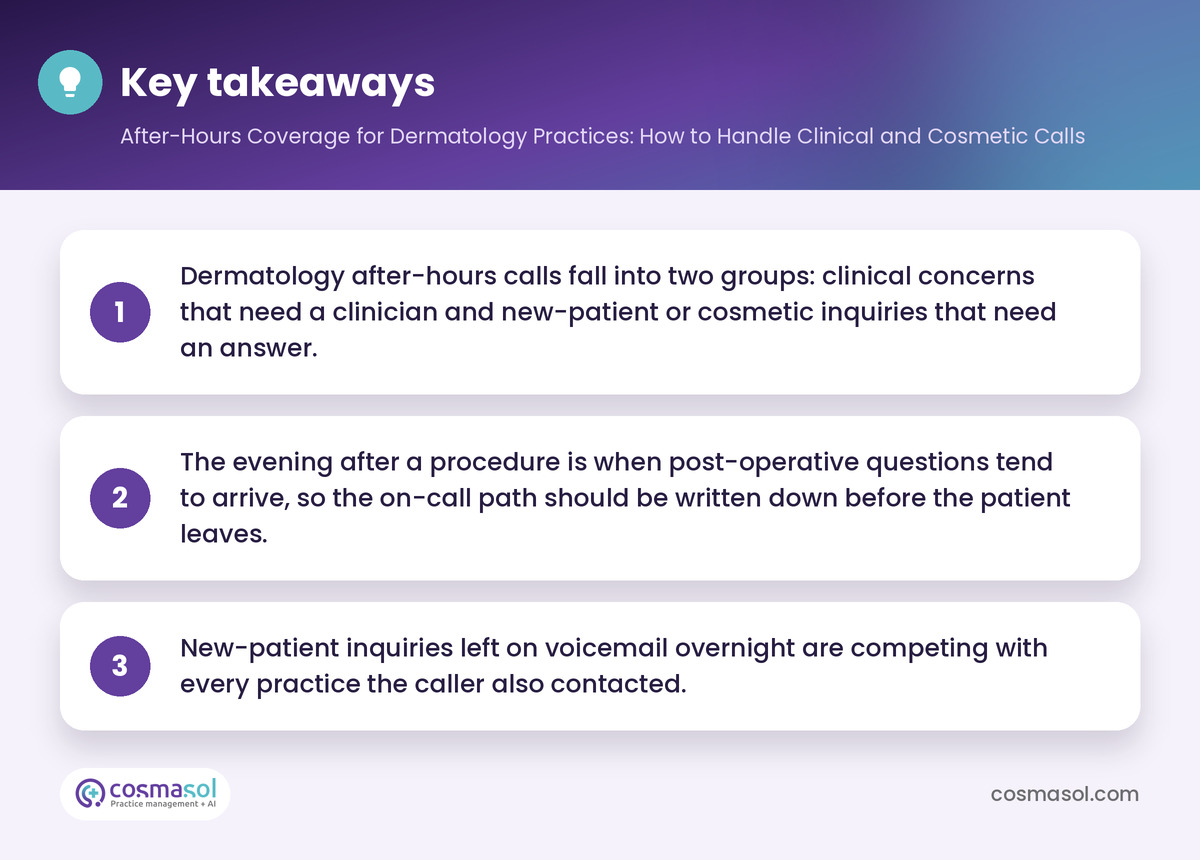
Most aesthetic practices hear one main kind of evening call: a prospective patient asking about a procedure. A dermatology practice that offers medical, surgical and cosmetic services under one phone number hears several kinds at once, and each one needs something different from your after-hours coverage.
Each kind of call has a different level of urgency and a different right destination. The table below is a simple way to sort them. Your own categories will depend on your services, and the clinical rows should always be set by your medical director, not by a vendor or a front-desk script.
| Call type | Typical example | Who should handle it after hours | Can it wait until morning? |
|---|---|---|---|
| Post-procedure concern | Bleeding or pain on the evening of Mohs surgery or an excision | On-call clinician, under your written policy | Decided by your policy, never by a script |
| Medical question from an established patient | A rash, a medication side effect, a question about a biopsy | On-call clinician or the next clinical day, under your policy | Some can, some cannot |
| New medical patient | A request for a skin check or a mole evaluation | Someone who can offer an appointment | Yes, but the caller may book elsewhere |
| Cosmetic inquiry | Questions about neuromodulators, fillers, lasers or peels | Someone who knows your services and can book a consult | Rarely, because the caller may be comparing practices |
| Administrative | Rescheduling, directions, billing questions | Any trained front-desk channel | Usually yes |
The mistake to avoid is building after-hours coverage only for the first two rows. Those calls matter most clinically, but the last three rows are where new patients come from, and they get the least attention when the only after-hours option is an on-call line. If you are also reviewing the clinical software behind these calls, our guide to dermatology EMR software covers what to look for.
Dermatologic surgery creates a predictable window for clinical calls. In a randomized trial published in the Journal of the American Academy of Dermatology in 2020, researchers at the University of Missouri assigned 400 Mohs surgery patients to four groups: no follow-up call, or a physician call on the evening of surgery, the day after, or two days after. Among patients called on the evening of surgery, 83% reported active pain, compared with 67% of those called the next day and 51% of those called two days later.
The same trial found that no single group was best at identifying bleeding, and that follow-up calls did not measurably change patient satisfaction. The lesson for after-hours coverage is narrower: the evening of a procedure day is when post-operative patients are most likely to be uncomfortable, and that is often after the front desk has closed.
A 2018 pilot study from the University of Utah, published in the Journal of Clinical and Aesthetic Dermatology, adds detail. Staff reached 263 of 349 Mohs patients within 24 to 48 hours of surgery. Of those reached, 23.6% reported some complication, mostly bleeding, bruising or swelling, and one patient returned to the office for treatment of bleeding. Timed calls averaged about three minutes each.
In the Utah cohort, most reported problems were minor. The ones that are not minor need a fast, reliable path to a clinician, and that path has to work at 9pm on a Tuesday as well as at 9am. That is the clinical half of after-hours coverage, and it is a policy question before it is a phone question.
Dermatology is one of the hardest specialties to get into. AMN Healthcare’s 2025 Survey of Physician Appointment Wait Times, which covered 1,391 physician offices in 15 large metro areas, found an average wait of 36.5 days for a new dermatology appointment, up 6% since 2022 and 50% since 2004. In Portland, Oregon, dermatology waits ranged from one day to 291 days.
Long waits change how people look for care. A caller who expects to wait weeks has every reason to contact several practices and take the first reasonable slot. That is our reading of the numbers rather than something the survey measured, but it is why the new-patient half of after-hours coverage deserves as much design as the clinical half.
Patient expectations point the same way. In Press Ganey’s March 2025 analysis of its consumer research, 46% of consumers said they would reconsider booking if they struggled to reach the main office, and 80% said online scheduling influences their choice of provider.
Cosmetic demand adds competition. The American Society for Dermatologic Surgery’s 2025 consumer survey of more than 3,500 US consumers found that 70% were considering a cosmetic procedure, 94% said rate and review websites influence which provider they choose, and nearly half said a provider’s social media presence affects their decision to book.
None of these studies measures dermatology after-hours calls directly, and we are not aware of a reliable published figure for how many dermatology inquiries arrive outside office hours. What the studies show is the context: patients who struggle to get in, who compare providers, and who drop off when the office is hard to reach. After-hours coverage that only takes messages leaves those callers to whoever answers first.
Research outside healthcare points the same way. In The Short Life of Online Sales Leads, published in Harvard Business Review in 2011, Oldroyd, McElheran and Elkington reported that most companies they studied were not responding to online inquiries nearly fast enough. The work is cross-industry and dated, so treat it as direction rather than a dermatology benchmark. Our earlier post on automating DMs for medical and aesthetic clinics applies the same idea to Instagram and Facebook messages.
Practices often combine more than one of these. The comparison below is about what each model does with the two kinds of call, not about any particular vendor or dermatology answering service.
| Model | Clinical concerns | New-patient and cosmetic inquiries | Main limitation |
|---|---|---|---|
| Voicemail with an on-call number in the greeting | Caller dials the on-call clinician directly | A message for the morning, if the caller leaves one | New patients get no answer and may not leave a message |
| Answering service relaying to the on-call clinician | Service takes details and contacts the clinician | A message taken against a script | Operators may not know your services or schedule |
| Nurse triage line | A nurse assesses and escalates | Usually outside its scope | Costly to staff for non-clinical questions |
| AI front desk for non-clinical calls, on-call path for clinical calls | Directed to your on-call process under your written policy | Questions answered and details captured from your own information | Must be set up so the AI never makes clinical judgments |
Whatever mix you choose, design the clinical path and the new-patient path separately. One phone number can serve both, but the rules for each are different, and your after-hours coverage is only as good as the weaker of the two paths.
If you want a cost comparison of these options for aesthetic practices, our breakdown of after-hours patient calls and what each option costs covers it in detail. This post stays with the dermatology-specific question of how to split the calls.
The one figure every practice can check is what it would cost to staff evenings itself. The US Bureau of Labor Statistics puts the median wage for receptionists at $18.27 an hour in May 2025, and $19.00 an hour for receptionists in healthcare and social assistance. The median registered nurse earned $97,550 a year, or $46.90 an hour, in the same period.
Here is a hypothetical scenario, not a benchmark. Assume your practice wants a person on the phones from 6pm to 9pm on weekdays and from 9am to 1pm on Saturdays, either a front-desk employee or a registered nurse.
| Input (hypothetical scenario) | Front-desk cover | Nurse cover |
|---|---|---|
| Hourly wage (BLS median, May 2025) | $19.00 | $46.90 |
| Weekday evenings, 6pm to 9pm | 15 hours | 15 hours |
| Saturday, 9am to 1pm | 4 hours | 4 hours |
| Weekly hours | 19 | 19 |
| Weekly wage cost | $361.00 | $891.10 |
| Annual wage cost (52 weeks) | $18,772 | $46,337 |
These are wages only. Payroll taxes, benefits, recruitment and cover for holidays and sick days come on top, and local wages vary. The schedule also covers 19 hours of a 168-hour week, which leaves 149 hours, including every overnight, without a person on the phone.
That gap is why combining models is usually more practical than staffing every hour. It also shows why the two halves of after-hours coverage are priced so differently: clinical judgment needs a clinician, while most new-patient questions do not.
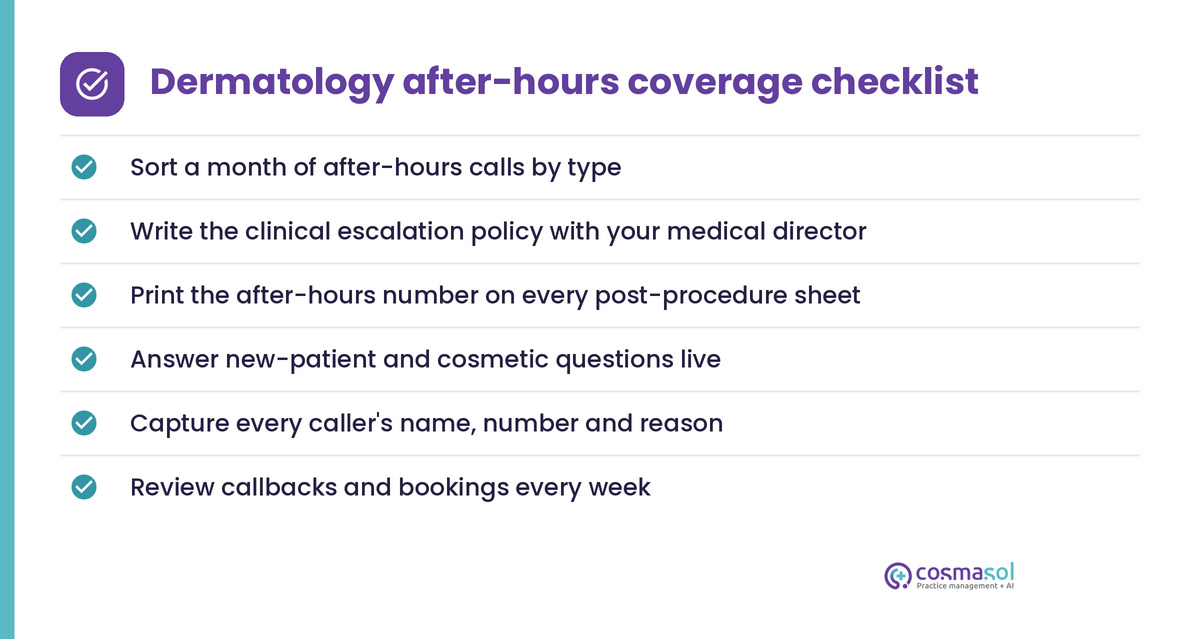
These guardrails apply whether your after-hours coverage is a person, an answering service or an AI agent. They protect patients first, and they also protect the practice from a well-meaning answer given by the wrong person.
Pick a small set of numbers and track them from the day you change anything. Compare them against the baseline from your call sort in step one.
If bookings do not move after two months, look upstream: check whether the inquiries are arriving at all, and whether the daytime front desk has room to follow up. Daytime overflow is a separate problem from after-hours coverage, and our post on AI receptionists and overflow calls covers it.
Cosmasol builds AI Digital Agents for aesthetic, plastic surgery and dermatology practices. The AI Calling Agent answers practice phone calls, including after hours, and the AI Website Chatbot and AI Social Media Chatbot handle website chat and Instagram and Facebook messages. Each agent is trained on the practice’s own procedures, policies and FAQs, captures and qualifies inquiries, supports scheduling and passes leads into automated follow-up and the practice’s CRM.
In a dermatology practice, that makes Cosmasol a fit for the non-clinical half of after-hours coverage: new-patient questions, cosmetic inquiries and booking requests. Clinical judgment stays with your on-call clinicians, and the practice’s own after-hours policy, including where urgent concerns should go, is part of what the agent is trained on. For practices on 4D EMR, Cosmasol’s two-way 4D EMR integration keeps patient and appointment records in sync.
It covers two kinds of calls. Clinical calls from existing patients, such as post-procedure concerns, go to an on-call clinician under a written policy. New-patient, cosmetic and administrative calls need an answer or a captured callback so the caller is not lost overnight.
Practices that perform procedures need a reliable way for post-operative patients to reach a clinician. How that is staffed, and which concerns qualify, is a decision for your medical director and belongs in your written after-hours policy.
It should not make clinical judgments. A sensible setup uses AI for non-clinical questions and booking, and follows the practice’s written policy so that callers with clinical concerns are directed to the on-call clinician or to emergency services.
In a hypothetical schedule of 19 hours a week, wages alone come to about $18,772 a year for a front-desk employee at the BLS healthcare median of $19.00 an hour, or about $46,337 for a registered nurse at the BLS median of $46.90 an hour, before taxes and benefits.
AMN Healthcare’s 2025 survey found an average wait of 36.5 days for a new dermatology appointment across 15 large metro areas. Patients facing long waits have reason to call several practices, so the practice that answers and offers a next step has an advantage.
If your evenings and weekends currently end in voicemail, it is worth seeing what a split model looks like with your own call types and policies. You can book a short demo and we will walk through how Cosmasol handles the non-clinical side of after-hours coverage while your on-call process stays exactly as your medical director set it.
Website chat vs chatbot for a plastic surgery practice: compare staffed live chat, AI chatbots and hybrids on coverage, cost,...
Does a med spa chatbot actually convert? See what the research shows, why many setups fail, and how to test...
Overflow calls ring while your front desk is with a patient. See how an AI receptionist answers them, when to...