Website Chat vs Chatbot for a Plastic Surgery Practice: Which One Fits?
Website chat vs chatbot for a plastic surgery practice: compare staffed live chat, AI chatbots and hybrids on coverage, cost,...


The latest news and expert insights for aesthetic practices.
Published on: November 10, 2026
Go Back
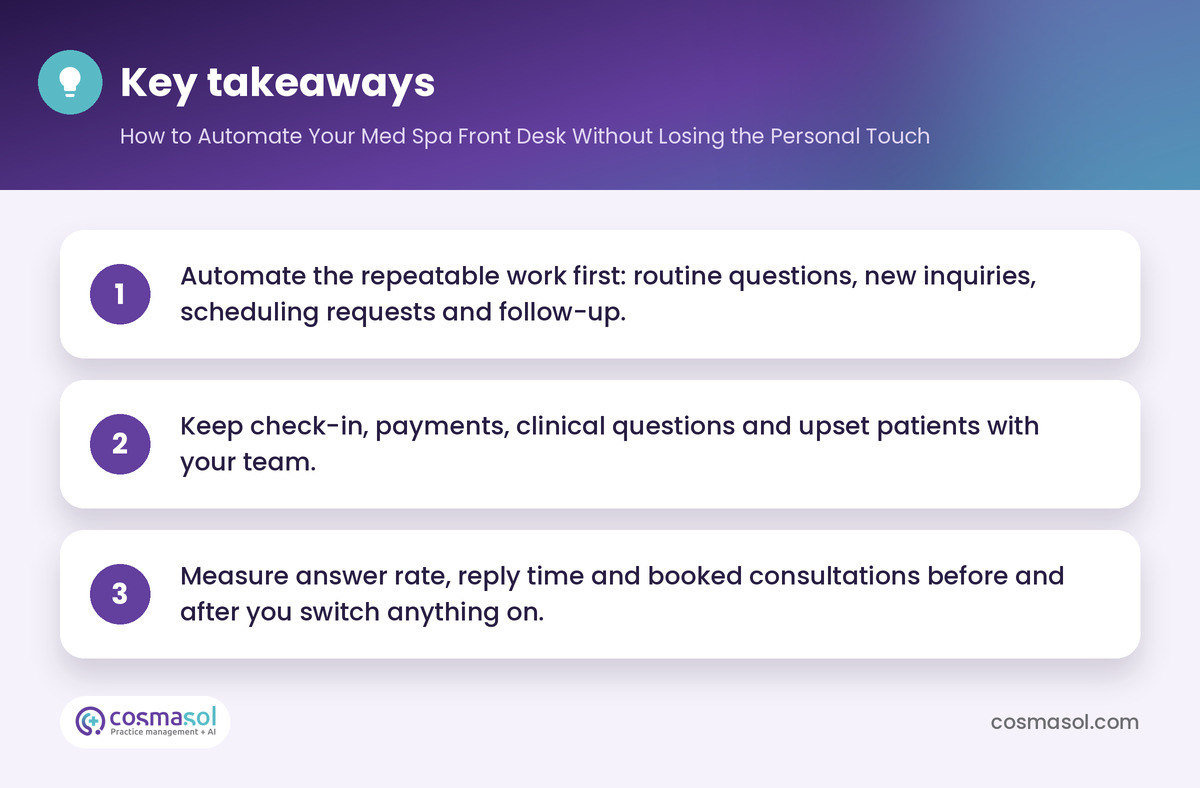
Yes, you can automate a large part of your med spa front desk. Routine calls, website chat, Instagram and Facebook DMs, new-inquiry capture, scheduling requests and follow-up with people who did not book are all repeatable, and software can handle them the same way every time. What should stay with your team is the work that needs judgment or a human presence: greeting patients, checkout and payments, clinical questions and anyone who is upset. The goal is not an empty med spa front desk. It is a front desk that is no longer answering a phone, a DM and a patient at the same time.
This guide is for med spa owners, practice managers and the people who run the desk. It covers why the med spa front desk gets overwhelmed, what that costs, the seven tasks to automate first, what to keep human, the rules to check, a 30-day rollout plan and how to measure results.
In its Occupational Outlook Handbook, the US Bureau of Labor Statistics lists the core duties of a receptionist: answering the phone and taking messages, scheduling and confirming appointments, greeting and checking in visitors, and entering information into the organization’s database. In doctors’ offices, BLS adds collecting patients’ personal information, and some receptionists also handle billing and payments.
A med spa front desk does all of that and more. It answers Instagram DMs and website chat, sells retail products, rebooks injectables and memberships, and explains treatments to people who are still comparing practices. That work arrives through different channels, but at most practices it lands on the same one or two people.
The American Med Spa Association’s 2024 State of the Industry executive summary, built on a survey of med spa professionals, found that 81% of med spas are single-location and that single-location practices average eight employees in total. The same summary reports an average of 245 patient visits per month and says 73% of patients are repeat patients. Eight people covering providers, management and the med spa front desk leaves little room for a dedicated phone person.
Repeat patients are good news, but they also call to rebook, ask about a membership or move an appointment. Each request is short, and short requests pile up when the same person is checking out the patient in front of them.
This is not unique to aesthetics. In a March 2026 MGMA Stat poll of 294 medical practice leaders, 31% named scheduling as their staff’s most time-consuming phone task, behind eligibility and prior authorization at 45%, with intake at 9%. Most med spas do little insurance work, so it is reasonable to expect scheduling and intake to take an even larger share of their phone time. MGMA’s own summary is that the phone asks staff to do two jobs at once: keep access moving and act as the intake engine.
Practice leaders know it. In a December 2025 MGMA Stat poll of 236 respondents, no-shows (27%), online scheduling (24%), phone access (22%) and wait times (21%) were the top patient access priorities for 2026. Three of those four land squarely on the med spa front desk.
Adding staff is the obvious fix, and it is not getting easier. In a November 2026 MGMA Stat poll of 186 medical practice leaders, about four in five reported an open administrative position, and 16% said their longest opening had been vacant for six months or more. Among jobs open one to three months, nearly half involved reception, scheduling or phone work. MGMA also cites its own compensation data showing receptionist pay rose 4.8% in 2025. These are medical groups rather than med spas, but they hire from the same pool of front desk candidates.
When a med spa front desk is stretched, the cost shows up in three places. The first is missed or slow replies to new inquiries. In a 2011 Harvard Business Review article, Oldroyd, McElheran and Elkington reported from their research on online lead handling that most companies respond to inquiries far too slowly. Aesthetic patients often contact several practices while they research, so the practice that answers first has an edge. We looked at the phone side of this in our post on how many patient calls a practice misses.
The second is staff time. Every routine question answered by hand is time not spent with the patient standing at the desk. The third is consistency: when the desk is rushed, answers about pricing, prep or cancellation policies vary by who picks up.
There is no published benchmark for how many calls and messages a med spa front desk handles, so here is an illustration with every assumption shown. Replace each one with your own numbers.
| Assumption (hypothetical) | Figure |
|---|---|
| Calls per day | 40 |
| DMs and website chats per day | 15 |
| Share that are routine questions | 50% |
| Minutes per routine contact | 3 |
| Working days per month | 22 |
| Routine contact time per month | About 30 hours |
| Median receptionist wage in healthcare (BLS, May 2025) | $19.00 per hour |
| Wage value of that time | About $575 per month |
Hypothetical scenario, not a result. The math is 55 contacts x 50% x 3 minutes x 22 days, or about 30 hours, multiplied by the BLS median hourly wage for receptionists in healthcare. The dollar figure is modest. The real point is that roughly 30 hours a month of the desk’s attention goes to questions with the same answer every time, usually while someone else is waiting.
Revenue is the bigger lever. AmSpa’s 2024 executive summary puts average patient spend per med spa visit at $527. If better coverage turned two extra inquiries a week into booked visits, that would be 2 x $527 x 52 weeks / 12 months, or about $4,567 a month. That is an illustration built on assumed numbers, not a forecast, and it ignores return visits, which AmSpa’s data suggests are where most of a med spa’s patients come from.
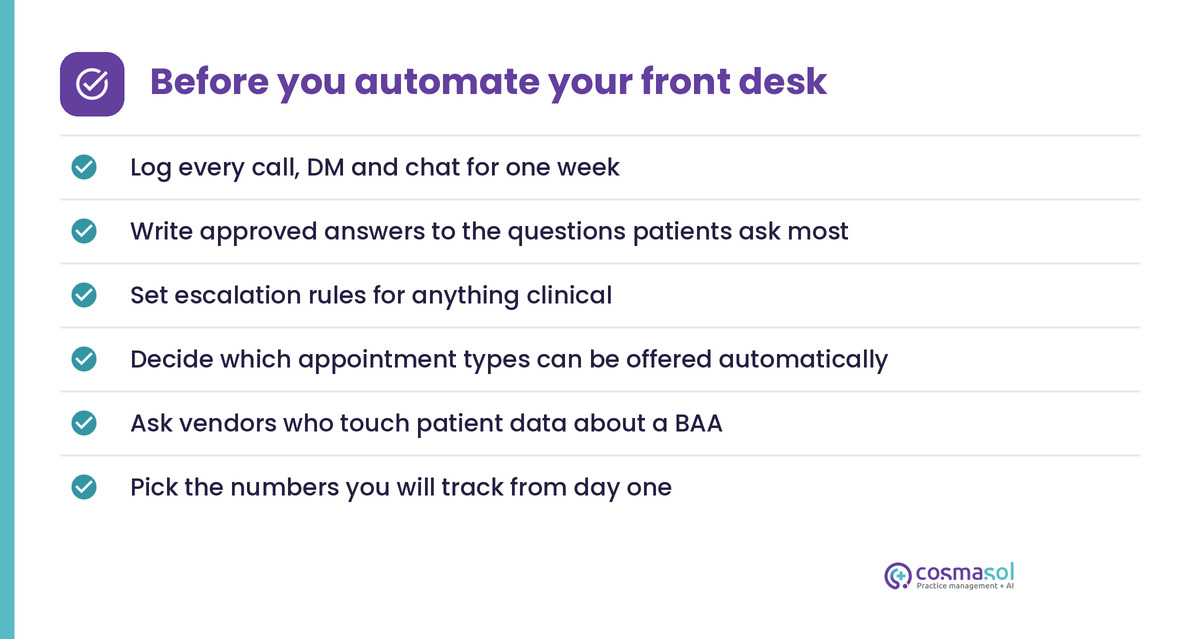
MGMA’s practical advice in the same phone analysis is to map your top call types, set escalation rules for anything clinical, and start with high-volume, lower-risk workflows before expanding. For a med spa front desk, these seven tasks fit that description. They repeat, they follow your rules, and a wrong answer is easy to spot and correct.
Hours, location, parking, what a consultation involves, how long a treatment appointment takes, the prep instructions you have written down and the price ranges you are comfortable sharing. Your team will recognize these as the questions they answer over and over. Write the answers down once and approve them. An automated system should answer from that approved content, not improvise, and it should never give medical advice.
Calls that ring while the med spa front desk is busy, and calls that arrive after closing, are the easiest place to start because the alternative is usually voicemail. An AI front desk for phone calls can answer, handle routine questions, take the caller’s details and pass anything it should not handle to your team. Our breakdown of after-hours patient calls compares the realistic options and what each one costs.
Website visitors often have one quick question before they are ready to book. An AI website chatbot trained on your treatments and policies can answer it on the spot, capture contact details and offer a consultation, instead of leaving a contact form to sit in an inbox until someone has a free minute.
DMs are where many aesthetic patients start, and they are the channel most likely to sit unanswered through a busy afternoon. Meta’s rules shape how this works. Its Instagram messaging documentation says a business generally has a 24-hour standard messaging window to reply after a person messages, that a human agent can reply for longer under a separate Human Agent tag, and that apps using Instagram messaging must offer a path to a human agent. Our guide on how to automate DMs for a medical or aesthetic clinic covers the details.
Every new inquiry should end up with the same basic record: name, phone, email, the treatment they asked about, how they found you and when they would like to come in. Automation is good at asking those questions every time, in the same order, and saving the answers in one place, so nobody has to retype them from a voicemail or a sticky note at the med spa front desk.
Offering available times, confirming a booking and sending reminders are rule-based tasks. The evidence on reminders is reasonably solid for healthcare in general. A 2013 Cochrane review of randomized trials found that text message reminders improved attendance compared with no reminders, with attendance of 67.8% without reminders and 78.6% with text reminders, and that texts worked about as well as phone call reminders. The authors rated the evidence low to moderate quality, and none of the trials were in aesthetics, so treat it as directional.
Many inquiries end with “I’ll think about it.” A short, polite follow-up a day or two later, and again after a week, keeps the conversation open without pressure. It is easy to forget by hand and easy to schedule automatically. Keep it brief, stop when the person says no, and hand any reply with a real question back to a person on your team.
Automation works when it handles the predictable part of the job and hands off the rest quickly. These are the moments where a person should take over every time, no matter how capable the software is.
| Front desk task | Who should handle it | Why |
|---|---|---|
| Greeting and check-in | Your team | The in-person welcome sets the tone for the visit |
| Checkout, payments and refunds | Your team | Money questions and disputes need judgment and authority |
| Clinical questions and post-treatment concerns | Your clinical team | No automated system should give medical advice |
| Complaints and upset patients | Your team | People want to be heard by a person |
| Consultation conversations | Providers and coordinators | This is where trust is built and treatment is planned |
| Routine questions and new inquiries | Automation, with handoff | Repeatable, rule-based and easy to review |
| Rebooking and reminders | Automation, with oversight | High volume, low risk and easy to correct |
Share these rules with the whole team, not just the person who sets up the software. The med spa front desk is only as reliable as its handoffs, and everyone should know where escalated conversations land and how fast they need a reply.
Before you automate any part of your med spa front desk, check how patient information will be handled. Under HIPAA, a business associate is a person or company that performs services for a covered entity involving access to protected health information, and HHS guidance on business associate contracts says covered entities generally need a written contract requiring those associates to safeguard that information. Whether HIPAA applies to your practice depends on how you operate, so confirm it with your compliance advisor, and ask any vendor that will touch patient information whether it will sign a business associate agreement.
Disclosure matters too. Meta’s Instagram messaging documentation says automated chat experiences must tell people they are talking to an automated service where the law requires it, naming California as one example, and recommends doing so even where it is not required. Telling patients up front is also simply good practice. Texting rules and consent requirements vary, so review your reminder and follow-up messages with counsel. This section is general information, not legal advice.
You do not need to switch everything on at once. A staged rollout lets you find and fix problems while volume is low and your team is still learning the new workflow.
After the first month, review transcripts weekly. Most fixes are small: a missing answer, a changed policy or a handoff sent to the wrong person. Treat med spa front desk automation like onboarding a new team member, with regular check-ins rather than a one-time setup.
MGMA suggests that practice leaders track call abandonment, time to resolution, staff minutes per call and after-hours message backlogs. For a med spa front desk, these are the measures we would start with.
| Metric | What it tells you | How to measure it |
|---|---|---|
| Answer rate | How many calls, DMs and chats got a real reply | Answered contacts divided by total contacts, by channel |
| Time to first reply | How long new inquiries wait | Median minutes from first message to first response |
| Consultations booked from new inquiries | Whether faster replies turn into bookings | Bookings attributed to each channel per week |
| Handoffs handled correctly | Whether your escalation rules work | Share of clinical or complaint contacts that reached a person |
| Desk time on routine questions | Whether staff got time back | A one-week log, repeated after 30 days |
Compare everything against the week you measured before you started. If bookings do not move, the problem may sit upstream, in marketing or provider availability, rather than at the med spa front desk. That is still useful, because it tells you where to look next.
Cosmasol is an AI front desk and practice management platform for plastic surgery, cosmetic surgery and med spa practices. Its AI Calling Agent answers practice phone calls, the AI Website Chatbot handles website chat, and the AI Social Media Chatbot replies to Instagram and Facebook DMs. Each is trained on the clinic’s own procedures, policies and FAQs. Together they capture and qualify inquiries, support scheduling, run automated follow-up and record conversations in the Cosmasol CRM so your team picks up with context. For practices on 4D EMR, Cosmasol offers a two-way 4D EMR integration. As with any tool, set it up so that anything clinical goes straight to your team.
An overwhelmed med spa front desk is usually a routing problem, not a people problem. Automate the questions and requests that repeat, write clear rules for what goes to a person, and measure before and after. Done that way, automation gives your team back time for the part of the job only they can do: making each patient feel looked after.
No, and you should not try. Routine questions, new inquiries, scheduling requests and follow-up can be automated, but greeting patients, payments, clinical questions and complaints need a person. A hybrid works best: automation handles the first touch and the team handles anything that needs judgment.
Start with overflow and after-hours calls, website chat and Instagram DMs, because the alternative is usually voicemail or a slow reply. Then add new-inquiry capture, scheduling requests and follow-up with people who did not book.
They should. Meta says automated chat experiences must disclose that a person is talking to an automated service where the law requires it, and recommends doing so everywhere. A short line at the start of the conversation is enough.
It changes what they spend their time on. Automation takes the repeatable questions and requests so staff can focus on patients in the room, consultations, payments and anything that needs judgment. It works best as support for the team, not a replacement.
It should never give medical advice, assess a symptom, promise results, discuss a complication or guess at an answer it does not have. Those situations should go straight to your clinical team or practice manager.
Keep a person in every conversation that needs one, write approved answers in your own voice, and make it easy to reach a human at any point. A fast, accurate answer to a routine question, followed by a person when it matters, keeps the experience personal.
If your med spa front desk is juggling phones, DMs and patients at the same time, it may help to see how an AI front desk handles the repeatable part of that work. You can book a short demo and walk through it with your own questions and workflows.
Comments are closed.
Website chat vs chatbot for a plastic surgery practice: compare staffed live chat, AI chatbots and hybrids on coverage, cost,...
Does a med spa chatbot actually convert? See what the research shows, why many setups fail, and how to test...
After-hours coverage for dermatology practices has two jobs: clinical calls for the on-call clinician and new-patient inquiries. Here is how...
Med Spa AI Receptionist: 10 Essential Checks for a Great Fit
November 11, 2026[…] script and red flags. If you are still deciding which tasks to hand off, start with our guide to automating your med spa front desk. For pricing models and HIPAA questions, see our AI receptionist guide for plastic surgery and med […]
Overflow Calls: 4 Smart Routing Rules for a Busy Front Desk
November 17, 2026[…] you are also rethinking the rest of the desk workflow, our guide to automating a med spa front desk covers which tasks to hand off and which to keep personal, and our AI receptionist buyer’s […]