AI Chatbots for Med Spas: Do They Actually Convert?
Does a med spa chatbot actually convert? See what the research shows, why many setups fail, and how to test...


The latest news and expert insights for aesthetic practices.
Published on: October 23, 2026
Go Back
After-hours patient calls are the inquiries that arrive once the front desk has gone home: evenings, weekends and holidays. Most aesthetic practices send them to voicemail, and most of those callers never leave a message. There are four realistic ways to cover them, and they differ more in cost than in capability.
This post sets out what each option costs using published wage data, so you can compare them against your own case value rather than against a vendor’s claim.
There is no published figure for how many after-hours patient calls an aesthetic practice receives. Every percentage in circulation comes from a company selling call software, and those companies tend to cite each other rather than an original study. We said the same thing when we looked at how many patient calls a practice misses and what it costs, and it has not changed.
What is documented is the demand behind those calls. The American Society of Plastic Surgeons recorded 1,523,330 cosmetic surgical procedures in 2025, a 7% rise on 2024, with breast augmentation up 11% and facelifts up 13%. More procedures mean more inquiries, arriving at front desks that have not grown at the same rate.
Patient expectations are documented too. Press Ganey reports that 80% of healthcare consumers say online scheduling influences which provider they choose, and that only 9% have never used it. Those are people who expect to act on their own schedule, not yours.
Two things make after-hours patient calls more expensive here than in general medicine.
The first is case value. Using the most recent published fee table from ASPS, which covers 2024, surgeon fees alone run from $4,575 to $8,000 for breast augmentation and $12,000 to $19,000 for a facelift. Those figures exclude anesthesia and facility costs, so the real value of a booked case is higher. One recovered consultation can cover a year of call handling.
The second is competition. An aesthetic patient researching a procedure in the evening is usually contacting more than one practice. Research published in Harvard Business Review in 2011 by Oldroyd, McElheran and Elkington found that firms making contact within an hour of an inquiry were about seven times more likely to reach a decision maker than those waiting one hour longer. The study is cross-industry and over a decade old, but nothing since has contradicted the direction.
Each of these is a real option used by practices today. The table compares what they do, not what they cost. Costs come next.
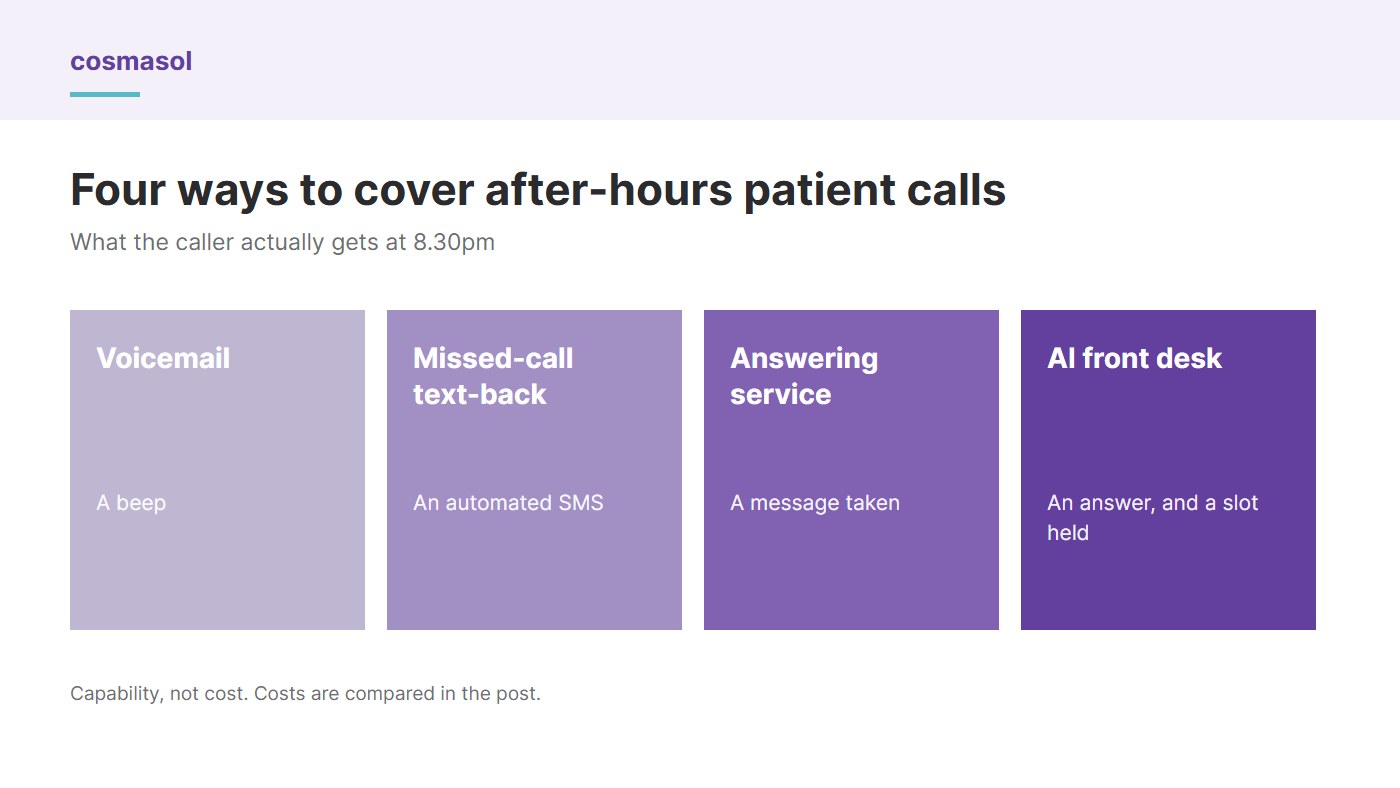
| Voicemail | Missed-call text-back | Answering service | AI front desk | |
|---|---|---|---|---|
| Answers the call live | No | No | Yes | Yes |
| Available at 2am | Message only | Yes | Yes | Yes |
| Knows your procedures and prices | No | No | Rarely | Yes, once trained |
| Can book or hold a consultation | No | No | Sometimes | Yes |
| Covers website chat and Instagram DMs | No | No | No | Yes |
| Cost scales with call volume | No | Low | Yes, per minute | No |
This is the comparison most practices never run, and it is the one with hard public data behind it. The US Bureau of Labor Statistics puts the median receptionist wage at $18.27 an hour as of May 2025.
Say you want cover from 6pm to 9pm on weekdays, plus Saturday from 9am to 5pm. That is 23 hours a week.
| Input | Figure |
|---|---|
| Median receptionist wage (BLS, May 2025) | $18.27 per hour |
| Weekday evening cover, 6pm to 9pm | 15 hours per week |
| Saturday cover, 9am to 5pm | 8 hours per week |
| Total | 23 hours per week |
| Weekly wage cost | $420.21 |
| Annual wage cost | $21,851 |
That is roughly $21,851 a year in base wages to answer after-hours patient calls in house, before employment costs. It also buys you one person, answering one call at a time, on the nights they turn up.
Set that against the case values above. The arithmetic is not an argument for any particular tool. It is an argument for knowing the number before you decide.
Answering services bill per minute or per call, usually on a monthly plan with an included allowance. Vendors advertise entry plans in the low hundreds of dollars a month, with per-minute overage on top. We are not treating those as verified figures, because published rates and quoted rates differ and almost every number online sits on a vendor’s own site.
The structural point matters more than the price. An answering service costs more as your call volume grows, which means it charges you most in the months your marketing works best. It also takes messages against a script, so the caller who wants to know whether you do deep plane facelifts usually gets a callback promise rather than an answer.
Work through these in order.
If your losses sit mostly in business hours, this is a staffing and call-routing problem, not an after-hours one. The measurement method is here.
It helps to picture the caller rather than the channel. A woman finishes work at six, spends an hour reading about breast augmentation, and calls three practices from her sofa at half past eight. She is not in a crisis and she is not ready to book surgery. She wants to know roughly what it costs, how long recovery takes, and whether she can be seen in the next fortnight.
Practice one sends her to voicemail. Practice two answers with a service that takes her name and promises a callback. Practice three answers the question about recovery time and offers her a consultation slot on Thursday.
By the time practice one calls back at nine the next morning, she has already booked. This is what after-hours patient calls cost, and it is why the comparison is about capability rather than availability. All three practices were reachable. Only one was useful.
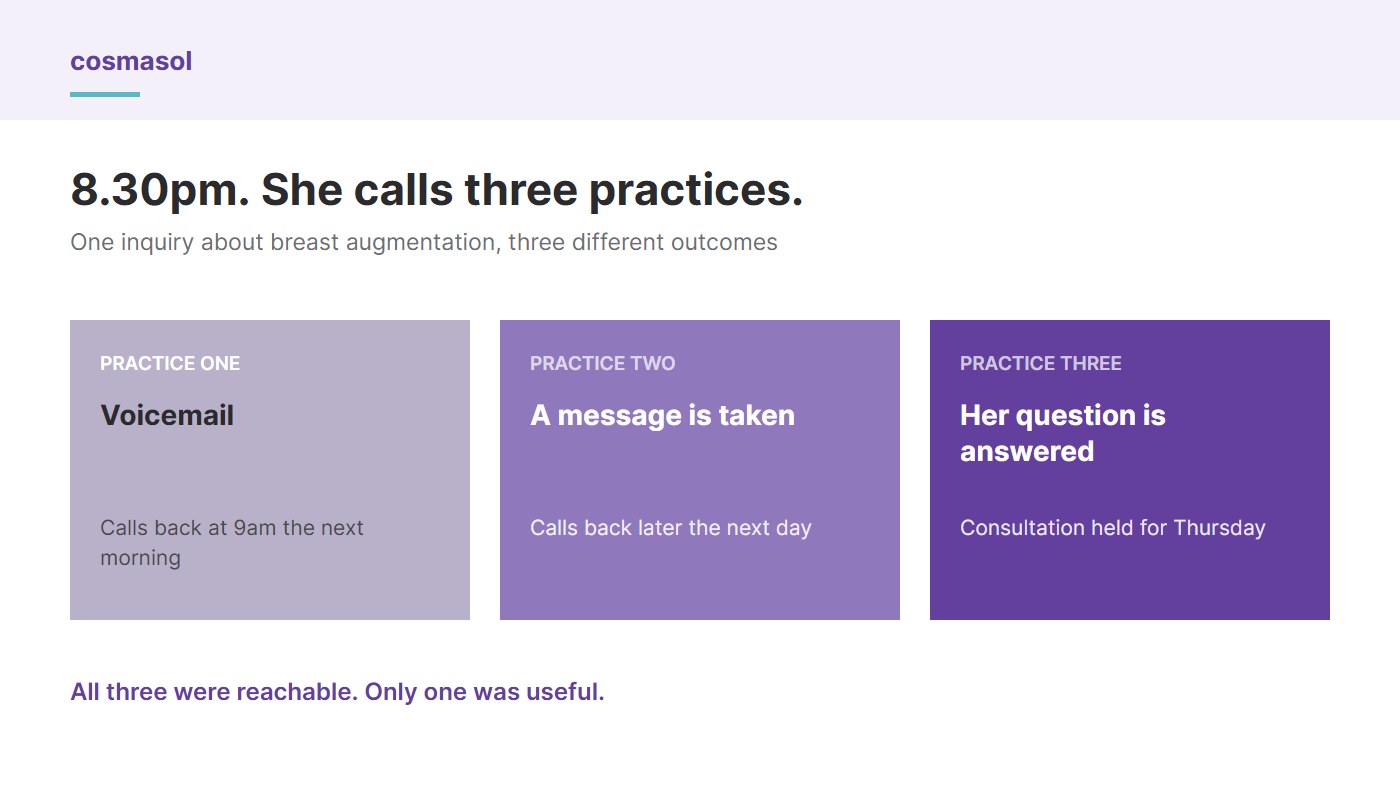
Measured against that list, voicemail covers none of it and a message-taking service covers one. That is the real gap in how most practices handle after-hours patient calls.
Whichever option you pick, four numbers tell you within a month whether it is working. Track them from the day you switch on, and compare them against the baseline you measured before.
If consultations booked does not move after two months, the problem is upstream of the phone. It is worth checking whether the inquiries are arriving at all before spending more on answering them.
Cosmasol builds AI Digital Agents for aesthetic and plastic surgery practices. The AI Calling Agent answers after-hours patient calls, the AI Website Chatbot and AI Social Media Chatbot handle website and Instagram inquiries, and each is trained on the practice’s own procedures, policies and FAQs so the answers match what your team would say. Inquiries flow into your existing workflow rather than a separate inbox, and anything clinical or unusual is escalated to a person. For a fuller comparison including HIPAA, see our guide to the AI receptionist for plastic surgery and med spas.
There is no reliable published figure for aesthetics. The circulating numbers come from call-software vendors and are not specific to this sector. Measure your own over five working days, which is the only number that describes your practice.
Usually not. Vendor call studies consistently report that only a minority of missed callers leave a message, which is why the gap between your after-hours call count and your voicemail count is the more useful measurement.
At the median receptionist wage of $18.27 an hour published by the Bureau of Labor Statistics for May 2025, covering weekday evenings and Saturdays costs about $21,851 a year in wages alone, before payroll taxes and benefits. Whether that is cheaper depends on what you compare it against.
Partly. It sends an automatic message so the caller is not met with silence, but it does not answer the call, cannot qualify the inquiry and still needs a person to continue the conversation the next morning.
As fast as is practical. The 2011 Harvard Business Review research on inbound leads found contact within the first hour sharply improved the odds of reaching the person. Aesthetic patients are usually contacting several practices, so the same logic applies.
It depends on what it is asked to do. Answering a question about recovery time or holding a consultation slot works well. Clinical questions and unhappy callers should route to a person, and any system you use should be set up to do that.
Does a med spa chatbot actually convert? See what the research shows, why many setups fail, and how to test...
Choosing a med spa AI receptionist? Use this 10-point checklist to test accuracy, booking rules, handoffs, DMs, privacy terms and...
Your med spa front desk can't answer every call, DM and patient at once. See which 7 tasks to automate...
Aesthetic Surgery Patient Demographics: Best 2026 Data
October 28, 2026[…] In both cases the failure mode is the same, and it is not a marketing failure. It is a coverage failure, and it is the subject of our post on what after-hours patient calls actually cost. […]
Automate DMs at Your Clinic: 7 Smart Rules That Win Consults
November 9, 2026[…] which matters because evenings and weekends are when many patients browse. Our breakdown of after-hours patient calls shows how much of that demand arrives outside office hours on the phone, and DMs follow a similar […]
Med Spa Front Desk Automation: 7 Proven Tasks to Hand Off
November 11, 2026[…] questions, take the caller’s details and pass anything it should not handle to your team. Our breakdown of after-hours patient calls compares the realistic options and what each one […]
Overflow Calls: 4 Smart Routing Rules for a Busy Front Desk
November 12, 2026[…] that should not be interrupted. If your main concern is the evening and weekend gap, our guide to after-hours patient calls compares those options. This article is about the daytime version of the same […]
Med Spa Chatbot Conversion: 7 Costly Mistakes to Avoid
November 17, 2026[…] and capture the inquiry so your team starts the next morning with a list, not a guess. Our guide to after-hours patient calls compares coverage options for the phone […]
How to Connect 4D EMR to Your CRM: Two-Way Sync Setup
November 20, 2026[…] Calling Agent answers calls your front desk cannot pick up, including after hours and during […]
After-Hours Coverage for Dermatology: 6 Smart, Safe Steps
November 20, 2026[…] you want a cost comparison of these options for aesthetic practices, our breakdown of after-hours patient calls and what each option costs covers it in detail. This post stays with the dermatology-specific question of how to split the […]
Website Chat vs AI Chatbot: 7 Honest Tradeoffs for Surgeons
November 20, 2026[…] get an offline form, and follow-up depends on someone checking it the next morning. Our look at after-hours patient calls covers the same gap on the phone […]