AI Chatbots for Med Spas: Do They Actually Convert?
Does a med spa chatbot actually convert? See what the research shows, why many setups fail, and how to test...


The latest news and expert insights for aesthetic practices.
Published on: October 30, 2026
Go Back
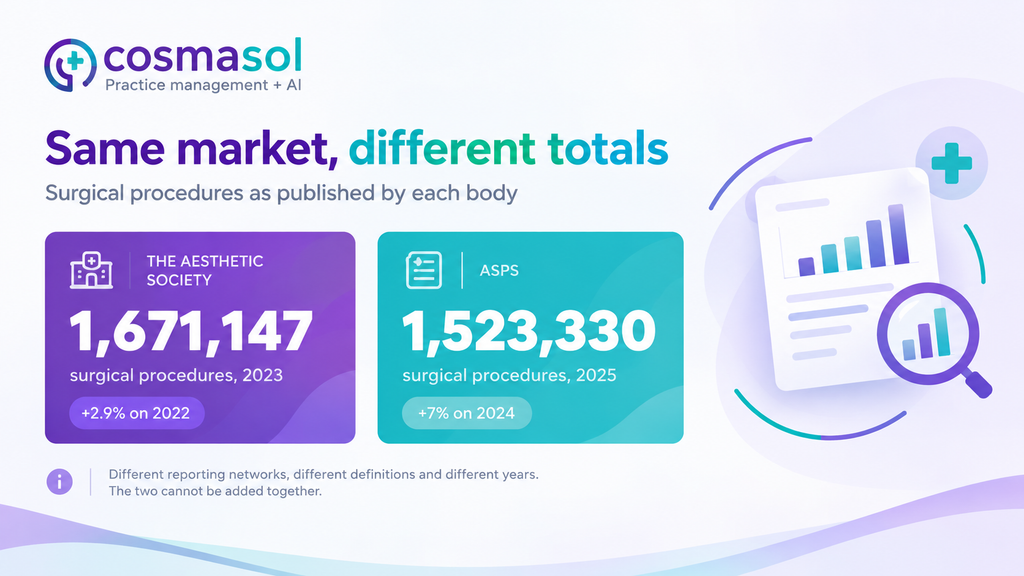
Cosmetic surgery statistics from the two leading US bodies do not agree, and the gap is large. The Aesthetic Society counted 1,671,147 surgical procedures in 2023. The American Society of Plastic Surgeons counted 1,523,330 cosmetic surgical procedures in 2025, two years later. Neither is wrong. They are counting different things.
If you quote one of these figures in a pitch, a board paper or a marketing claim, it is worth knowing which one you are holding.
Almost every cosmetic surgery statistic in circulation traces back to one of two annual reports.
| The Aesthetic Society | ASPS | |
|---|---|---|
| Report | Aesthetic Plastic Surgery National Databank | Plastic Surgery Statistics Report |
| Compiled with | CosmetAssure | ASPS member survey and data collection |
| Most recent full year | 2023 | 2025 |
| Surgical procedures reported | 1,671,147 | 1,523,330 |
| Growth stated | +2.9% on 2022 | +7% on 2024 |
| Regional breakdown | Not in the same form | Five regions |
| Age and gender split | Yes | Not in the same detail |
The first thing to notice when comparing cosmetic surgery statistics is that the years do not line up. The Aesthetic Society’s most recent published databank covers 2023. ASPS has published 2025. Comparing them directly is already comparing two different periods.
This is normal for cosmetic surgery statistics and it is not a scandal. It becomes a problem only when a figure gets quoted as though it were the total, which is what usually happens.
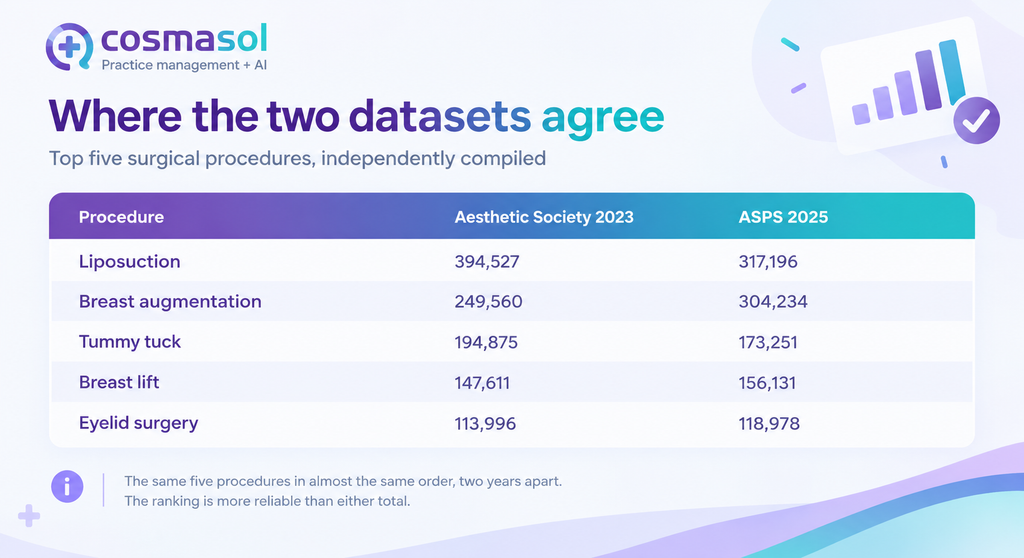
Strip away the totals and the two sets of cosmetic surgery statistics tell a consistent story about which procedures dominate.
| Rank | The Aesthetic Society 2023 | ASPS 2025 |
|---|---|---|
| 1 | Liposuction, 394,527 | Liposuction, 317,196 |
| 2 | Breast augmentation, 249,560 | Breast augmentation, 304,234 |
| 3 | Tummy tuck, 194,875 | Tummy tuck, 173,251 |
| 4 | Breast lift, 147,611 | Breast lift, 156,131 |
| 5 | Eyelid surgery, 113,996 | Eyelid surgery, 118,978 |
The same five procedures, in almost the same order, from two separately compiled datasets two years apart. When independent sources converge like that, the ranking is far more trustworthy than either total.
That is the practical lesson about cosmetic surgery statistics. Use them for shape and direction. Do not use them for precision.
Here is the most common mistake people make with cosmetic surgery statistics. A practice builds a slide claiming “the US cosmetic surgery market performs over 3 million procedures a year” by adding The Aesthetic Society’s 1,671,147 to the ASPS 1,523,330.
That number is wrong twice over. The two bodies share members, so a procedure performed by a surgeon who belongs to both can appear in each dataset. And the figures describe different years, so the sum is not a measurement of any single period.
Anyone in the room who knows these cosmetic surgery statistics will spot it, and the credibility cost lands on everything else in the deck. The safe version is to cite one figure, name the body and name the year.
The largest gap in the published cosmetic surgery statistics is not a disagreement between the two bodies. It is everything sitting outside both.
This is why cosmetic surgery statistics should be read as a floor rather than a total. The real market is larger than either report, by an amount neither can quantify.
Which cosmetic surgery statistics you should use depends entirely on the question.
We used the ASPS regional figures in our post on cosmetic surgery demand by region, and The Aesthetic Society’s patient data in our post on who actually has aesthetic surgery, for exactly these reasons.
Cosmasol builds AI Digital Agents for aesthetic and plastic surgery practices, covering phone, website and social inquiries. Published cosmetic surgery statistics describe the market. What they cannot tell you is how much of your own share of it reaches a consultation, which is a number only your own records answer.
Learn how the Cosmasol AI front desk picks up after-hours calls and replies to every chat and DM.
It depends which body you ask. The Aesthetic Society recorded 1,671,147 surgical procedures in 2023. ASPS recorded 1,523,330 cosmetic surgical procedures in 2025. Different reporting populations and different years.
The two organisations survey different memberships, define procedures slightly differently, publish for different years, and neither is a complete census of the US market.
Neither is more accurate in general. ASPS is better for regional comparison, The Aesthetic Society for patient age and gender. Pick the one that answers your question and name it.
No. The reporting populations overlap, so adding them double-counts procedures.
Largely not. Both headline figures cover surgical procedures. Most nonsurgical and med spa work sits outside these datasets.
Liposuction leads in both datasets, at 394,527 procedures in The Aesthetic Society’s 2023 figures and 317,196 in the ASPS 2025 figures.
Does a med spa chatbot actually convert? See what the research shows, why many setups fail, and how to test...
Choosing a med spa AI receptionist? Use this 10-point checklist to test accuracy, booking rules, handoffs, DMs, privacy terms and...
Your med spa front desk can't answer every call, DM and patient at once. See which 7 tasks to automate...