AI Chatbots for Med Spas: Do They Actually Convert?
Does a med spa chatbot actually convert? See what the research shows, why many setups fail, and how to test...


The latest news and expert insights for aesthetic practices.
Published on: November 18, 2026
Go Back
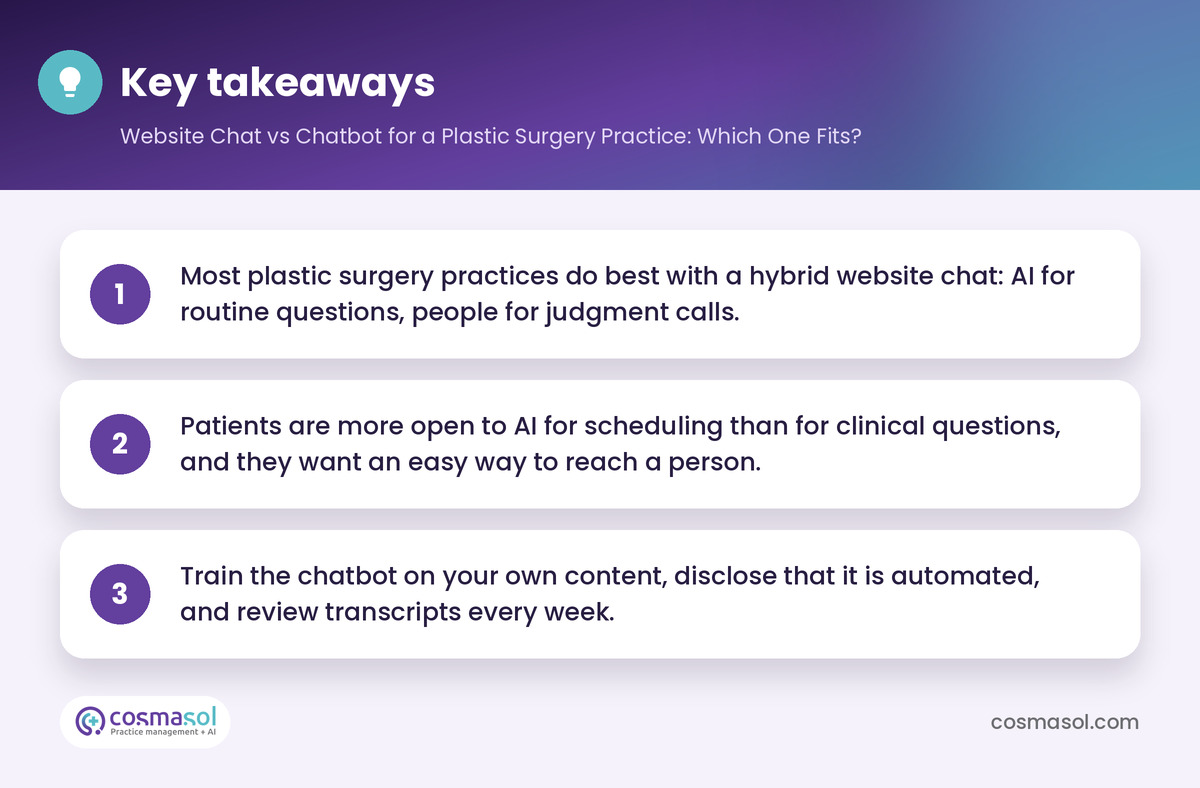
If you are weighing website chat vs chatbot for a plastic surgery practice, the short answer is that most practices do best with a hybrid: an AI chatbot that answers your website chat at any hour from your own approved information, plus clear handoffs to your team for anything clinical, sensitive or complex. Staffed live chat alone only works when someone is actually watching it, and a chatbot alone only works when it is trained well and knows when to step aside.
This guide compares staffed live chat, an AI chatbot and a hybrid website chat on coverage, cost, accuracy and patient trust. It draws on current research from the American Society of Plastic Surgeons, Pew Research Center, Gartner and the U.S. Bureau of Labor Statistics, and it ends with a setup plan and the numbers worth tracking.
Website chat is the small message window on your site where a visitor can type a question and get a reply without picking up the phone. For a plastic surgery practice, website chat often catches people early: comparing surgeons, checking whether you offer a procedure, or trying to understand how a consultation works.
There are three common ways to run website chat:
Some practices also use an outside chat or answering service. That is still staffed live chat, just with people who are not part of your team, so the quality depends on how well they are trained on your surgeons, policies and procedures.
The live chat vs chatbot question is really a question about coverage, consistency and judgment. Here is how the three website chat models compare on the points that matter most to an aesthetic practice.
| Factor | Staffed live chat | AI chatbot | Hybrid website chat |
|---|---|---|---|
| Who replies first | A person on your team | Software trained on your information | Software, with a person stepping in |
| Hours covered | Only when someone is watching | Any hour, including nights and weekends | Any hour, with staff during office hours |
| Answer consistency | Varies by person and workload | Consistent if the source content is accurate | Consistent, with human review of edge cases |
| Judgment and empathy | Strong | Limited | Strong where it matters |
| Main cost driver | Staff hours | Setup, training content and subscription | Both, with fewer staff hours on routine questions |
| Biggest risk | Unanswered chats when the desk is busy | Wrong or overconfident answers | Poorly defined handoff rules |
No column wins every row. Staffed live chat brings judgment but not coverage. An AI chatbot brings coverage but needs guardrails. A hybrid website chat tries to keep the strengths of each, which is why it is a sensible starting point for most practices.
Most practices do not struggle with website chat because they picked the wrong tool. They struggle because chat lands on a front desk that is already handling phones, check-ins and consultation scheduling. When a patient is standing at the desk, the chat window waits. If you have read our breakdown of missed patient calls in plastic surgery, the pattern will look familiar.
Demand is not slowing down. The American Society of Plastic Surgeons 2025 Procedural Statistics Report, released in September 2026, found that cosmetic surgical procedure volume rose 7 percent in 2025 compared with 2024, led by liposuction, breast augmentation and tummy tucks. The same release says 82 percent of ASPS Member Surgeons reported consultation requests related to GLP-1 use in 2025. More interest means more questions, and some of them will arrive through your website chat.
Speed matters here. Research published in Harvard Business Review in 2011 found that most companies were not responding to online inquiries nearly fast enough. A website chat that sits unanswered for an hour is not much better than no chat at all. The same problem shows up on the phone when staff are busy, which is why many practices also look at AI coverage for overflow calls.
Patients are more open to AI for administrative tasks than for clinical ones. In a Pew Research Center survey of 3,488 U.S. adults conducted June 22-28, 2026, 29 percent said they were open to AI scheduling an appointment on its own, and another 44 percent were open to it if a human does a final review. Only 18 percent were not open to AI scheduling at all.
Openness dropped sharply for clinical work. Just 3 percent were open to AI making a diagnosis on its own. That split maps neatly onto website chat: questions about hours, consultation fees and booking are reasonable to automate, while anything that sounds like medical advice belongs with your clinical team.
People also want a clear path to a person. A Gartner survey of 5,728 customers, conducted in December 2023 and published in July 2024, found that 64 percent would prefer companies not use AI in customer service. Their top concern was that AI would make it harder to reach a person. Gartner’s advice was direct: an AI chatbot should tell customers it will connect them to an agent when it cannot solve the problem, and the agent should pick up where the chatbot left off.
The lesson is not to avoid AI. It is to design your website chat so nobody feels trapped by it.
Staffed live chat is priced in hours. According to the U.S. Bureau of Labor Statistics Occupational Outlook Handbook, the median hourly wage for receptionists was $18.27 in May 2025, and $19.00 for receptionists working in healthcare and social assistance. Those figures cover wages only, not payroll taxes, benefits, training or turnover.
The numbers below are an illustration, not a quote or a client result. Change the assumptions to match your own practice.
| Assumption or step | Hypothetical value |
|---|---|
| Hours the office is staffed each week | 45 |
| Total hours in a week | 168 |
| Hours with no one watching website chat (168 – 45) | 123 |
| Extra staffed chat hours added for evenings and weekends | 30 |
| Hourly wage used (BLS healthcare median, May 2025) | $19.00 |
| Added weekly wages (30 x $19.00) | $570 |
| Added yearly wages ($570 x 52) | $29,640 |
| Hours still uncovered each week (123 – 30) | 93 |
In this scenario, a practice would spend about $29,640 a year in wages alone and still leave 93 hours a week with nobody watching website chat. That is the gap an AI chatbot is built to cover. It does not mean staff time disappears: someone still has to train the chatbot, review transcripts and follow up on the conversations it hands off.
A plastic surgery chatbot is only as good as what it knows and the limits it follows. Published research on general-purpose AI in aesthetic surgery points to the same lesson. In a 2023 study in Aesthetic Plastic Surgery, specialist plastic surgeons reviewed ChatGPT’s answers to nine rhinoplasty consultation questions drawn from an ASPS checklist. The answers were coherent and easy to understand, but the authors noted limits in detailed and personalized advice, and the model kept directing patients back to the surgeon.
For a practice, that means your website chat should not improvise. It should answer from your own approved content and route everything else to people.
Disclosure is also a legal question in some states. California Business and Professions Code section 17941 makes it unlawful to use a bot online to knowingly mislead a person in California about its artificial identity in order to encourage a purchase or sale, and it says a person using a bot is not liable under that section if the bot discloses that it is a bot. The disclosure must be clear and conspicuous. This is not legal advice, so confirm your own obligations with counsel.
Accessibility matters too. In 2022 the U.S. Department of Justice issued guidance on web accessibility and the ADA for businesses open to the public, and it points to the Web Content Accessibility Guidelines as a resource. Before launch, test that your website chat works with a keyboard and a screen reader.
Most practices see a mix: routine questions at all hours plus a smaller share that needs a person. A hybrid model lets the chatbot answer routine website chat right away and capture contact details, while staff spend their time on conversations that need judgment. It also matches what the Pew and Gartner findings above suggest people want: speed for simple tasks and a person for everything else.
Connecting website chat to the rest of your patient communication matters as much as the chat itself. If someone starts in website chat and then sends an Instagram DM, your team should see one person, not two. Our guide to automating DMs for an aesthetic clinic covers the social side.
Measure for a few weeks before you change anything, then compare. That gives you your own baseline instead of relying on someone else’s benchmark.
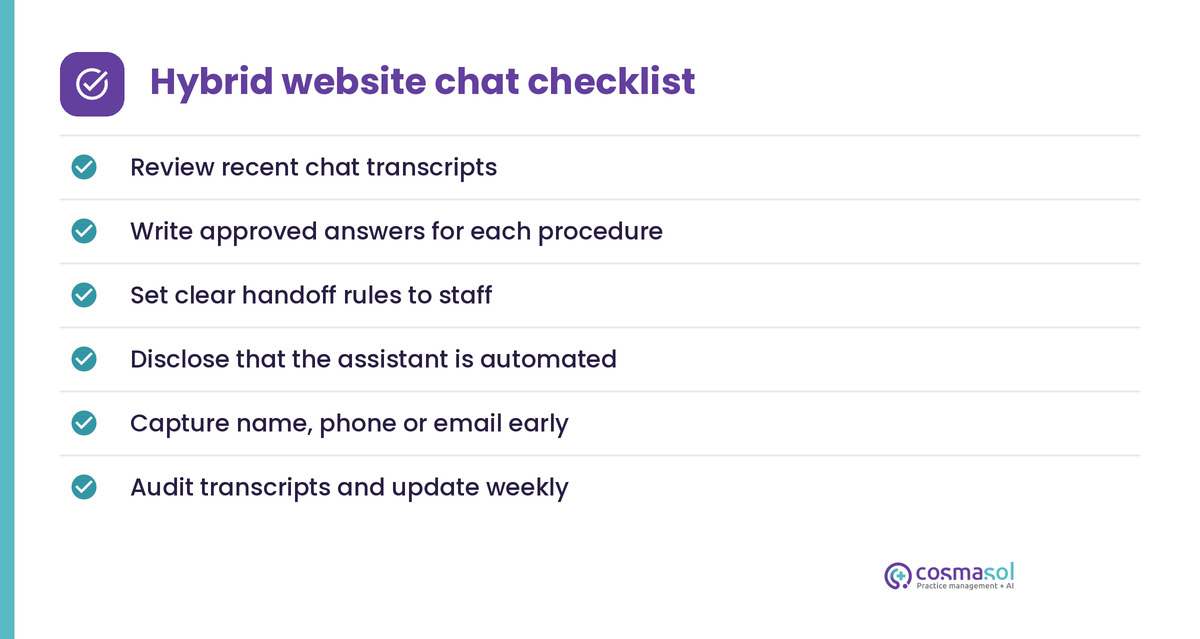
Cosmasol’s AI Website Chatbot fits the hybrid model described above. It answers website chat at any hour using what each clinic trains it on, including procedures, policies and FAQs, and it captures and qualifies leads and supports appointment scheduling. Conversations and contact details go into Cosmasol’s CRM and patient management tools so your team can follow up, and automated follow-up and nurture can keep the conversation going after the chat ends.
The same approach covers Instagram and Facebook DMs through the AI Social Media Chatbot and phone calls through the AI Calling Agent. For practices on 4D EMR, Cosmasol offers a two-way integration. It is designed to support your front desk, not replace your team.
For most practices, a hybrid works best. An AI chatbot answers routine website chat at any hour from your approved content, and staff handle clinical, sensitive or complex conversations. Staffed live chat alone works only if someone can watch the chat window whenever visitors arrive.
Yes. Clear disclosure builds trust, and in California, Business and Professions Code section 17941 addresses bots that mislead people about their artificial identity to encourage a purchase. Check your own legal obligations with counsel.
Only with pricing language your practice has approved, such as consultation fees, starting prices or financing options. Final pricing should come from the consultation, and the chatbot should say so.
Anything clinical, including candidacy, symptoms and post-op concerns, plus complaints, upset patients and questions the chatbot cannot answer from approved content.
Track chats started, time to first reply, contact capture rate, handoff response time and consultations booked from chat. Audit a sample of transcripts each week for accuracy.
If you want to see how an AI Website Chatbot would handle your own procedures, policies and booking flow, you can book a demo with Cosmasol. Bring a few recent website chat transcripts and we can walk through what to automate and what to keep with your team.
Does a med spa chatbot actually convert? See what the research shows, why many setups fail, and how to test...
After-hours coverage for dermatology practices has two jobs: clinical calls for the on-call clinician and new-patient inquiries. Here is how...
Overflow calls ring while your front desk is with a patient. See how an AI receptionist answers them, when to...