AI CRM vs. Traditional CRM: Which Drives Higher Patient Conversion?
AI CRM is reshaping how plastic surgery and aesthetic practices manage patient relationships, respond to inquiries, and convert leads into...


The latest news and expert insights for aesthetic practices.
Published on: November 20, 2026
Go Back
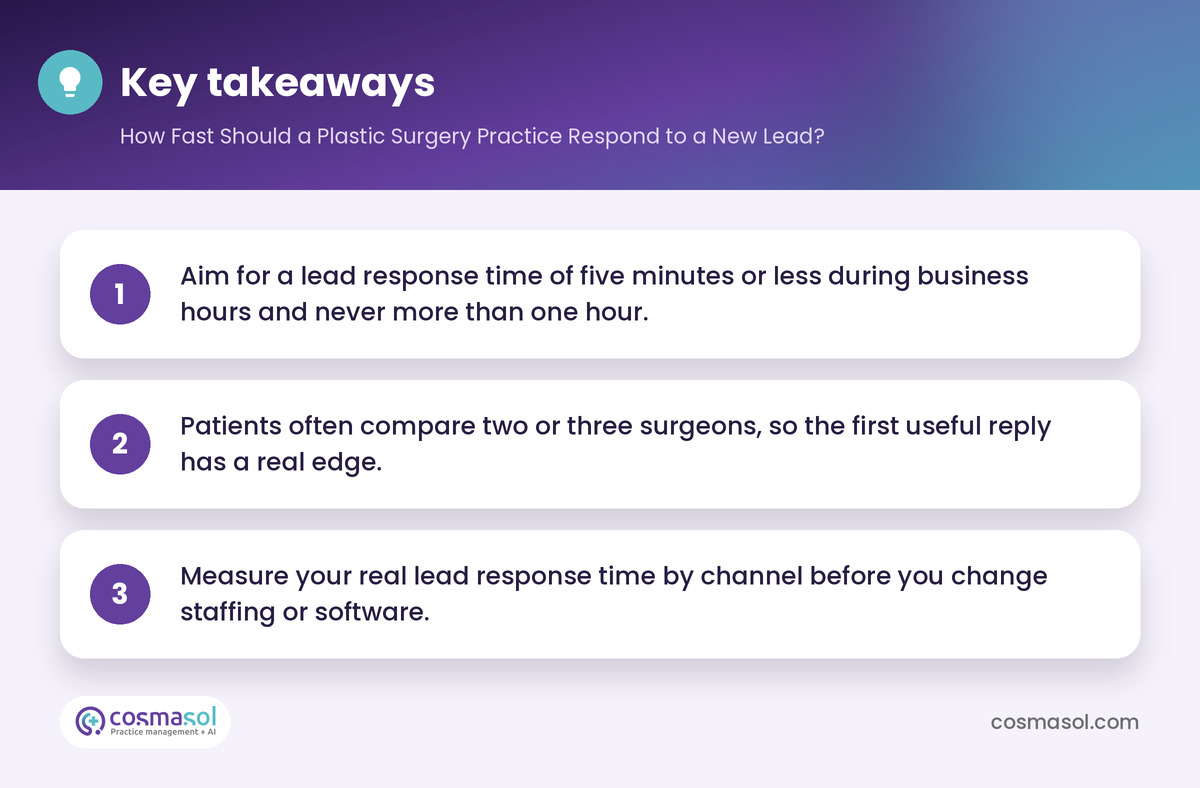
A plastic surgery practice should aim for a lead response time of five minutes or less for every new inquiry during business hours, and it should never let a new lead wait more than an hour. After hours, the target is an immediate, useful reply that answers basic questions and offers a next step, followed by a call or text from your team at the next opening. Research on web leads shows that the odds of reaching and qualifying a prospect drop within minutes, not days.
That target sounds aggressive until you look at how patients shop. Many compare two or three surgeons before booking, and most inquiries arrive by web form, phone or direct message while your front desk is busy with patients in the office. This guide covers what the research actually measured, how aesthetic practices tend to perform, what a slow lead response time can cost, and a practical plan to hit a five-minute standard without hiring another coordinator.
Lead response time, often called speed to lead, is the gap between the moment a prospective patient reaches out and the moment someone from your practice gives a real, useful reply. A reply means a live answer on the phone, a personal text or email, or a DM response that addresses the question and offers a next step. An auto-acknowledgment that only says “we received your message” may look good in a report, but it does not stop the patient from contacting the next practice on their list.
The targets below are practical recommendations, not regulatory requirements. They are built from the research summarized in the next section and from how plastic surgery patients tend to contact practices today.
| Channel | Target lead response time | What counts as a response |
|---|---|---|
| Phone call (business hours) | Answer live; return any missed call within 5 minutes | A person or trained agent who can answer questions and offer consult times |
| Website form or chat | Within 5 minutes | A personal text, call or chat reply that answers the question asked |
| Instagram or Facebook DM | Within 5 to 15 minutes | A reply in the same thread with a clear next step |
| Email inquiry | Within 1 hour at most | A personal reply, not only an autoresponder |
| After hours and weekends | Immediate useful reply; staff follow-up at the next opening | Answers to common questions plus a way to request a consultation |
If five minutes feels out of reach today, use one hour as the floor for lead response time and five minutes as the goal. Each step down puts your practice in front of more patients while they are still deciding where to book.
Most lead response time statistics trace back to two pieces of research led by James Oldroyd. They are often blended together online, so it helps to keep them separate and to be clear about what each one measured.
This study, presented in 2007 by Dr. James Oldroyd, then at MIT, and InsideSales.com, analyzed three years of data from six companies, covering more than 15,000 web-generated leads and more than 100,000 call attempts. It measured two outcomes: making contact with the lead and qualifying the lead. It did not measure closed sales. As Modern Aesthetics summarized it, the odds of making contact were 100 times higher when a lead was called within five minutes instead of 30 minutes, and the odds of qualifying the lead were 21 times higher.
The same study reported that contact odds fell by a factor of five between the five-minute and ten-minute marks, and fell more than tenfold over the first hour. In other words, most of the drop happens early. A practice that returns web inquiries at the end of a busy morning has a lead response time of several hours on leads that were most reachable in the first few minutes.
In 2011, Harvard Business Review published research by Oldroyd, Kristina McElheran and David Elkington. The authors submitted web test leads to 2,241 US companies and timed the replies. Thirty-seven percent responded within an hour, 16% within one to 24 hours, 24% took longer than 24 hours, and 23% never responded at all. Among companies that replied within 30 days, the average lead response time was 42 hours.
The article also drew on a separate data set of 1.25 million sales leads received by 42 US companies. Firms that tried to contact a lead within an hour were nearly seven times as likely to qualify it as firms that waited even an hour longer, and more than 60 times as likely as firms that waited 24 hours or more.
Neither study looked at plastic surgery practices, and neither measured booked surgeries. Both looked at web leads handled by sales teams, and both are more than a decade old. What they show clearly is timing: the value of a fresh inquiry falls fast, and the steepest drop comes in the first hour. The patient data from aesthetic medicine below points in the same direction.
The best available numbers for aesthetic practices come from RealSelf, the aesthetic procedure review and inquiry platform, and were published in Modern Aesthetics. They are vendor-collected and several years old, so treat them as a directional benchmark rather than a current national average.
In a 2015 Modern Aesthetics column, RealSelf’s founder reported a survey of more than 2,000 consumers who had sent an online inquiry to a doctor through RealSelf. Only 12% received a response the same day. Almost 40% had no response after three days, and 22% still had no response at all after 28 days. In a separate survey of 157 RealSelf doctors, 90% agreed or strongly agreed that they respond to online inquiries within 24 hours.
Two years later, RealSelf surveyed practices at the 2017 meeting of the American Society for Aesthetic Plastic Surgery. As reported in a 2017 Modern Aesthetics article, only 6% said they respond to email inquiries within five minutes, 21% said within an hour and 72% said within one day. The same article said the typical practice took 28 hours to respond to an email lead, if it responded at all.
| Source | What was measured | Finding |
|---|---|---|
| RealSelf consumer survey (2015) | More than 2,000 consumers who sent an online inquiry | 12% got a same-day response; 22% had none after 28 days |
| RealSelf doctor survey (2015) | 157 doctors on RealSelf | 90% agreed they respond within 24 hours |
| RealSelf survey at the ASAPS meeting (2017) | Practices attending the meeting | 6% respond to email inquiries within five minutes |
| HBR audit (2011) | 2,241 US companies across industries | Average reply among responders: 42 hours |
The gap between the two 2015 surveys is the useful part. Most practices believe their lead response time is fine, while patients report long waits or silence. You cannot close that gap until you measure it.
An inquiry is often the moment a patient moves from research to action. RealSelf data cited in the 2015 column found that 36% of aesthetic consumers research their options for a year or more. When that person finally fills out a form or sends a DM, they are ready for a conversation that day, not later in the week.
The American Society of Plastic Surgeons noted in October 2026 that patients may meet with two or three surgeons and spend months researching before moving forward. A patient who contacts three practices on the same evening will often book with the one that answers first and answers well. A slow lead response time does not just delay a consultation. It hands the first conversation to another practice.
A follow-up plan that relies only on phone calls has its own problem. A Pew Research Center survey conducted in July 2020 found that eight in ten US adults say they do not generally answer cellphone calls from unknown numbers, and 67% say they let those calls go unanswered but check voicemail if a message is left. A practice that calls back once and leaves no message may count the lead as contacted when the patient never heard a word.
Patient preferences point the same way. In NewBeauty’s 2023 State of Aesthetics survey of its readers, 68.2% named email as their preferred way to communicate with an aesthetic provider, and only 19% named phone calls, down from 37.8% the year before. For scheduling, 57.9% preferred an online service or app and 36.6% preferred a phone call. A fast lead response time has to mean fast in the channel the patient chose.
Slow replies are rarely a sign that staff do not care. They usually come from how the work is set up. The 2015 Modern Aesthetics column listed several common causes, and they still sound familiar.
If phone overflow is your main gap, our guide on answering calls while the front desk is with a patient covers the coverage options. If you want to size the problem first, see how many patient calls plastic surgery practices miss and what that can cost.
The numbers below are an illustration, not a benchmark and not a client result. Replace each assumption with your own data. The point is to show how small changes in booking rate add up when the value of a case is high.
Assumptions for this hypothetical scenario: 120 new inquiries per month across all channels; a consultation booking rate of 25% when the practice replies within minutes and 15% when it typically replies the next day; a consult-to-surgery rate of 30%; and an average surgical case value of $8,000. None of these figures come from the studies above.
| Hypothetical scenario | Fast replies | Next-day replies |
|---|---|---|
| New inquiries per month | 120 | 120 |
| Consultations booked | 120 x 25% = 30 | 120 x 15% = 18 |
| Surgeries (30% of consults) | 30 x 30% = 9 | 18 x 30% = 5.4 |
| Case value at $8,000 each | $72,000 | $43,200 |
In this illustration the difference is $28,800 in monthly case value from the same marketing spend. Your own numbers could be higher or lower. The research does not tell you how much your booking rate will change, so the only reliable way to know is to measure your lead response time and booking rate before and after you change your process.
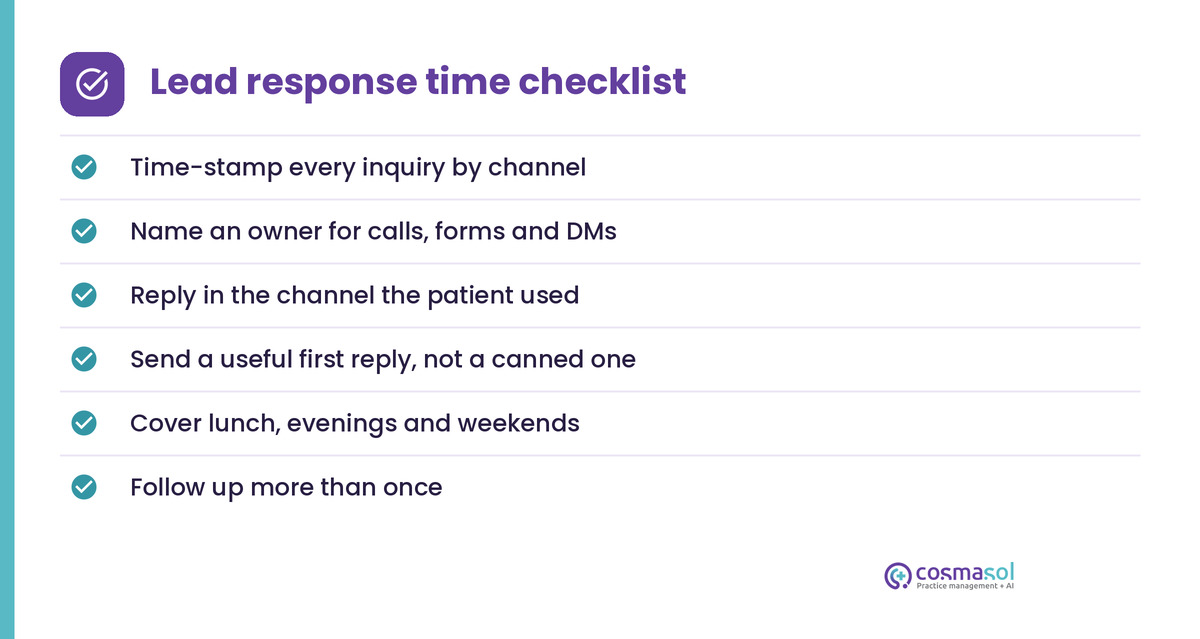
You do not need a bigger team to respond to a new lead in minutes. You need a clear owner, one queue and coverage for the hours nobody is watching.
Keep clinical questions for the surgeon and the consultation. A fast reply should never guess at candidacy, outcomes or pricing that your practice has not approved. Speed helps only when the answer is accurate.
Many inquiries arrive when nobody is at the desk. A lead response time target that only applies from 9 to 5 falls apart for a patient who submits a form at 9 p.m. or sends a DM on a Sunday afternoon. The right lead response time is the one your practice hits on every inquiry, including the ones that arrive during lunch, at night, or on a Saturday.
There are three common ways to cover those hours. An answering service takes messages, so the patient still waits for a callback. Rotating a staff member on call works in small doses but wears people out. AI agents trained on your practice’s procedures, policies and FAQs can answer common questions, collect contact details and help schedule consultations at any hour, then hand the conversation to your team. Our breakdown of after-hours patient call options and what each costs compares these in more detail.
Whatever you choose, connect it to the same queue so the morning team can see what was said and pick up from there. For website inquiries, see our comparison of live website chat and an AI chatbot for plastic surgery practices.
Cosmasol is an AI front desk and practice management platform for plastic surgery practices and med spas. It is built to help your team keep lead response time low across the channels where patients reach out, while your staff stay in charge of the patient relationship.
Cosmasol does not replace your coordinators. It covers the minutes and hours when they cannot reply, so the first response goes out quickly and the follow-up starts on time.
Aim for a lead response time of five minutes or less during business hours, and treat one hour as the outer limit. After hours, send an immediate reply that answers common questions and offers a way to request a consultation, then follow up with a person at the next opening.
It comes from a 2007 MIT and InsideSales.com study of more than 15,000 web leads, which found the odds of contacting a lead were 100 times higher at five minutes than at 30 minutes. The study covered sales leads rather than patients, but it is widely used as a benchmark for patient inquiries too.
For internal reporting it can, but patients judge whether the reply helped. A message that only confirms receipt leaves them waiting. A useful first reply answers their question and offers consultation times or a booking link.
Record the time each inquiry arrives and the time a person or trained agent sends the first useful reply, by channel. Review the median and the share answered within five minutes each week, and test your own channels with mystery inquiries on evenings and weekends.
More than once. RealSelf reported in 2017 that the typical practice followed up one time, while its own team found it could take up to 15 follow-ups to connect. Spread a few attempts across text, email and calls over several days, then move the lead to a longer nurture sequence.
Reply in the channel the patient used and ask their preference on your form. Pew Research Center found in 2020 that eight in ten US adults do not generally answer calls from unknown numbers, so a text or DM often reaches people faster than a cold callback.
If you want to see what a five-minute lead response time could look like across your phone line, website and social inboxes, you can book a short demo with the Cosmasol team and walk through it using your own procedures and workflows.
AI CRM is reshaping how plastic surgery and aesthetic practices manage patient relationships, respond to inquiries, and convert leads into...

AI CRM is redefining patient communication for aesthetic practices, plastic surgery clinics, and medical spas. Patients today expect instant, personalized...
AI CRM is transforming how aesthetic clinics manage patient communication, lead conversion, and long-term retention. Clinics are losing qualified leads...