Website Chat vs Chatbot for a Plastic Surgery Practice: Which One Fits?
Website chat vs chatbot for a plastic surgery practice: compare staffed live chat, AI chatbots and hybrids on coverage, cost,...


The latest news and expert insights for aesthetic practices.
Published on: November 17, 2026
Go Back
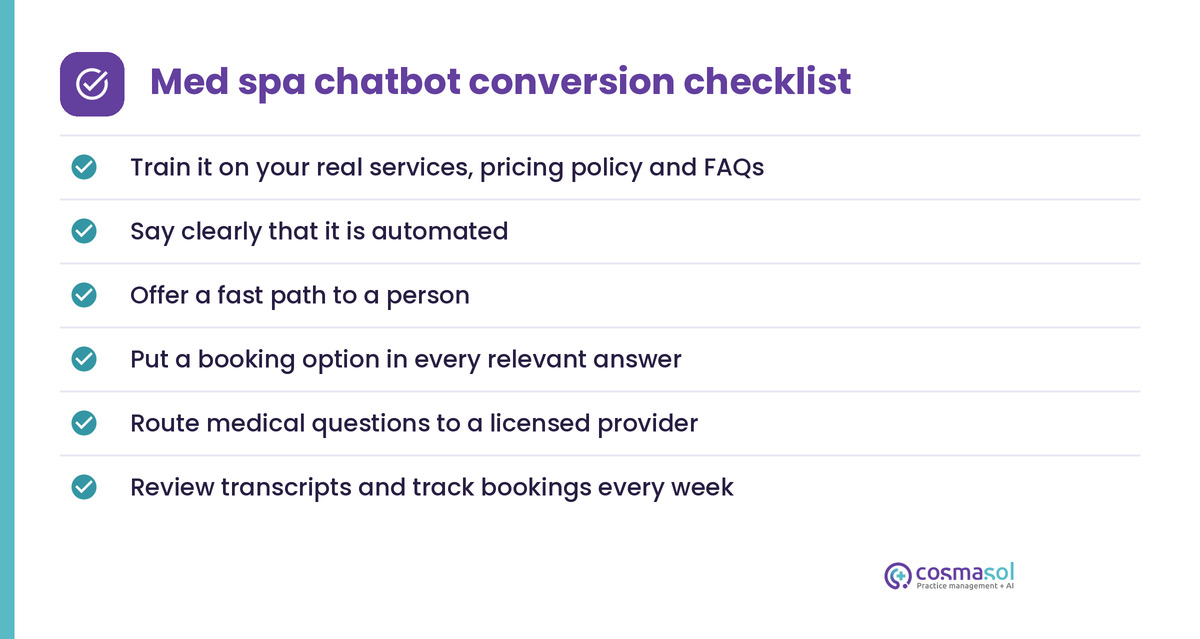
Yes, a med spa chatbot can turn website and Instagram inquiries into booked appointments, but it only converts when it answers quickly and accurately, captures contact details, and makes the next step obvious. A med spa chatbot that gives vague answers, hides the booking option, or refuses to hand off to a person will not fix a conversion problem. It usually makes the problem more visible.
So the better question is not whether AI chatbots for med spas work in general. It is whether yours is set up to convert and whether you are measuring the right things. This guide covers what the research says, why many setups disappoint, where a chatbot helps most, and a simple way to test your own results with your own numbers instead of a vendor’s promise.
Most owners judge a med spa chatbot by one question: did bookings go up? That is the right end goal, but it hides where things break. A chat can stall at five different points, and each one needs its own number.
| Funnel stage | What it means | What to measure |
|---|---|---|
| Chat started | A visitor or follower starts a conversation | Chats per month, by channel |
| Question answered | The med spa chatbot gives a correct, useful answer | Share of audited chats answered correctly |
| Contact captured | The person shares a name and a phone number or email | Contact capture rate |
| Booked | An appointment or consultation is on the calendar | Booking rate from captured contacts |
| Showed | The patient arrives for the visit | Show rate and first-visit value |
Repeat patients belong in this picture too. According to the American Med Spa Association’s summary of its 2024 Medical Spa State of the Industry Report, 73% of med spa patients are repeat patients, up from 65% in the 2022 report. The same summary puts the U.S. count at about 10,488 med spas as of 2023, with an average of 245 patient visits per month.
If your med spa chatbot only tracks brand-new leads, it misses the rebooking conversations with the patients who make up most of a typical med spa’s base. Count both, and keep them separate so you can see which one is moving.
There is no large public study that measures med spa chatbot conversion across many practices. Be careful with any vendor statistic that claims otherwise without showing who was measured and how. What does exist is solid research on how people respond to chatbots, and it points to what matters in your setup.
A field experiment published in Marketing Science in 2019 randomized more than 6,200 customers to receive structured outbound sales calls from either chatbots or human workers. Undisclosed chatbots were as effective as proficient workers and four times as effective as inexperienced workers at producing purchases. When the chatbot disclosed its identity before the conversation, purchase rates fell by more than 79.7%, and customers who knew they were talking to a machine were curt and saw it as less knowledgeable and less empathetic.
Two caveats matter. The study involved outbound sales calls, not inbound web chat or Instagram DMs at a med spa. And the authors found the negative effect shrank with later disclosure and with customers’ prior AI experience. Hiding a bot is not the lesson. The lesson is that perceived competence and warmth drive results, so a med spa chatbot has to earn trust in its first few replies.
Prior AI experience is rising quickly. In a Pew Research Center survey of 5,119 U.S. adults conducted in February 2026, 49% said they ever use AI chatbots, up from 33% in 2024, and about a quarter said they use them daily. Pew notes that the question wording changed between those years, so treat the comparison as directional.
Pew’s October 2026 report on AI in healthcare, based on a June 2026 survey of 3,488 U.S. adults, found that 29% are open to AI scheduling an appointment on its own and another 44% are open to it if a human does a final review. Only 18% are not open to AI scheduling at all. The same survey found that 60% would be uncomfortable with their own doctor using AI for things like diagnoses and treatments.
For a med spa chatbot, that is a useful map. Patients are fairly comfortable with AI handling logistics like booking, and much less comfortable with AI making clinical calls.
A 2023 study in JAMA Internal Medicine compared physician and chatbot answers to 195 patient questions posted on a public online forum. Licensed health care professionals preferred the chatbot response in 78.6% of 585 evaluations and rated 45.1% of chatbot answers empathetic or very empathetic, compared with 4.6% of physician answers.
The authors list real limits: forum questions are not typical clinic messages, accuracy was not independently assessed, and the evaluators were also coauthors. The takeaway for med spas is narrow. A well-built chatbot can be warm and thorough, but clinical questions still belong with your licensed providers.
When a med spa chatbot disappoints, the cause is usually setup and ownership, not the idea of a chatbot. These seven patterns stall conversion most often:
Timing on social channels also has a technical side. Meta’s Instagram messaging documentation says an app has 24 hours to respond to a message an Instagram user sends to a business account. Meta allows a human agent to reply outside that window in some cases, but a slow follow-up on DMs limits what automation can do.
Speed matters on every channel. The 2011 Harvard Business Review article The Short Life of Online Sales Leads reported that most companies were not responding to online inquiries nearly fast enough. A med spa chatbot replies in seconds, which helps only if the rest of your process keeps pace.
A med spa chatbot is strongest where volume is high, questions repeat, and timing matters. The table below sorts common inquiries by fit.
| Inquiry | Good fit for a med spa chatbot? | Why |
|---|---|---|
| Hours, location, parking | Yes | Simple, repeated, and easy to keep accurate |
| What does a treatment cost? | Yes, with a pricing policy | Answer only within the ranges or rules you approve |
| Can I book a facial this Saturday? | Yes | Patients are relatively open to AI handling scheduling |
| Do you have specials or packages? | Yes, if kept current | Only approved, dated promotions |
| Is this treatment right for my medical condition? | No | Route to a licensed provider |
| I had a reaction after my treatment | No | Send to your clinical team under your urgent-care protocol |
Three situations deserve special attention:
These are also the moments when AI tools for med spas earn their keep, because they protect the conversations your team cannot get to in time.
Most conversion gains come from small wording choices. The examples below are illustrations of the pattern, not scripts to copy word for word. Fill in your own services and policies.
| Patient question | Weak reply | Stronger reply |
|---|---|---|
| How much is lip filler? | Pricing varies. Please call us. | Our pricing depends on the treatment plan your injector recommends. I can share our current starting price or set up a consult. Which would help more? |
| Do you have anything Saturday? | Please visit our booking page. | We have Saturday hours. I can check open times for you now. Is morning or afternoon better? |
| Does it hurt? | Everyone is different. | That is a great question for your provider, who can explain what to expect and comfort options. Would you like to book a consult? |
The stronger replies share three habits. They answer what they can, they stay inside approved information, and they end with one easy question that moves toward a booking. A med spa chatbot that follows this pattern feels helpful rather than pushy.
Ask for contact details once the person has a reason to share them, such as holding a time or sending a quote. That sequence tends to feel fair to the patient and keeps the conversation going.
The numbers below are an illustration built on assumptions, not benchmarks or client results. Replace each one with your own data before drawing conclusions about your med spa chatbot.
| Assumption | Scenario A | Scenario B |
|---|---|---|
| Chats per month (website and DMs) | 150 | 150 |
| Contact capture rate | 40% = 60 leads | 40% = 60 leads |
| Booking rate from leads | 30% = 18 bookings | 35% = 21 bookings |
| Show rate | 80% = 14.4 visits | 80% = 16.8 visits |
| Average first-visit value | $450 | $450 |
| Monthly first-visit revenue | $6,480 | $7,560 |
In this hypothetical scenario, raising the booking rate by five percentage points adds about 2.4 visits and $1,080 per month, or $12,960 over a year. It leaves out rebookings, which matter in a business where most patients return.
The exercise also shows where to look first. If your contact capture rate is low, better answers and a softer ask may matter more than any booking feature.
You do not need a data team to answer the conversion question. You need a baseline, consistent tracking, and some patience.
Ask new patients at check-in how they first reached you. Self-reported answers are imperfect, but they catch cases software misses, such as someone who chatted with the bot at night and called the next morning.
A med spa chatbot speaks for your practice in every message. These rules keep it accurate and credible:
For a fuller list of what to check before you buy, see our buyer’s guide to choosing an AI receptionist for a med spa, and our guide to automating a med spa front desk without losing the personal touch.
Cosmasol builds AI front desk tools for plastic surgery practices, cosmetic surgery practices, and med spas. The AI Website Chatbot and AI Social Media Chatbot answer website visitors and Instagram and Facebook DMs, and the AI Calling Agent answers practice phone calls. Each is trained on your clinic’s procedures, policies, and FAQs.
Around those conversations, Cosmasol supports lead capture and qualification, automated follow-up and nurture, appointment and scheduling support, and a CRM for patient management, with two-way 4D EMR integration. The goal is to support your team, not replace it, so staff spend less time on repeat questions and more time with patients who are ready to book.
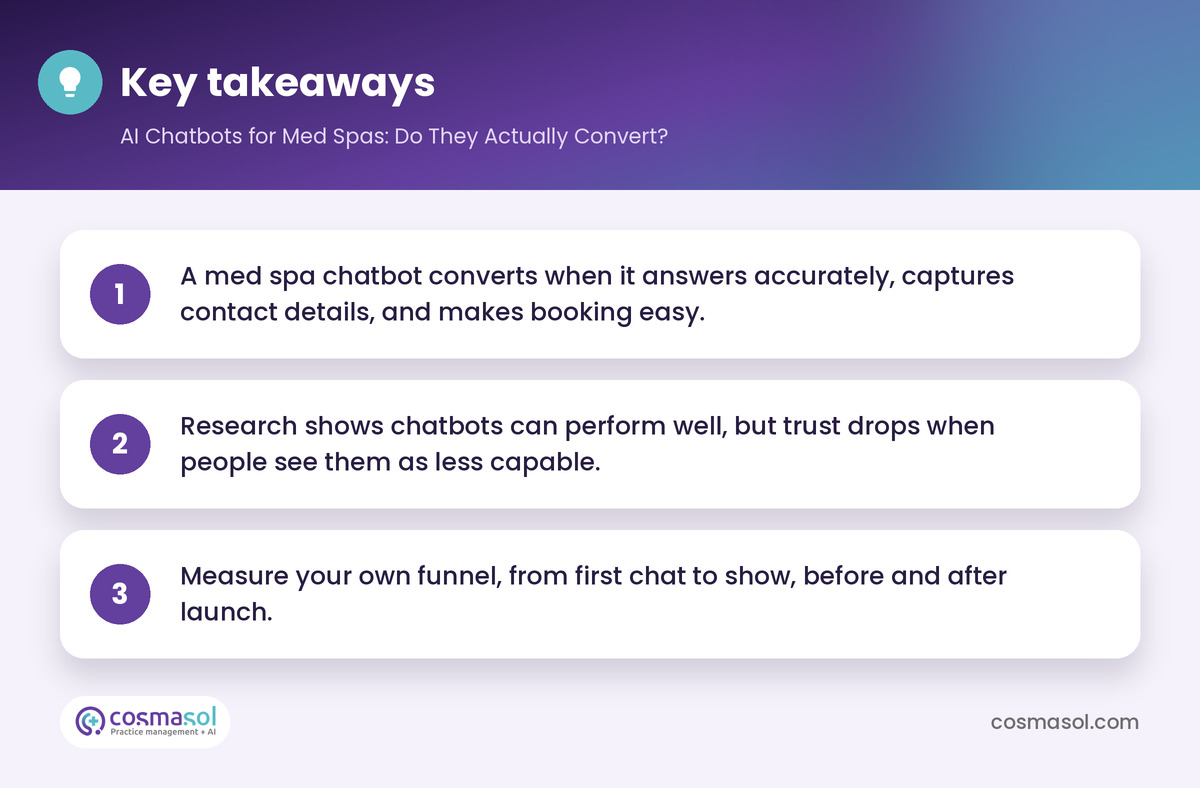
They can. A med spa chatbot converts when it answers accurately and quickly, captures contact details at the right moment, offers a clear way to book, and hands off to a person when needed. Results depend on setup, training, and follow-up, so measure your own funnel before and after launch.
There is no reliable public benchmark for med spa chatbot conversion across practices. Instead of chasing an outside number, set your own baseline and track contact capture, booking, and show rates separately over time.
Yes. Some laws require disclosure, and Meta recommends it as a best practice for automated chats. Research suggests disclosure can lower trust when a bot seems less capable, so focus on accurate, warm answers and an easy path to a person.
It should not give medical advice. Questions about candidacy, medical conditions, or reactions after treatment should go to a licensed provider through your clinical protocol. The chatbot can share approved general information and help book a consultation.
No. A chatbot works best on repeat questions, after-hours inquiries, and booking logistics, so your team can focus on the patients in front of them and on conversations that need a human.
Plan on at least two to three months of consistent tracking against a baseline. Shorter tests can be skewed by seasonality, promotions, and staffing changes.
If you want to see how an AI front desk would handle your own procedures, pricing policy, and booking flow, you can book a demo with Cosmasol. Bring your current inquiry numbers and we can walk through what to measure.
Website chat vs chatbot for a plastic surgery practice: compare staffed live chat, AI chatbots and hybrids on coverage, cost,...
After-hours coverage for dermatology practices has two jobs: clinical calls for the on-call clinician and new-patient inquiries. Here is how...
Overflow calls ring while your front desk is with a patient. See how an AI receptionist answers them, when to...