Website Chat vs Chatbot for a Plastic Surgery Practice: Which One Fits?
Website chat vs chatbot for a plastic surgery practice: compare staffed live chat, AI chatbots and hybrids on coverage, cost,...


The latest news and expert insights for aesthetic practices.
Published on: November 9, 2026
Go Back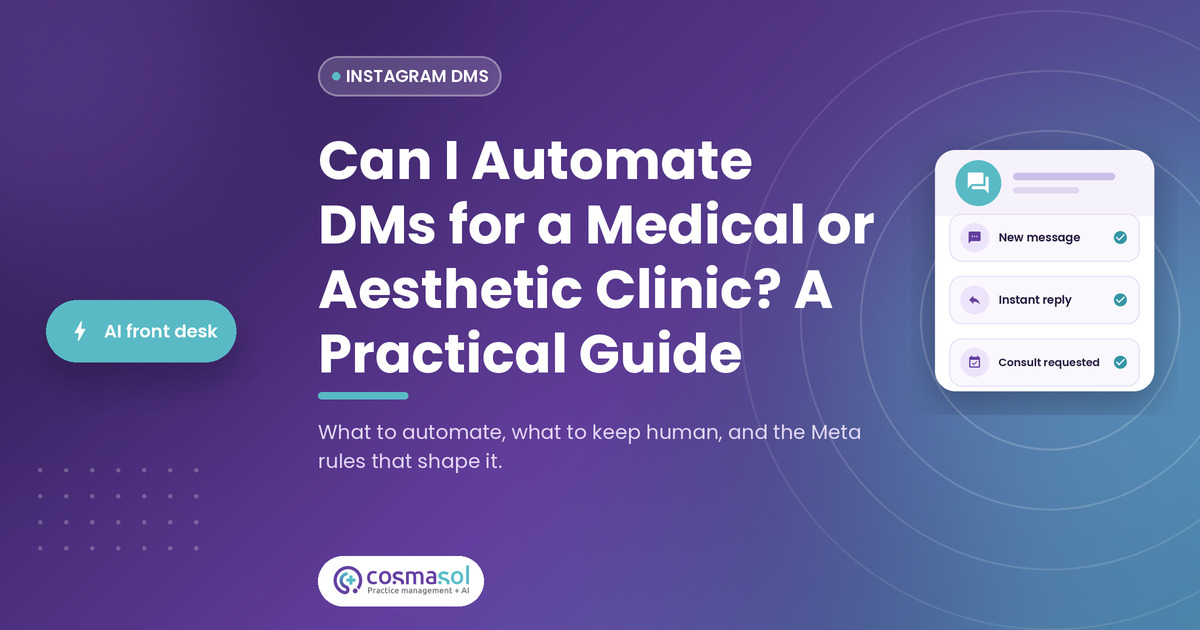
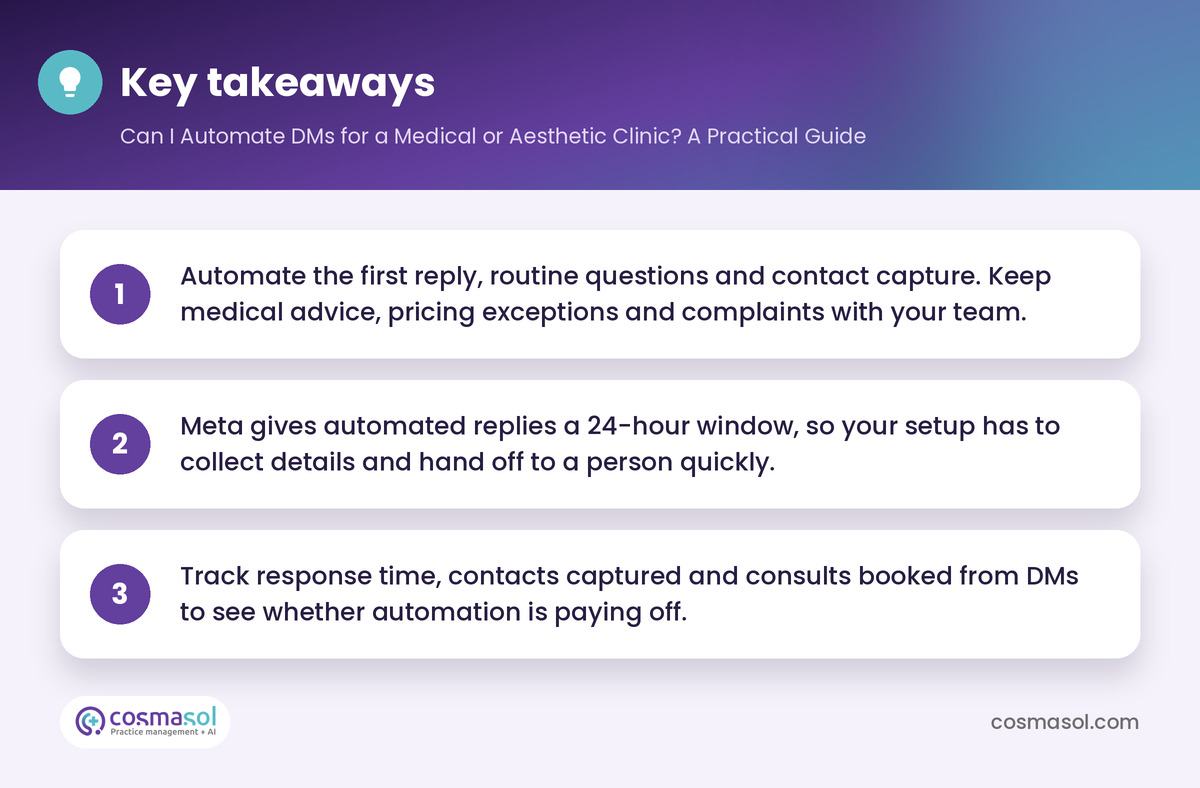
Yes, you can automate DMs for a medical or aesthetic clinic, and most practices that get a steady stream of Instagram and Facebook messages should. The goal is not to replace your patient coordinator. The goal is to make sure every message gets a fast, accurate first reply, routine questions get answered on the spot, and the people who are ready to book reach your team while they are still interested.
This guide covers what to automate, what to keep human, the Meta rules that shape how automated DMs work, the privacy guardrails a clinic needs, and a simple way to measure whether it is working. It is written for US plastic surgery practices, med spas and aesthetic clinics, and for the practice managers who run their front desks.
For many aesthetic patients, a direct message is the first conversation they have with your practice. They see a before-and-after post, a reel about recovery, or a story from a happy patient, and they tap the message button instead of calling. Social media is not a side channel for this specialty. In the 2019 annual survey of the American Academy of Facial Plastic and Reconstructive Surgery, 72% of members reported seeing patients who wanted procedures to look better in selfies. Patients who think about their appearance on social media also tend to contact practices there.
The problem is timing. DMs arrive while your coordinator is checking in a patient, while your injector is mid-treatment, and late in the evening when nobody is at the desk. Each one sits in an inbox that someone has to remember to open. When the reply comes the next afternoon, the person who asked about lip filler at 9 PM may already have booked somewhere else.
Patients expect a fast answer. Sprout Social reports that most consumers want brands to respond on social media within 24 hours or sooner, and many expect much faster. Research on sales inquiries points the same way. A Harvard Business Review study of online leads found that firms that tried to contact a prospect within an hour were nearly seven times as likely to qualify the lead as firms that waited longer. That study was not about healthcare, but the lesson holds for any practice that sells elective care: interest fades quickly.
That is the real reason clinics automate DMs, and it is the main reason to automate DMs at a busy practice. It is not about volume for its own sake. It is about making sure the first reply happens in minutes, at any hour, so a curious patient becomes a conversation instead of an unread message. We cover the same timing problem for phone calls in our guide to missed patient calls at plastic surgery practices.
The best candidates for Instagram DM automation are messages that have a correct, repeatable answer your practice has already approved. These make up a large share of most inboxes, and when you automate DMs like these, answering them quickly does not require clinical judgment.
| Message type | Automate it? | How to handle it |
|---|---|---|
| Hours, location, parking | Yes | Answer directly from your approved practice details |
| Which procedures you offer | Yes | Short description plus a link to the procedure page |
| How consultations work | Yes | Explain the steps, consultation fee policy and what to bring |
| Financing availability | Yes, if you offer it | Name the options you accept and point to your financing page |
| Booking a consultation | Yes | Collect contact details and preferred times, then confirm or hand off |
| “Am I a candidate?” | Partly | Explain that a provider decides at consultation and offer to book one |
| Price for my specific case | No | Share published starting prices only, then hand off to your team |
| Post-op concerns or complications | No | Give your clinic phone number and urgent care instructions right away |
| Complaints or reviews | No | Acknowledge and route to the practice manager |
Beyond answering questions, there are three jobs where it pays to automate DMs. The first is the instant acknowledgment: a friendly reply within seconds that tells the patient they reached the right place. The second is contact capture: name, phone number, email and the procedure they are interested in, so your team can follow up even if the conversation goes quiet. The third is after-hours coverage, which matters because evenings and weekends are when many patients browse. Our breakdown of after-hours patient calls shows how much of that demand arrives outside office hours on the phone, and DMs follow a similar pattern.
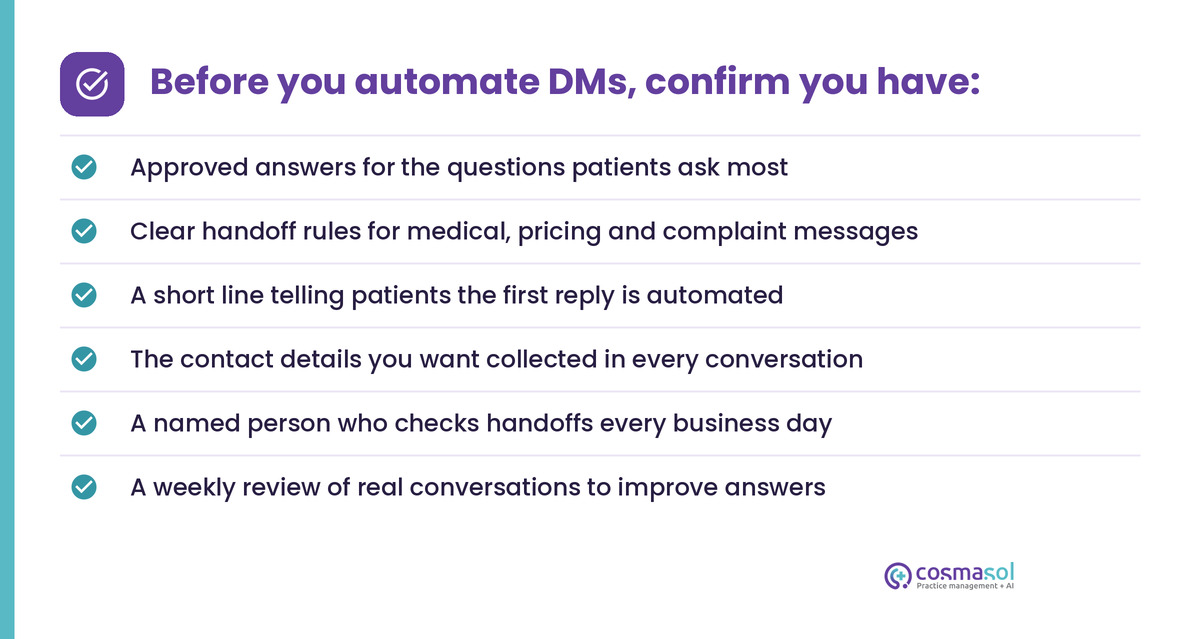
Automated replies are only as good as the answers behind them. Before you automate DMs, sit down with your practice manager and lead provider and write approved answers for the twenty or so questions you see every week. Keep each answer short, friendly and specific to your practice. If the answer depends on the patient, say so and offer a consultation instead of guessing.
Some messages should never get an automated answer beyond a polite handoff. Drawing this line clearly is what keeps Instagram DM automation safe for a medical practice, and it is the first decision to make before you automate DMs.
A good setup also tells patients when they are talking to an automated assistant. It can be as simple as a first line that says the reply is automated and a team member will follow up during business hours. Patients generally accept automation when it is honest and useful, and they lose trust when it pretends to be a person.
Instagram and Facebook allow businesses to automate DMs, but only through Meta’s official messaging tools and only within specific rules. Any software you use should work through those official tools. Be cautious with any service that asks for your Instagram password instead of connecting through Meta.
When a person sends your business a message, Meta opens a standard messaging window. According to Meta’s messaging policy, businesses have up to 24 hours to respond, and every new message from the patient opens a fresh window. Automated replies must happen inside that window. In practice, this means your setup should answer quickly, ask for contact details early, and get the conversation to your team the same day.
After the standard window closes, Meta’s policy allows a Human Agent tag that lets a person on your team reply manually within seven days of the patient’s last message. It is meant for real people answering questions that could not be resolved in time, not for automated follow-ups or promotions. If a DM conversation stalls, the follow-up should come from a coordinator, or move to the phone number or email the patient already shared.
Meta’s Instagram messaging documentation states that apps using its messaging APIs must offer an escalation path to a human agent. The same page says automated chats must disclose that a person is talking to an automated service where the law requires it, and recommends disclosure as a best practice everywhere else. For a medical or aesthetic clinic, both rules line up with good patient care anyway.
Before you automate DMs, settle how private information is handled. Social media DMs are a convenient place to start a conversation, but they are not the right place for a medical history. The HIPAA Privacy Rule, summarized by the US Department of Health and Human Services, sets standards for how covered health care providers protect patient health information. Your compliance advisor is the right person to decide exactly how your practice applies it to social messaging.
For day-to-day operations, a few practical guardrails go a long way:
Here is a simple illustration of a single weeknight at a med spa that decided to automate DMs. The messages are typical examples, not real patient conversations.
8:40 PM: “Do you do lip filler and how much is it?” The automated reply says yes, shares the published starting price, explains that the final cost depends on the amount of product the provider recommends at the visit, and asks if the patient would like a consultation. The patient says yes and shares a name, phone number and preferred days. The request lands in the practice’s CRM for the coordinator to confirm in the morning.
9:15 PM: “I had a treatment last week and one side looks swollen. Is that normal?” This is a post-treatment concern, so the system does not try to answer it. The reply shares the clinic phone number, the practice’s after-hours instructions for urgent concerns, and flags the conversation for a nurse first thing in the morning.
10:30 PM: “Are you open Saturdays?” The reply answers directly from the approved practice hours and offers a Saturday consultation slot.
Without automation, all three messages would wait until the next day. With it, two patients get a complete answer in minutes and the third gets the right instructions immediately. That is the practical case to automate DMs: not to replace the coordinator, but to make sure the morning starts with a clear list of who to call back instead of a pile of unread messages.
Notice what the automation did not do. It did not guess at a price for a specific patient, it did not reassure someone about swelling, and it did not pretend to be a nurse. Clinics that automate DMs well are strict about these limits, and patients notice the difference.
Most practices can automate DMs in a few weeks without disrupting the front desk. The order matters more than the software.
Once it is live, keep a person in the loop. Practices that automate DMs successfully have someone review handoffs every business day and read a sample of automated conversations every week. That review is how you catch outdated answers, new questions and awkward replies. If you are already working on turning social conversations into bookings, our post on converting DMs into consultations goes deeper on the booking side.
You do not need a complex dashboard. A handful of numbers, tracked monthly, will tell you whether it is worth it to automate DMs at your practice.
| Metric | What it tells you | Where to find it |
|---|---|---|
| Time to first reply | Whether patients get an answer while they are still interested | Your inbox or messaging tool reports |
| Conversations with contact details captured | Whether DMs are turning into follow-up opportunities | CRM or patient management system |
| Handoffs to staff | How often automation needs help, and which topics cause it | Messaging tool or handoff log |
| Consultations booked from DMs | Whether the channel produces real revenue opportunities | Booking source in your CRM |
| Messages left unanswered after 24 hours | Gaps in coverage or handoff follow-through | Inbox review |
Compare these numbers to the month before you started. If time to first reply drops and booked consultations from social media rise, the setup is working. If handoffs pile up without follow-up, the problem is usually staffing or ownership, not the automation itself.
Cosmasol’s AI Social Media Chatbot answers Instagram and Facebook DMs for aesthetic and plastic surgery practices, using the procedures, policies and FAQs your clinic approves. It replies right away, collects the patient’s contact details and procedure interest, and hands conversations to your staff when a person is needed. It works alongside the Cosmasol AI Front Desk, so calls, website chat and social messages feed into one practice workflow instead of three separate inboxes.
If you want a broader look at how practices recover leads from social channels, read our article on AI Social and lead recovery for plastic surgery practices.
Yes. Meta allows businesses to automate DMs on Instagram and Facebook through its official messaging tools. Automated replies must be sent within the 24-hour messaging window, and the experience must include a way to reach a person. Avoid any service that asks for your Instagram password instead of connecting through Meta.
Yes. Meta requires automated chats to disclose that they are automated where the law requires it, and recommends disclosure everywhere else. A short first line saying the reply is automated and a team member will follow up is usually enough.
Not as an automated message. After the 24-hour window, Meta’s Human Agent tag lets a person on your team reply manually within seven days of the patient’s last message. Follow-ups after that should use the phone number or email the patient already shared.
Medical advice, candidacy decisions, custom price quotes, post-op concerns and complaints should go to a person. Automation can acknowledge these messages and hand them off, but it should not try to answer them.
As fast as possible. Sprout Social reports that most consumers want brands to respond within 24 hours or sooner, and sales research shows interest drops quickly after the first hour. An automated first reply in minutes, followed by a staff reply the same business day, is a practical standard.
If messages are slipping through during busy afternoons and late-night scrolling, see how Cosmasol answers DMs alongside your front desk. Book a short demo and we will walk through it using your own procedures and FAQs.
Comments are closed.
Website chat vs chatbot for a plastic surgery practice: compare staffed live chat, AI chatbots and hybrids on coverage, cost,...
Does a med spa chatbot actually convert? See what the research shows, why many setups fail, and how to test...
After-hours coverage for dermatology practices has two jobs: clinical calls for the on-call clinician and new-patient inquiries. Here is how...
Med Spa AI Receptionist: 10 Essential Checks for a Great Fit
November 11, 2026[…] people, and describes escalation paths from automated experiences to a human agent. Our guide on how to automate DMs for an aesthetic clinic covers the […]
After-Hours Coverage for Dermatology: 6 Smart, Safe Steps
November 17, 2026[…] and dated, so treat it as direction rather than a dermatology benchmark. Our earlier post on automating DMs for medical and aesthetic clinics applies the same idea to Instagram and Facebook […]
Website Chat vs AI Chatbot: 7 Honest Tradeoffs for Surgeons
November 18, 2026[…] website chat and then sends an Instagram DM, your team should see one person, not two. Our guide to automating DMs for an aesthetic clinic covers the social […]
Med Spa Chatbot Conversion: 7 Costly Mistakes to Avoid
November 20, 2026[…] and Facebook DMs. Social inquiries are casual and fast-moving. Our guide on how to automate DMs for a medical or aesthetic clinic covers channel-specific […]