
AI Receptionist for Plastic Surgery & Med Spas: Cost, HIPAA, and What Beats Missed-Call Text-Back (2026 Guide)
An AI receptionist for plastic surgery practices and med spas (also called an AI front desk) answers your calls, website...


The latest news and expert insights for aesthetic practices.
Published on: August 13, 2026
Go Back
Plastic surgery scheduling software has to solve a problem that ordinary calendar tools ignore completely. A single procedure needs a surgeon, an anaesthetist, a theatre, a recovery space and specific stock, all available at once. Book only the surgeon and you create conflicts everywhere else. This guide covers how surgical scheduling actually works, what drives the price of these systems, and where practices lose the most theatre time.
A general appointment book answers one question. Is the practitioner free. Surgical scheduling answers five at once. Is the surgeon free, is the theatre free, is the anaesthetist available, is a recovery bay open, and is the required implant in stock.
When any one of those is missing, the booking fails on the day rather than at the point of entry. That is expensive. A cancelled theatre session cannot be resold at short notice, and staff are already rostered and paid.
Effective plastic surgery scheduling software links these resources so that reserving a procedure holds all of them together. It should also release them together when a case is cancelled, so the freed slot becomes visible to whoever manages the waiting list. Ask vendors to demonstrate a cancellation that frees a surgeon, a theatre and an implant simultaneously, then show exactly who gets notified.
Test the awkward variations too. A procedure that overruns and pushes the following case. A surgeon who becomes unavailable at short notice, requiring several bookings to move together. Plastic surgery scheduling software handles the straightforward booking well in almost every demo, so the differences between platforms only appear when you present the situations that actually consume your team’s time during a normal week.
Follow up chains are the second half of this problem. A surgical booking usually implies a pre operative appointment and two or three post operative reviews. If those are created manually, some will be missed. If the surgical date then moves, the whole chain must move with it. Plastic surgery scheduling software that handles this automatically removes a recurring source of error that patients notice immediately.
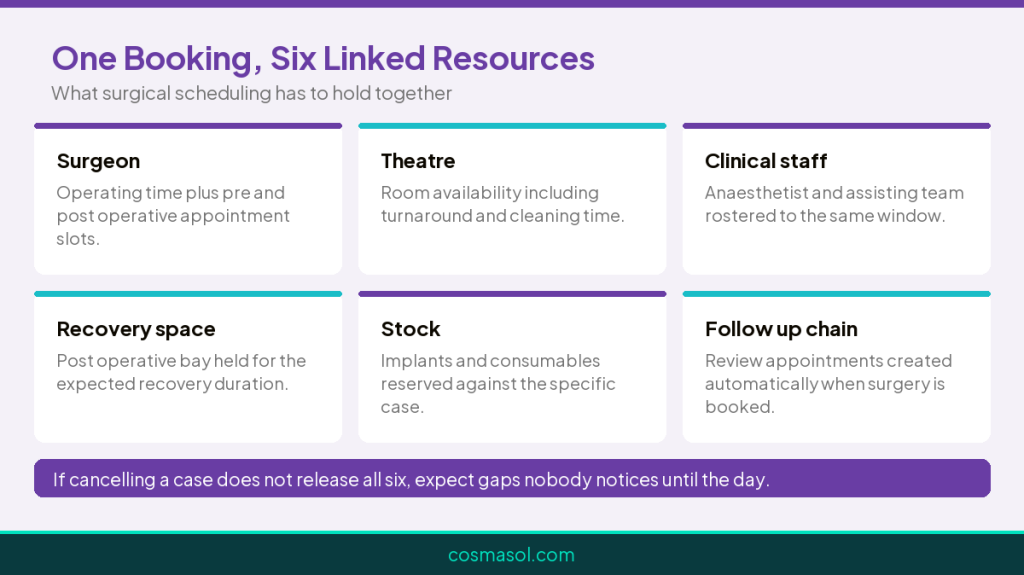
Six linked resources plastic surgery scheduling software must reserve together
Aesthetic patients rarely decide immediately. A consultation may convert into surgery three weeks later or three months later. Many never convert at all, and most practices cannot explain why.
This gap is the single largest revenue opportunity in surgical scheduling. It needs structured follow up rather than good intentions. The system should show every consultation that has not yet converted, how long ago it happened, and who owns the next contact.
Response speed matters just as much at the front of the journey. Aesthetic patients typically contact several clinics, and the first practice to reply often wins the consultation. That is the reasoning behind treating response management as a growth strategy, and why many practices now route enquiries through automated booking assistance outside clinic hours.
Measure the gap explicitly. Track how many consultations convert, the average number of days from consultation to booked surgery, and the conversion rate by surgeon and by source. Those three figures usually explain more about practice performance than any marketing report, and they are only available when scheduling and enquiry data sit in the same system.
Every empty slot costs twice. The revenue is lost and the staff cost is already committed. Reducing no shows is therefore one of the fastest returns available from plastic surgery scheduling software.
Three mechanisms do most of the work. Automated reminders sent through the channel each patient actually uses. Simple self service rescheduling, so a patient who cannot attend moves the appointment rather than silently missing it. A waiting list that can fill a freed slot quickly and without a round of phone calls.
Deposits change behaviour more than any reminder. A consultation fee or surgical deposit materially reduces non attendance, which is why scheduling and billing should sit in the same platform rather than being connected afterwards. The approach carries across aesthetic settings, and our guide to booking and appointment software covers the mechanics in more detail.
Reminder timing repays testing. A single message the day before performs worse than a short sequence spread across the week, but too many messages irritate patients and increase opt outs. Track no show rate against reminder cadence for a quarter and settle on what works for your patient base rather than accepting a vendor default.
Surgical no shows deserve separate treatment from consultation no shows. Missing a consultation costs a clinic slot, while missing a procedure costs theatre time, staff time and stock that may already have been opened. Plastic surgery scheduling software should let you apply different reminder sequences, different deposit rules and different escalation paths to each, because treating them identically underprotects the appointment type that costs most when it goes wrong.
Reminder messages carry privacy obligations as well as operational value. Appointment details sent by text or email are patient information, so confirm what your platform includes in each message and who can configure the templates. National guidance on privacy and security for health IT is a useful reference for what a vendor should be able to evidence here.
Practices researching plastic surgeon scheduling software pricing usually find published figures unhelpful, because vendors price on variables rather than a single published rate.
Four factors move the number. User count, since most platforms charge per user or per practitioner. Location count, because multi site configuration adds real complexity. Module scope, as scheduling bundled with records and billing costs more than scheduling alone. Finally implementation, migration and training, which are often quoted separately and sometimes omitted entirely from a headline comparison.
Compare on total cost of ownership across three years. Include the tools a single platform would replace, using your own current invoices rather than an estimate. A scheduling product that looks cheaper monthly frequently costs more once you add the separate reminder service, the payment tool and the reporting workaround it requires.
Ask what happens at renewal as well. An attractive first year followed by a steep increase is a common pattern, and a cap negotiated before signing is far easier to obtain than a concession requested afterwards. Settle export rights at the same time, since scheduling history has real operational value if you ever move platform.
Weigh the price against theatre utilisation rather than against other quotes alone. If plastic surgery scheduling software raises utilisation by even a few percentage points, the value of the recovered operating time usually exceeds the annual fee comfortably. That comparison is more useful than ranking vendors on monthly cost, and it gives partners a figure they can actually judge the decision against.
Selecting the best plastic surgery software for patient booking comes down to testing rather than comparing feature grids, which tend to look identical across vendors.
Run four scenarios with each vendor. Book a complex procedure needing several resources. Cancel it and watch what is released and who is told. Reschedule a consultation and confirm the follow up chain moves with it. Take a deposit at booking and check it appears against the eventual invoice without manual intervention.
Watch the click count throughout. Reception staff repeat these actions hundreds of times each month, so a workflow taking eight clicks instead of three decides whether the system is adopted or quietly bypassed. Include reception in the demo for exactly this reason, because they notice friction that partners never encounter.
Finally, look at how the system handles the awkward cases rather than the clean ones. A patient who books, cancels, rebooks with a different surgeon and pays a partial deposit is ordinary practice reality. Demand context helps with planning too, and the procedural statistics from the American Society of Plastic Surgeons help with capacity planning across the year.
Plastic surgery scheduling software earns its cost by protecting theatre time and converting more consultations into booked procedures. Look for a system that reserves every resource together, follows up unconverted consultations automatically, and keeps deposits attached to the booking. Test those behaviours with your own cases rather than trusting a demo script. To see the workflow end to end, book a Cosmasol demo.
It is a system that books surgical and consultation appointments while reserving the linked resources each case requires, including theatre time, clinical staff, recovery space and the specific implants or consumables that particular procedure depends on.
A normal calendar checks whether one practitioner is free at a given time. Surgical scheduling must confirm several resources simultaneously, then release all of them together if the case is later cancelled or moved to an entirely different date.
Pricing depends on user count, number of locations and which modules are included in the package. Compare total cost across three years, including implementation, training and any separate tools the platform would eventually allow you to retire.
Yes. Automated reminders, self service rescheduling and a functioning waiting list all help measurably. Taking a deposit at the point of booking has the strongest effect of all, which is why scheduling and billing should share a single platform.
It should. Separating them forces staff to re enter details repeatedly and makes it difficult to see a patient journey from first enquiry through consultation, procedure and follow up within one continuous view that everybody can access.
The system should release every reserved resource at once and surface the freed slot to whoever manages the waiting list, so short notice cases can fill the gap before that expensive theatre time is lost entirely for the day.
For consultations, usually yes, and it reduces telephone load on reception considerably. Surgical bookings normally stay staff controlled because of the resource dependencies involved and the clinical assessment required before a procedure date can safely be confirmed.
Track consultation to surgery conversion, theatre utilisation, no show rate and average time from enquiry to booked consultation. Those four figures together explain most scheduling performance problems in a surgical practice and point clearly towards the fix.
Yes. Groups need shared records combined with per site calendars and permissions so staff see what is relevant to them. Our guide to managing multiple clinics covers the operational differences in detail.
The features overview shows how scheduling sits alongside records, billing and patient communication inside one platform, and the about page explains the background of the company behind it.

An AI receptionist for plastic surgery practices and med spas (also called an AI front desk) answers your calls, website...

Virtual consultation booking software for plastic surgery has moved from convenience to expectation. Patients researching a procedure increasingly want an...

Software for plastic surgeons is often discussed as though every practice needs the same thing. It does not. A solo...