
Migrating a Plastic Surgery EMR System Without Data Loss
Replacing a plastic surgery EMR system is the change practices delay longest. The fear is reasonable. Clinical history, consent records...


The latest news and expert insights for aesthetic practices.
Published on: July 8, 2026
Go Back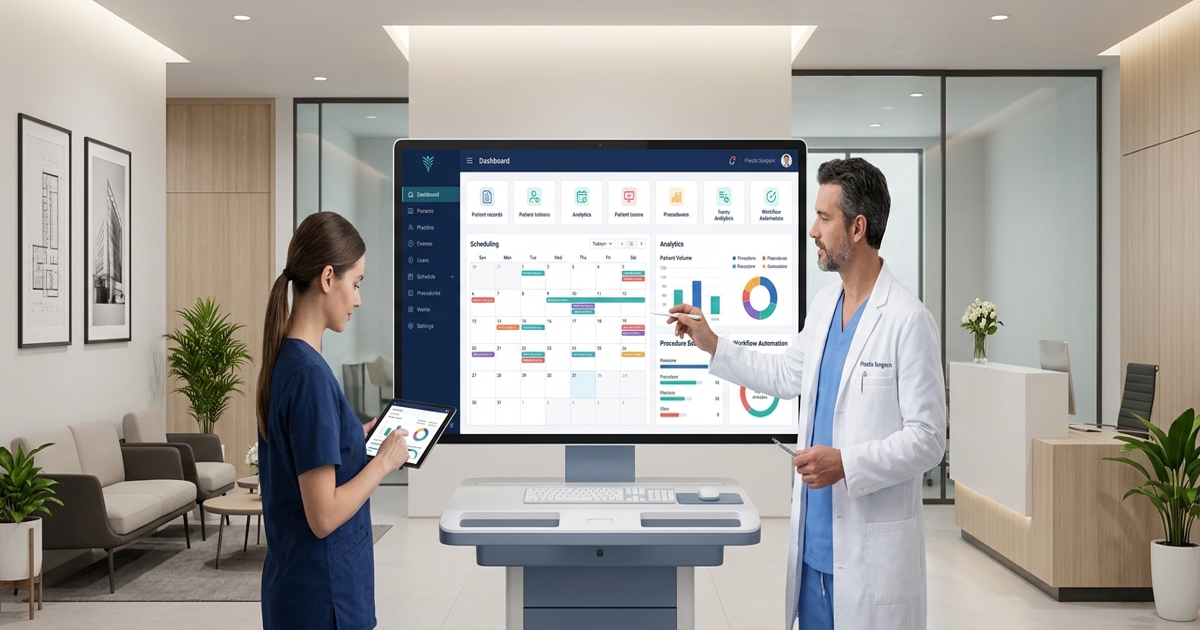
Plastic surgery EMR software is no longer just a tool for storing patient records. As practices grow and patient volumes increase, the right platform becomes the operational backbone of your entire clinic. From consultation notes and consent forms to clinical photography and follow-up communication, plastic surgery practices generate more documentation than almost any other medical specialty. Choosing the wrong system can quietly drain productivity, fragment patient data, and limit your ability to scale.
This guide walks you through what to evaluate before selecting a plastic surgery EMR system, what features matter most, and why scalability should be your primary buying criterion rather than an afterthought.
Generic EMR systems are built for broad clinical use, not for the specific workflows of aesthetic and reconstructive surgery. A family medicine practice and a plastic surgery clinic have fundamentally different documentation requirements. Selecting software that was not designed for your specialty creates friction at every step.
Plastic surgery documentation goes well beyond standard clinical notes. Each patient encounter may require detailed consultation summaries, treatment planning records, operative reports, post-operative instructions, and long-term follow-up notes. Consent documentation alone can involve multiple forms tailored to each procedure. The American Society of Plastic Surgeons continues to report sustained demand for both cosmetic and reconstructive procedures, reinforcing why practices need systems built to manage this volume efficiently.
Before-and-after photography is central to plastic surgery practice. A best EMR for plastic surgery must support structured clinical image management, including the ability to organize photos by procedure, date, and patient, and to link images directly to the corresponding clinical record. This allows clinicians to review visual treatment histories quickly and accurately during consultations and follow-ups.
Practices that offer both cosmetic and reconstructive services need an EMR that can handle the documentation and billing nuances of each. Cosmetic procedures involve patient-driven decisions and detailed consultation records. Reconstructive cases often involve insurance documentation, referrals, and coordination with other providers. A plastic surgery EMR system designed for this dual scope removes the need to work around generic templates that were never built for your specialty.
Many plastic surgery practices initially implement generic or hospital-grade EMR systems because they appear cost-effective. Over time, these systems create compounding operational problems that become increasingly difficult and expensive to resolve.
When clinical records, appointment history, billing data, and patient communication exist in separate systems, staff must manually cross-reference information to complete basic tasks. This fragmentation increases error rates, slows down workflows, and makes it difficult to maintain a complete view of each patient’s journey. The Office of the National Coordinator for Health Information Technology emphasizes that interoperable electronic health records are foundational to coordinated, high-quality care delivery.
Generic systems rarely include automation for the specific administrative tasks that plastic surgery practices face daily, such as appointment reminders, consent form distribution, post-consultation follow-ups, and treatment plan communication. Staff end up handling these tasks manually, consuming hours that could be directed toward patient care and practice growth. Cosmasol’s practice management platform is built to eliminate this manual overhead through purpose-built automation for aesthetic practices.
A standalone EMR with no connection to scheduling, CRM, or billing creates silos that slow down every department. Front desk staff, clinical teams, and administrators end up working in isolation rather than as a coordinated unit. This disconnect is one of the most common reasons growing practices hit operational ceilings.
The best EMR for plastic surgery is one that supports both clinical excellence and operational performance. The following features define a platform capable of growing alongside your practice.
Every patient record should be fully digital, structured, and searchable. This includes consultation notes, treatment histories, procedure documentation, consent forms, and communication logs. Records should be accessible to authorized staff in real time, regardless of location, which is a core advantage of a cloud based plastic surgery EMR.
CRM integration allows practices to manage the full patient lifecycle from initial inquiry to long-term follow-up. When CRM and EMR data share a single platform, staff can see consultation history, treatment status, and communication records in one place. This reduces duplicated data entry and improves the consistency of patient interactions. Cosmasol’s integrated platform combines EMR and CRM capabilities designed specifically for aesthetic practices.
Scheduling should be directly connected to the EMR so that appointment details, patient records, and provider availability are synchronized in real time. Automated appointment reminders, confirmation workflows, and waitlist management reduce no-shows and improve daily clinic throughput without adding to staff workload.
Paper consent forms create storage challenges, compliance risks, and workflow delays. A scalable plastic surgery practice EMR software should support digital consent collection, e-signatures, and automatic document filing within the patient record. This simplifies pre-procedure preparation and ensures documentation is always complete before procedures begin.
Structured photo management within the EMR allows clinical teams to capture, organize, and retrieve before-and-after images as part of the patient record. Images should be linked to specific procedures and dates, enabling clinicians to track visual treatment progress accurately during follow-up consultations.
According to McKinsey research on AI in healthcare, AI and automation continue to reduce administrative burden and improve healthcare productivity significantly. AI-assisted documentation tools can reduce the time clinicians spend on note-taking, template completion, and repetitive data entry, freeing them to focus on patient care. Workflow automation handles routine tasks like follow-up scheduling, reminder delivery, and document routing without manual intervention.
Billing integration within the EMR eliminates the need to re-enter clinical data into a separate billing system. Procedure codes, treatment records, and patient information flow directly from the clinical record to billing workflows, reducing errors and accelerating revenue cycle processing. This is especially valuable for practices managing both cosmetic and insurance-covered reconstructive procedures.
Practice leaders need real-time visibility into appointment volumes, conversion rates, treatment trends, revenue performance, and staff productivity. Integrated analytics dashboards built into the plastic surgery EMR system provide this visibility without requiring manual reporting across disconnected tools.
Patient data in plastic surgery practices is highly sensitive. A compliant platform must support HIPAA-aligned data management, role-based access controls, audit logging, and secure data storage. A cloud based plastic surgery EMR with enterprise-grade security ensures that patient information is protected across all access points, including mobile and remote access.
Practices that move from disconnected systems to integrated plastic surgery EMR software consistently report measurable improvements across both clinical and operational dimensions. The American Medical Association highlights growing adoption of integrated digital health technologies as a driver of improved efficiency and patient care outcomes.
Before committing to a platform, decision-makers should evaluate vendors using a structured set of criteria. These questions help separate purpose-built solutions from generic systems repackaged for aesthetic practices.
Bringing these questions to vendor demonstrations helps practices identify which platforms are truly built for scalability and which simply offer basic EMR functionality with a cosmetic surgery label. Schedule a demo with Cosmasol to see how an integrated platform performs against these criteria in a real practice context.
The technology landscape for aesthetic practice management is evolving rapidly. Understanding where the market is heading helps practices make investment decisions that remain relevant for years to come.
AI-powered tools are increasingly capable of supporting real-time documentation, auto-populating procedure templates, and reducing the time clinicians spend on note completion after each appointment. These capabilities directly address one of the most significant time burdens in modern plastic surgery practices.
Advanced platforms are beginning to use patient data and behavioral patterns to predict scheduling gaps, identify patients overdue for follow-ups, and flag potential cancellations before they occur. This predictive layer allows practices to act proactively rather than reactively across their daily operations.
The shift toward cloud based plastic surgery EMR platforms accelerated significantly in recent years and shows no signs of slowing. Cloud delivery provides real-time access, automatic updates, scalable infrastructure, and reduced reliance on on-premise hardware, all of which support multi-location and remote clinical teams.
Patients increasingly expect seamless digital experiences from their first online inquiry through their post-operative care. Platforms that unify patient communication, scheduling, clinical records, and follow-up into a single digital journey create stronger patient relationships and higher satisfaction rates.
As Deloitte’s healthcare outlook identifies, integrated technologies and data-driven workflows are among the highest priorities for healthcare organizations. EMR platforms that surface clinical insights from aggregated patient data will increasingly support better treatment planning and outcome tracking for plastic surgery practices.
Plastic surgery EMR software should be evaluated as a long-term strategic investment, not simply a documentation upgrade. The right platform unifies clinical records, patient management, scheduling, billing, analytics, and AI-powered automation into a single operational system. This integration is what separates practices that scale efficiently from those that accumulate software complexity and administrative overhead. Choosing a scalable, specialty-specific platform today positions your practice for stronger clinical performance, better patient experiences, and sustainable growth as demand for aesthetic and reconstructive procedures continues to rise.
Cosmasol combines specialty-focused EMR capabilities with CRM, AI-powered patient communication, scheduling, workflow automation, analytics, and practice management in one integrated platform. Connect with our team to explore how a scalable solution can streamline your operations, enhance patient care, and support your practice as it grows.
Plastic surgery EMR software is a digital platform that manages patient records, clinical documentation, consent forms, treatment histories, and operational workflows specific to cosmetic and reconstructive practices. Unlike generic EMR systems, specialty-built platforms support clinical photography, procedure-specific templates, and integrated practice management tools.
Plastic surgery involves unique documentation requirements including before-and-after photography, detailed consent forms, and dual cosmetic and reconstructive workflows. Generic systems lack the structured templates, image management, and workflow automation that specialty-focused platforms provide, making purpose-built software essential for clinical accuracy and operational efficiency.
The best EMR for plastic surgery should include digital patient records, clinical image management, integrated CRM, scheduling automation, digital consent forms, AI-assisted documentation, billing workflow integration, HIPAA-compliant data security, and real-time analytics dashboards to support both clinical and operational performance across the entire practice.
Integrated plastic surgery EMR software reduces time spent on manual documentation, eliminates duplicated data entry, and connects clinical records with scheduling and billing. Clinicians access complete patient histories instantly, reducing consultation preparation time and improving the accuracy of treatment planning and post-operative follow-up coordination across all departments.
An EMR focuses on clinical documentation and patient health records, while practice management software handles scheduling, billing, and operational workflows. A plastic surgery practice EMR software that combines both gives practices a unified platform, which you can learn more about through the Cosmasol FAQ covering common platform questions from aesthetic practices.
When scheduling, clinical records, and patient communication are unified in a single platform, patients experience smoother consultations, timely reminders, and organized follow-ups. Integrated platforms reduce wait times and administrative errors, creating a more professional patient journey from initial inquiry through post-operative care and long-term follow-up management.
Evaluate platforms based on native integration with CRM, scheduling, billing, and analytics. Confirm the software supports multi-provider and multi-location expansion. Ask vendors how the system handles growing patient volumes and whether AI-powered automation is included. Reviewing the full list of Cosmasol platform features before your vendor comparison is a practical starting point.
Yes. AI-powered tools within a plastic surgery EMR system can assist with real-time documentation, auto-populate procedure templates, automate appointment reminders, and predict scheduling gaps. McKinsey research confirms that AI consistently reduces administrative burden and improves healthcare productivity, directly benefiting clinical teams and practice operations significantly.
A cloud based plastic surgery EMR provides real-time access from any authorized device, automatic software updates, scalable infrastructure, and reduced reliance on on-site hardware. Cloud platforms also support multi-location practices and remote clinical access, making them significantly more flexible and cost-efficient than traditional on-premise deployments over time.
CRM integration within the best EMR for plastic surgery gives staff a unified view of each patient’s inquiry history, consultation records, treatment status, and communication log. This eliminates duplicated data entry, improves follow-up consistency, and supports the patient-first approach that defines practices built for long-term growth, as outlined on the Cosmasol about us page.

Replacing a plastic surgery EMR system is the change practices delay longest. The fear is reasonable. Clinical history, consent records...
Introduction Dermatology EMR software is reshaping how aesthetic and cosmetic clinics deliver care. Outdated paper charts and disconnected systems slow...
Selecting the right EMR software companies for dermatology is one of the most consequential decisions a clinic can make. The...
AI Receptionist for Plastic Surgery: Effective 2026 Guide
October 8, 2026[…] and whether integration costs extra. The most practical approach is an AI layer that sits on top of your existing systems instead of asking you to […]