
AI Chatbots for Med Spas: Do They Actually Convert?
Does a med spa chatbot actually convert? See what the research shows, why many setups fail, and how to test...


The latest news and expert insights for aesthetic practices.
Published on: October 22, 2026
Go Back
Cosmetic surgery demand by region grew almost everywhere in the United States in 2025, with one exception. The Northeast fell 1%, while every other region rose between 7% and 8%. Two regions now account for roughly 72% of all cosmetic surgical procedures performed in the country.
Those figures come from the American Society of Plastic Surgeons, which publishes procedure counts every year. This post works through what the 2025 numbers say and, more usefully, what they do not say.
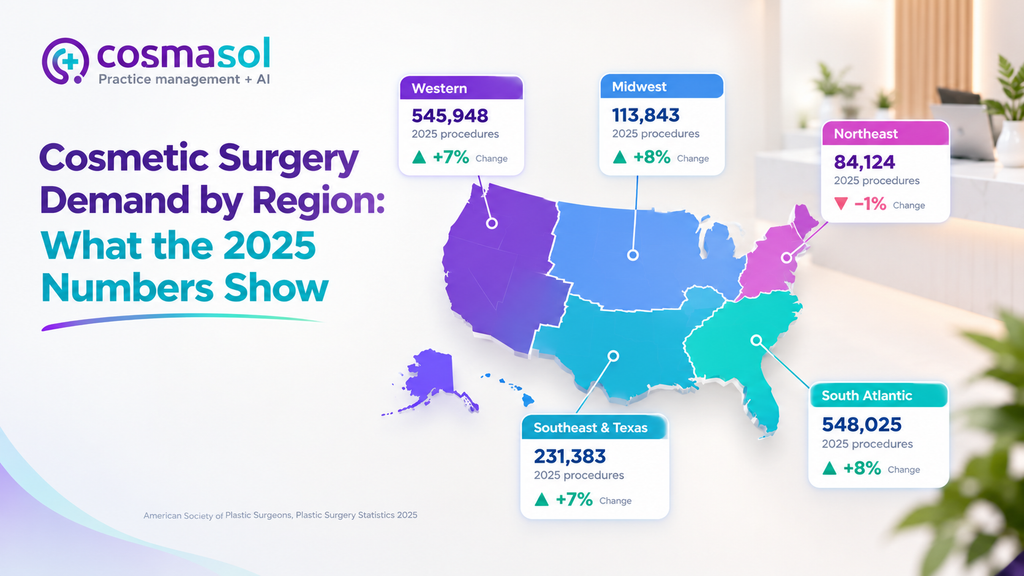
Across the United States, surgeons performed 1,523,330 cosmetic surgical procedures in 2025, up from 1,425,390 the year before. That is a 7% increase, and it comes after several years of growth rather than a rebound from a dip.
A 7% rise in cosmetic surgery demand is the headline most coverage stops at. It is also the least useful number in the report, because almost no practice competes nationally. Cosmetic surgery demand by region is where the figures start to mean something operationally.
| ASPS region | 2025 procedures | 2024 procedures | Change |
|---|---|---|---|
| Region 3: South Atlantic | 548,025 | 506,379 | +8% |
| Region 5: Western | 545,948 | 512,299 | +7% |
| Region 4: Southeast and Texas | 231,383 | 216,218 | +7% |
| Region 2: Midwest | 113,843 | 105,620 | +8% |
| Region 1: Northeast | 84,124 | 84,876 | -1% |
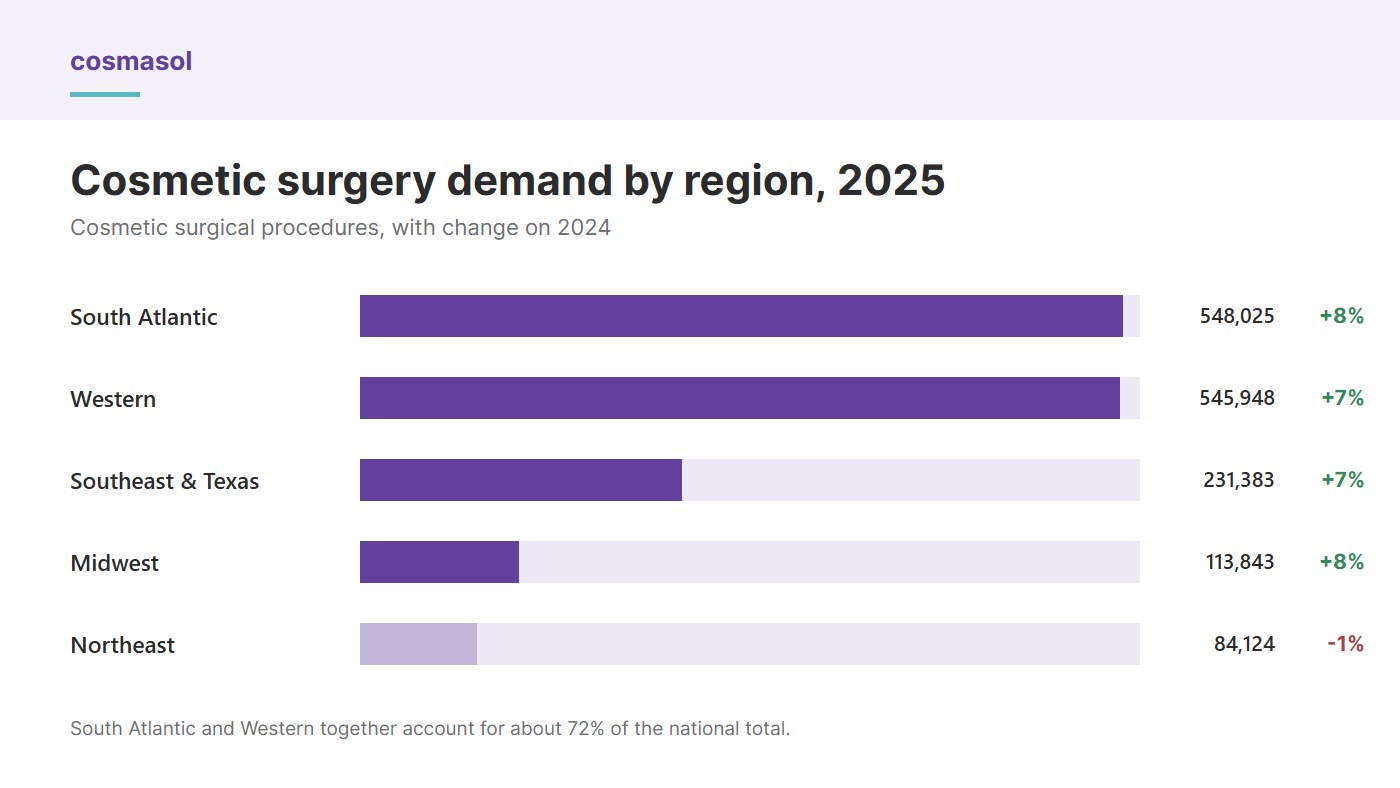
Three things stand out in the cosmetic surgery demand figures.
The South Atlantic and the West dominate. Together they account for 1,093,973 procedures, roughly 72% of the national total. Everywhere else combined makes up the remaining quarter.
The Northeast is the only region that shrank. It fell from 84,876 procedures to 84,124. In a year when every other region grew 7% or more, that is a meaningful divergence rather than noise.
Growth rates are remarkably even elsewhere. The Midwest grew 8% from a small base, the South Atlantic grew 8% from a very large one. Rising demand is not concentrated in one part of the country.
The temptation is to read cosmetic surgery demand in the Northeast as a problem and the South Atlantic figure as an opportunity. Both readings are too quick.
A region with 548,025 procedures also has the surgeons to match. High demand and high competition arrive together, and a practice opening in Florida is not walking into an empty market. The opposite applies in the Northeast: flat regional demand says nothing about whether a specific practice in Boston is growing.
What the regional data is genuinely useful for is calibration. If your practice grew 2% last year in a region that grew 8%, you lost ground in a rising market, which is a different problem from growing 2% in a flat one. That comparison is the single most useful thing in the report, and it takes one number from your own records to run.
| Procedure | 2025 volume | Change |
|---|---|---|
| Liposuction | 317,196 | -1% |
| Breast augmentation | 304,234 | +11% |
| Tummy tuck | 173,251 | +2% |
| Breast lift | 156,131 | +8% |
| Eyelid surgery | 118,978 | +19% |
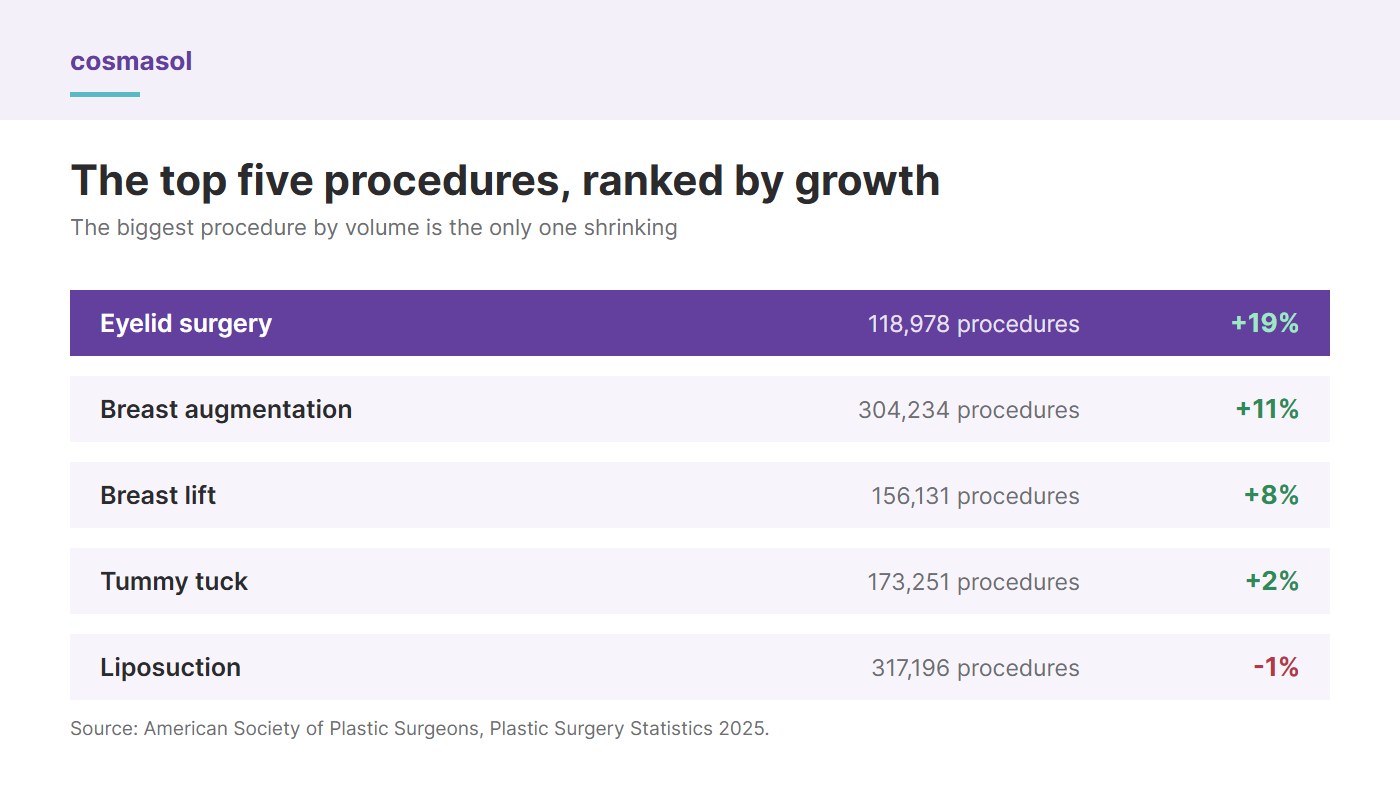
The pattern in cosmetic surgery demand by procedure is more interesting than the regional one. The largest procedure by volume, liposuction, is the only one in the top five that declined. Eyelid surgery grew 19%, faster than anything else on the list, and breast augmentation added roughly 30,000 procedures in a single year.
For a practice, the implication is narrow but real. If your marketing budget is still weighted towards the procedure that was growing three years ago, the mix has moved underneath it. Eyelid surgery growing at 19% while liposuction declines is the kind of shift that shows up in your inquiry volume long before it shows up in your planning.
This is the part most articles about cosmetic surgery demand leave out, and it matters more than any individual figure.
None of that makes the cosmetic surgery demand data less useful. It makes it a benchmark rather than a forecast, and benchmarks only work when you have your own number to set against them.
Cosmetic surgery demand is only half of what ASPS publishes. The same report covers minimally invasive treatments, and the concentration there is sharper than anything on the surgical side. Neuromodulator injections alone accounted for half of all minimally invasive treatments in 2025. Hyaluronic acid fillers took another 30%.
Two treatment categories therefore make up roughly 80% of the minimally invasive market. For a practice running both surgical and non-surgical arms, that concentration is worth sitting with. It means the non-surgical side of your business is competing in a far narrower market than the surgical side, usually on price and convenience rather than on surgeon reputation.
It also means the two halves of your practice generate inquiries that behave differently. A filler inquiry is often ready to book this week. A cosmetic surgery inquiry may take months and several conversations. Treating both with the same follow-up is the most common reason one of them underperforms.
Regional figures get quoted most often in expansion conversations, and that is where they are most frequently misused. Cosmetic surgery demand by region describes a market the size of a dozen states. It cannot tell you whether a specific city can support another practice.
Used carefully, the data still narrows the question. A region growing 8% is a reasonable place to look. A region that shrank 1% is not disqualified, but it does mean growth there has to come from someone else’s market share rather than from a rising tide, and that is a harder and slower proposition.
The decisive numbers are local and you will not find them in a national report: how many board-certified surgeons already operate within driving distance, what they charge, and how quickly they answer the phone. Regional cosmetic surgery demand sets the backdrop. It does not make the decision.
If the gap turns out to be in inquiries that never became consultations, the arithmetic in our post on how many patient calls a practice misses and what it costs is the place to start.
Cosmasol builds AI Digital Agents for aesthetic and plastic surgery practices. The AI Calling Agent, AI Website Chatbot and AI Social Media Chatbot answer inquiries across phone, website and Instagram, each trained on the practice’s own procedures, policies and FAQs. Inquiries flow into the practice’s existing workflow, and anything clinical or unusual is escalated to a person. None of that changes regional demand. It changes how much of your own share of it reaches a consultation.
Learn how the Cosmasol AI front desk picks up after-hours calls and replies to every chat and DM.
The South Atlantic region, with 548,025 cosmetic surgical procedures in 2025 according to ASPS. The Western region is close behind at 545,948. Together they account for roughly 72% of the national total.
Growing nationally. ASPS recorded 1,523,330 cosmetic surgical procedures in 2025, up 7% from 1,425,390 in 2024. The Northeast was the only region to decline, falling 1%.
ASPS publishes the counts, not the reasons. The report does not explain the regional variation, and anyone offering a confident single explanation is speculating.
Among the five highest-volume procedures, eyelid surgery grew fastest in 2025 at 19%, followed by breast augmentation at 11%. Liposuction, the largest by volume, declined 1%.
Not comprehensively. The figures cover procedures reported to ASPS, which skews towards board-certified plastic surgeons and surgical work. Much of the non-surgical and med spa market sits outside this dataset.
As a benchmark for your own growth rate, not as a forecast. Compare your 2025 versus 2024 procedure count against your own region rather than the national average, then break it down by procedure to find where the gap sits.

Does a med spa chatbot actually convert? See what the research shows, why many setups fail, and how to test...
Choosing a med spa AI receptionist? Use this 10-point checklist to test accuracy, booking rules, handoffs, DMs, privacy terms and...
Your med spa front desk can't answer every call, DM and patient at once. See which 7 tasks to automate...
Cosmetic Surgery Statistics: The Best 2026 Comparison
October 30, 2026[…] used the ASPS regional figures in our post on cosmetic surgery demand by region, and The Aesthetic Society’s patient data in our post on who actually has aesthetic surgery, […]