
AI Receptionist for Plastic Surgery & Med Spas: Cost, HIPAA, and What Beats Missed-Call Text-Back (2026 Guide)
An AI receptionist for plastic surgery practices and med spas (also called an AI front desk) answers your calls, website...


The latest news and expert insights for aesthetic practices.
Published on: August 10, 2026
Go Back
Choosing plastic surgery software is one of the few decisions that touches every part of a surgical practice at once. It shapes how consultations are booked, how records are written, how money is collected, and how quickly your team answers a new enquiry. Most practices do not replace this system often, so the choice tends to last five years or more. This guide explains what plastic surgery software covers, which modules genuinely matter, what it costs, and how to run a buying process that produces a decision you can defend to partners and staff.
Plastic surgery software is the operational system a surgical practice runs on. At minimum it holds the patient record, the appointment calendar and the financial ledger. In practice the category has grown well beyond that. Modern platforms now absorb consultation notes, clinical photography, consent capture, quotations, deposits, inventory, staff rotas and marketing reporting.
Plastic surgery software matters as a distinct category because aesthetic surgery does not behave like general medicine. A patient journey often begins with a paid advertisement rather than a referral. The first contact is commercial, not clinical. Money is frequently collected before treatment rather than billed afterwards. Photographs carry evidentiary weight for years, sometimes decades. None of this fits neatly into a general ambulatory record system, and attempting to force it produces workarounds that outlast the people who invented them.
That mismatch explains why so many practices end up with several tools. They buy a records system built for general medicine, then add products to cover what it cannot do. Good plastic surgery software is designed around the aesthetic journey from the beginning, which removes the need for most of those additions and the manual work that connects them.
It is worth being precise about terminology, because vendors use these labels loosely. Plastic surgery practice management software usually refers to the administrative layer covering scheduling, billing and reporting. An EMR refers to the clinical record. A CRM refers to enquiry handling before someone becomes a patient. Some vendors sell all three under one name and some sell only one. Establishing which layers a product genuinely covers is the first useful question in any conversation, because it determines how many other subscriptions you will still be paying for afterwards.
A general electronic health record assumes an insurance funded episode of care. It is built around diagnosis codes, claims and payer rules. An aesthetic practice runs a different model. Much of the revenue is self pay. The record must hold before and after imaging, quotations, deposit schedules and staged treatment plans. General systems handle these as bolt ons if they handle them at all, which is why practices buy a second tool and reconcile by hand. The gap widens once a practice runs paid acquisition, because a general record system has no concept of a lead that has not yet become a patient.
Workable plastic surgery software covers seven areas. Clinical records with imaging and consent. Scheduling for consultations, theatre time and follow ups. Quotations, deposits and billing. Inventory for implants and consumables. A CRM that tracks enquiries before they convert. Communication across phone, web and social channels. Reporting that ties spend to booked surgery. Cosmasol groups these into a single practice management platform, which is the consolidation argument this guide returns to throughout. Our breakdown of the ten capabilities every modern practice should expect goes deeper on each one.
Most practices do not choose a fragmented stack. They accumulate one. A scheduling tool arrives first, then a records system, then a payment processor, then a marketing platform, then a separate phone or messaging service. Each purchase is individually sensible. The combined result rarely is.
The licence fees are the visible cost and usually the smaller one. The larger cost sits in the seams between products. Staff enter the same patient details into three systems. Somebody reconciles the payment report against the appointment list every week. A deposit is taken in one tool and recorded in another, so the numbers disagree at month end. When a report is needed, someone exports three spreadsheets and joins them by hand.
There is a revenue cost too, and it is larger than most practices estimate. When an enquiry sits in a marketing tool that reception does not watch, response time slips from minutes to days. Aesthetic patients shop across several clinics, and the practice that replies first is often the one that books the consultation. This is the reasoning behind treating response management as a growth strategy rather than an administrative task.
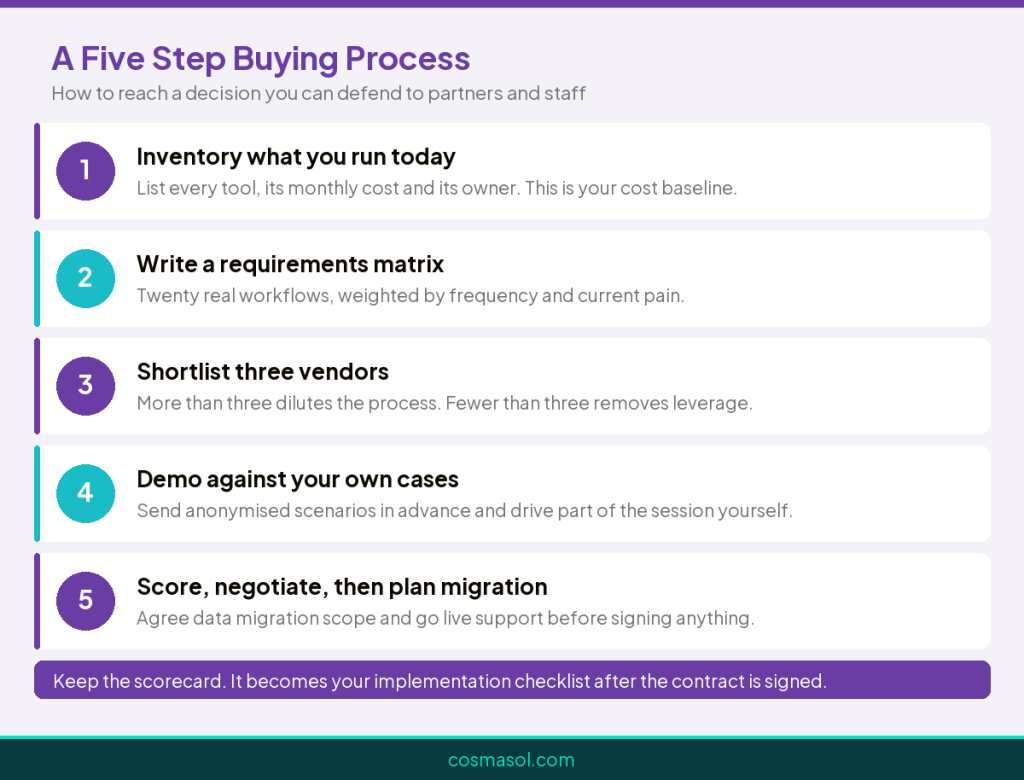
Before shortlisting any plastic surgery software, write down every tool the practice currently pays for, its monthly cost, and the person responsible for it. That inventory is the honest baseline for any comparison. Without it, a consolidation quote looks expensive when it is frequently cheaper. Practices that skip this step almost always judge the decision on licence fee alone, which is the one number that matters least.
Fragmentation also creates a quieter organisational cost. When five systems each hold part of the truth, nobody owns the whole picture. Questions that should take a minute take an afternoon. New staff take longer to become productive because they must learn five interfaces rather than one. Institutional knowledge concentrates in whoever understands how the tools fit together, and that person becomes a single point of failure the practice cannot afford to lose.
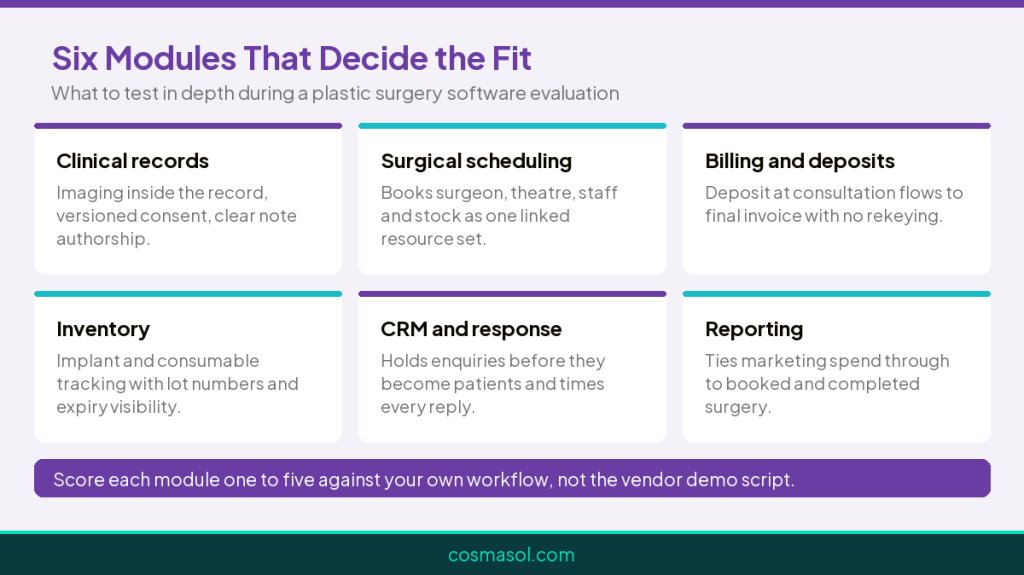
Every vendor of plastic surgery software claims every feature. The useful question is not whether a module exists but whether it works the way your practice actually operates. Evaluate depth, not presence. A module that technically exists but needs three workarounds daily will be abandoned within months, and you will buy a second tool to replace it. That is precisely how practices end up with the fragmented stack described earlier, one reasonable decision at a time.
Aesthetic documentation carries a heavier evidentiary burden than most specialties. Standardised before and after photography, consent versions tied to the procedure discussed, and clear authorship on every note all matter if a complaint arrives years later. Check whether images are stored inside the record or merely linked from a gallery. Ask how consent is versioned when a treatment plan changes. Test voice to text on a real consultation note rather than a scripted demo. Practices weighing records systems specifically should read our guide on how to choose a platform that scales.
Surgical scheduling is a resource problem, not a calendar problem. A single procedure may need a surgeon, an anaesthetist, a theatre, a recovery bay and a specific implant in stock. Plastic surgery software that books only the surgeon will create conflicts elsewhere, and those conflicts surface on the day rather than at the point of entry. Ask how the system handles pre operative and post operative appointment chains, cancellations that free several resources at once, and consultations that convert to surgery weeks later.
Aesthetic billing mixes self pay, deposits, staged payments, finance providers and, for reconstructive work, insurance claims. Where insurance applies, coding accuracy matters, and the AMA CPT code set governs how procedures are reported. Confirm that a deposit taken at consultation flows through to the final invoice without a manual adjustment, because that single workflow causes more month end reconciliation work than any other.
Implants and consumables need lot level tracking with expiry visibility, both for recall readiness and for margin control. Communication should bring phone, web chat and social messages into one queue rather than several inboxes. Reporting must connect marketing spend to completed surgery. Practices frequently treat these three as optional extras, then discover they are the modules that separate a platform from a records system with a calendar attached.
Aesthetic practices hold clinical notes, identifiable photographs and payment details. That combination attracts regulatory attention and criminal interest in equal measure. Compliance is therefore a procurement question, not an afterthought, and any plastic surgery software you shortlist should be assessed on it alongside clinical features rather than afterwards.
For practices operating in the United States, HIPAA obligations follow the data wherever it is processed. The Office for Civil Rights maintains a public portal of reported breaches, which is a sobering reference when assessing vendor risk. The National Institute of Standards and Technology publishes detailed implementation guidance for the HIPAA Security Rule, and it is a better evaluation framework than any vendor security page.
Ask concrete questions and require written answers. Where is data hosted and who can access it. How are audit logs kept and for how long. What happens to your data if you leave. Whether the vendor will sign a business associate agreement. Whether access controls are genuinely role based rather than all or nothing. A vendor that answers these quickly and in writing is signalling maturity, and one that deflects is telling you something equally useful.
Marketing carries its own duties. The Federal Trade Commission publishes guidance on health privacy covering how patient information may be used in advertising, which matters because aesthetic practices rely heavily on before and after imagery. Cosmasol builds these controls into its compliant platform architecture, and any plastic surgery software you consider should evidence the same.
Photography deserves particular attention during evaluation. Aesthetic practices generate large volumes of identifiable clinical images, and those images frequently travel between the practice, the patient and marketing channels. Ask where images are stored, who can export them, whether export is logged, and how consent for marketing use is recorded separately from consent for treatment. Practices that conflate the two consents create risk that only becomes visible when a patient withdraws permission years later and nobody can identify where their images have been published.
The best plastic surgery software for a solo surgeon is rarely the best choice for a four site group. Requirements diverge sharply once a second location or a second surgeon appears, and the divergence is structural rather than a matter of scale.
A solo practice optimises for simplicity and speed. One calendar, one ledger, minimal configuration, fast onboarding. Heavy permission structures and multi entity accounting add cost without adding value. The risk here is overbuying, then paying for complexity nobody uses and an implementation that takes months longer than it needed to.
A multi surgeon or multi site group optimises for control and comparability. It needs consolidated reporting alongside per location views, permissions that separate what each team can see, shared patient records across sites, and inventory tracked per location. The risk here is underbuying, then discovering at site three that the platform cannot separate the books. Our guide to managing multiple clinics on one system covers the operational detail.
Deployment model follows from this. Cloud delivery has become the default because it removes server maintenance and makes multi site access straightforward, a point we cover in the case for cloud based platforms. Practices with specific data residency obligations should still confirm hosting locations in writing before signing, since assurances given verbally during a demo are difficult to enforce later.
The awkward case sits between the two models. A practice buys plastic surgery software suited to its current size while planning to add a surgeon or a second site within the year. Migration is disruptive and expensive, so being forced into it during a growth phase is the worst possible timing. If expansion is realistically planned within eighteen months, evaluate against group requirements now and ask each vendor exactly what changes when a second location is added, what it costs, and whether it requires a fresh implementation.
Most disappointing software purchases share a single cause. The practice evaluated features instead of workflows, and the vendor with the best presenter won. A structured process avoids that outcome without adding much time.
Before contacting any vendor, list your twenty most frequent workflows. Booking a consultation. Taking a deposit. Documenting a procedure. Ordering an implant. Chasing a lead that went quiet. Weight each one by frequency and by how painful it is today. That matrix becomes your scorecard for every plastic surgery software vendor you meet. It stops a strong demo from overriding a poor fit, and it gives the whole team a shared basis for the decision rather than competing opinions expressed with varying confidence.
Send three anonymised scenarios to every shortlisted vendor and ask them to run those specific cases live. Insist on driving part of the session yourself, because watching is not the same as using. Note every point where the presenter says a capability is on the roadmap or requires a partner tool. Record how many clicks each workflow takes, because that number multiplies across thousands of appointments a year and is the difference between adoption and quiet abandonment.
A signed contract is the start of the work, not the end. Implementation is where value is either captured or lost, and it deserves the same rigour as the selection itself. Practices that treat go live as an IT task rather than an operational change consistently underperform their own business case.
Data migration is the highest risk step. Agree in writing what moves and what does not. Patient demographics usually migrate cleanly. Clinical notes, images and financial history are harder and more expensive. Decide early whether historic records move fully, move partially, or stay accessible in a read only archive. Reconcile record counts and financial totals before the old system is switched off, never afterwards.
Interoperability shapes what is possible. The national programme for certified health IT sets expectations for how systems exchange data, and asking whether both your current and prospective platforms follow those standards is a fair procurement question that will save considerable expense during migration.
Then measure. Set a baseline in the four weeks before go live. Track time to first response on new enquiries, consultation to surgery conversion rate, days from procedure to payment, and hours spent on administration each week. Review at ninety days. If none of those numbers moved, the problem is usually configuration or training rather than the plastic surgery software itself, and both are fixable without another procurement cycle.
Adoption deserves as much planning as the data. Choose a quiet period rather than a busy surgical week. Run the old and new systems in parallel briefly so problems surface while a fallback still exists. Train staff on their own daily workflows rather than generic modules, and appoint one internal expert per team who becomes the first point of contact for questions. Expect a temporary dip in throughput for two to three weeks and plan clinic capacity accordingly, because practices that book a full list for go live week almost always regret it.
Certain errors repeat across practices of every size. Knowing them in advance is cheap protection against an expensive five year commitment.
The first is buying on demo quality. A polished presenter is evidence of a good sales team, not a good product. The second is ignoring the front desk. The people who use the system hourly should sit in every demo, because their objections predict adoption more reliably than any partner opinion formed in a single meeting.
The third is treating marketing as out of scope. If your plastic surgery software cannot show which campaign produced a booked surgery, budget decisions stay guesswork. Many practices already understand this for marketing software selection but do not apply the same standard to the core system they use every day.
The fourth is underestimating communication load. Enquiries arrive by phone, web chat and social message, often outside clinic hours. Practices that route all three into one queue respond faster than those watching several inboxes, which is the operating principle behind AI assisted call handling.
The fifth and most expensive mistake is skipping the baseline measurement, because without it you can never prove the investment worked or diagnose why it did not. Industry context helps with planning too, and the procedural statistics published by the American Society of Plastic Surgeons are a useful benchmark when forecasting demand and sizing capacity for the year ahead.
A sixth mistake is worth adding because it is so common. Practices negotiate hard on the monthly fee and barely discuss the contract terms that matter more over five years. Settle the renewal increase cap, the data export rights and cost if you leave, the support response times, and whether the modules quoted are contractually included rather than subject to repackaging. Good plastic surgery software should come with terms you are comfortable reading twice, and a vendor reluctant to commit to any of these in writing is answering the question for you.
Selecting plastic surgery software is a workflow decision before it is a technology decision. The practices that get it right start by mapping what they actually do, count the true cost of the tools they already run, and score vendors against their own cases rather than a feature list. Consolidation usually wins because it removes the manual work sitting between systems. If you are evaluating plastic surgery software this year, book a Cosmasol demo and bring your own scenarios to the session.
It is the operational platform a surgical practice runs on. It combines patient records, clinical imaging, scheduling, billing, inventory and patient communication so that one system supports the whole journey, from a first enquiry through surgery to post operative follow up.
Standard records systems assume insurance funded care built around diagnosis codes and claims. Aesthetic practices run largely on self pay, need quotations and staged deposits, and depend heavily on clinical photography. Those requirements sit well outside what general medical systems handle comfortably.
Pricing varies with practice size, user count and the modules included, which is why few vendors publish figures. Compare total cost of ownership rather than the licence fee alone, including implementation, migration, training and every subscription the new platform would replace.
Usually not. Solo practices should optimise for simplicity and fast onboarding, while groups need consolidated reporting, per site permissions and shared patient records. Overbuying and underbuying are both common errors, and both prove expensive within the first two years of ownership.
It can be safer than on site servers when the vendor maintains strong access controls, encryption, audit logging and a signed business associate agreement. Ask for written evidence of each control rather than accepting a compliance badge displayed on a marketing page.
Most practices plan six to twelve weeks, though migration scope matters considerably more than practice size does. Agree what historic data moves before signing anything, and reconcile record counts and financial totals fully before retiring the previous system.
Often yes, provided each module is genuinely deep rather than a checkbox on a feature grid. Test the modules you rely on most against your own workflows. Read our evaluation lessons from high performing practices before deciding anything.
Ask the vendor to run your own anonymised cases live rather than presenting a scripted tour. Count clicks per workflow, and note every capability described as roadmap or partner delivered, because those are precisely the gaps you will feel after signing the contract.
Baseline four metrics in the month before go live. Time to first response on enquiries, consultation to surgery conversion, days from procedure to payment, and weekly administration hours. Review all four again at ninety days and act on whatever has not moved.
The about page explains the platform background and the team who built it, while the frequently asked questions page covers deployment, security, support and implementation for practices of different sizes and structures.

An AI receptionist for plastic surgery practices and med spas (also called an AI front desk) answers your calls, website...

Virtual consultation booking software for plastic surgery has moved from convenience to expectation. Patients researching a procedure increasingly want an...

Software for plastic surgeons is often discussed as though every practice needs the same thing. It does not. A solo...