AI Receptionist for Plastic Surgery & Med Spas: Cost, HIPAA, and What Beats Missed-Call Text-Back (2026 Guide)
An AI receptionist for plastic surgery practices and med spas (also called an AI front desk) answers your calls, website...


The latest news and expert insights for aesthetic practices.
Published on: August 27, 2026
Go Back
Virtual consultation booking software for plastic surgery has moved from convenience to expectation. Patients researching a procedure increasingly want an initial conversation before travelling to a clinic, and many enquiries now arrive from outside the practice catchment entirely. The difficulty is not running the video call. It is converting a remote enquiry into an attended consultation, and then into a booked procedure.
A virtual consultation is easier to book than an in person one. That is its main strength and its main weakness, and both need managing deliberately.
Lower commitment means more enquiries convert into booked slots. It also means a higher proportion fail to attend. Practices that treat virtual and in person consultations as equivalent are frequently surprised by the no show rate in the first few months, and some abandon the format before addressing the cause.
Geography changes as well. Remote consultations attract patients from outside the usual catchment, including people who will never realistically travel for surgery. Virtual consultation booking software for plastic surgery should therefore capture location and intent at the point of booking, so clinical time is spent on genuine prospects.
Reporting must separate the two formats. Blending virtual and in person consultations in a single conversion figure hides both problems, because a strong in person rate masks a weak remote one. Track attendance, conversion and revenue per format so you can judge whether the channel earns its clinical time.
Decide which procedures suit the format before promoting it widely. Straightforward enquiries and revision discussions often work well remotely, while complex cases usually need physical assessment early. Configuring virtual consultation booking software for plastic surgery to offer remote slots only for suitable procedure types protects clinical time and avoids the frustration of a consultation that reaches its natural limit within five minutes.
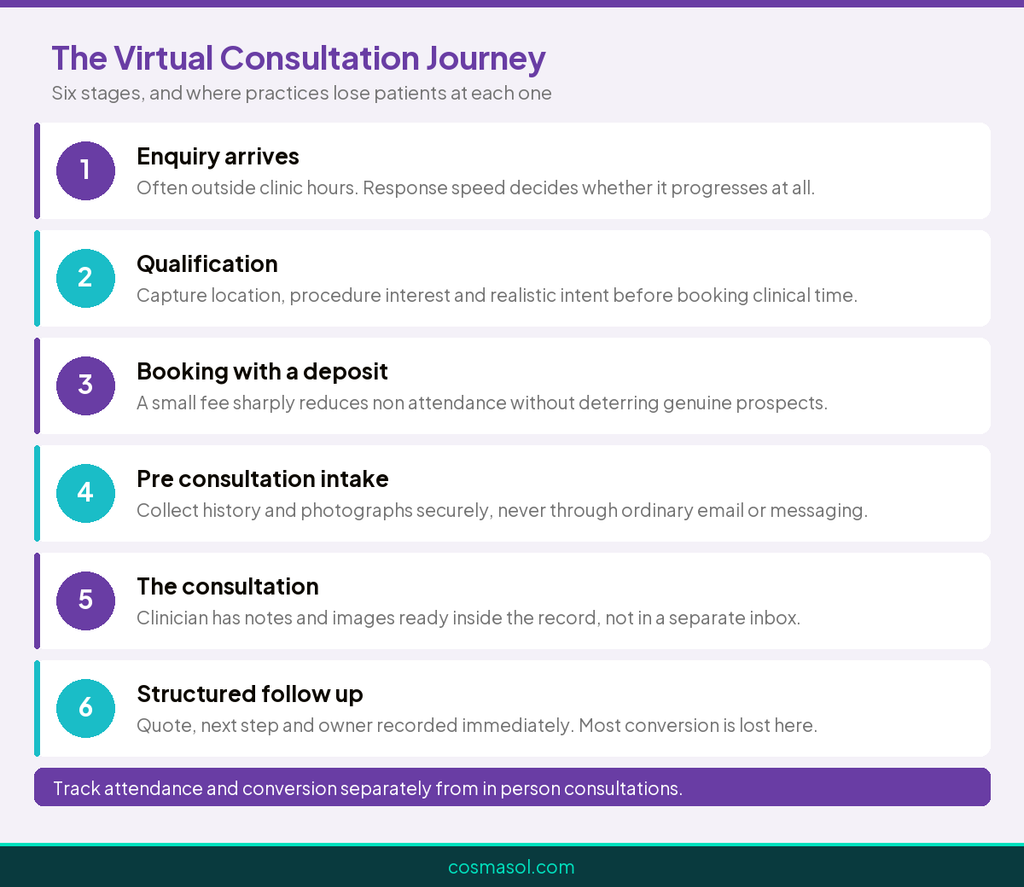
Six stage virtual consultation journey for a plastic surgery practice
The most reliable defence against virtual no shows is a small booking fee, often credited against treatment if the patient proceeds.
It works because it introduces commitment at the point where commitment is otherwise entirely absent. Practices commonly report a substantial fall in non attendance after introducing one, and the patients deterred are largely those who were never going to proceed to surgery anyway.
This only works cleanly when booking and payment share a system. If the fee is taken in a separate payment tool, someone reconciles it manually and crediting it against treatment becomes another administrative task. Reminders still matter alongside the fee, and the mechanics carry across aesthetic settings, as our guide to booking and appointment software explains.
Set the fee carefully. Too low and it changes nothing. Too high and it deters serious enquiries who simply wanted an initial conversation. Most practices settle on a modest figure that is clearly credited against treatment, and they state that credit prominently at the point of booking rather than burying it in terms.
Have a documented policy for cancellations and reschedules, and make sure the booking system enforces it automatically. Deciding case by case consumes management time and produces inconsistent outcomes that patients notice and discuss. Virtual consultation booking software for plastic surgery should apply the rule at the point of cancellation, refunding or retaining the fee according to notice given, without anyone needing to make a judgement call.
Virtual consultations depend on patient submitted photographs, and this is where practices most often create risk without realising it.
Images sent by ordinary email or social message sit in systems never designed to hold clinical data. Once received, they are clinical records and attract the same protection duties as any other patient information. They should arrive through a secure intake route and land directly in the patient record rather than in an individual’s inbox.
The relevant standards are well documented. National guidance on privacy and security for health IT sets the baseline expectations, and the Federal Trade Commission publishes health privacy guidance covering how such information may be used afterwards. Our overview of compliant platform design explains what to verify with any vendor.
Give patients clear instructions as well. Standardised angles, lighting and distance improve clinical usefulness considerably, and a short guide sent with the booking confirmation reduces the number of consultations wasted on unusable images. Good virtual consultation booking software for plastic surgery sends that guidance automatically as part of the intake sequence.
Remote enquiries do not respect opening times. A significant share arrive in the evening or at weekends, which is precisely when most practices cannot respond.
By the time reception replies on Monday, the patient has often booked elsewhere. This is the practical case for automated first response. A system that answers immediately, qualifies the enquiry and offers a booking slot converts substantially more of this traffic than a callback queue ever will.
Cosmasol handles this through its AI CRM, which answers across calls, website chat and social messages and books directly into the clinical calendar. Our guide to automated booking for surgical clinics sets out how the workflow operates in practice.
Measure this specifically. Report enquiry volume and conversion by hour of arrival for a quarter. Most practices are surprised by how much of their demand lands outside working hours, and by how sharply conversion falls for those enquiries when nobody responds until the following working day.
Set clear boundaries on what automation may do. Booking a consultation, capturing contact details and answering routine questions about location or pricing are safe. Clinical advice is not, and any virtual consultation booking software for plastic surgery should hand those questions to a clinician rather than attempting an answer. Agreeing that boundary before launch protects both patients and the practice, and it makes the system easier to trust internally.
Most conversion is lost after the consultation rather than during it. The patient attends, the conversation goes well, and then nothing structured happens.
Remote consultations make this worse because the patient never physically visited the clinic, so there is less natural continuity and less emotional investment in the relationship. Follow up therefore has to be deliberate rather than incidental.
Send the quotation the same day. Record a defined next step with a named owner and a date. Make every unconverted consultation visible in a queue rather than relying on individual memory. These three habits account for most of the difference between practices that convert remote consultations well and those that do not.
This is where the booking tool and the CRM must be the same system. If the consultation sits in a calendar and the follow up sits in someone’s inbox, opportunities disappear quietly and nobody notices until a quarterly review. Treating response management as a growth strategy applies just as strongly after the consultation as before it.
Give the follow up sequence a defined end point as well. Chasing indefinitely irritates people and consumes staff time that would be better spent on new enquiries. Most practices settle on three structured contacts across a few weeks, after which the record moves to a longer term nurture list. Virtual consultation booking software for plastic surgery should automate that progression rather than leaving each decision to whoever happens to review the queue.
Virtual consultation booking software for plastic surgery earns its place by converting remote interest into attended consultations and booked procedures. Qualify enquiries at booking, protect attendance with a small deposit, collect photographs through a secure route into the record, and follow up on a defined schedule. Track the format separately so you can see what it genuinely contributes. To see the workflow end to end, book a Cosmasol demo.
It is software that schedules remote consultations, collects patient history and photographs securely before the appointment, and records the outcome inside the patient record alongside in person visits so reporting stays continuous across both formats.
Typically yes, because booking one requires considerably less commitment from the patient. A small booking fee credited against treatment is the most effective correction available, alongside reminders sent through whichever channel that patient actually uses.
A modest fee credited against treatment usually improves attendance considerably without deterring serious prospects. It works best when booking and payment sit within the same platform, so the credit applies automatically rather than through a manual adjustment.
Through a secure intake route that places images directly into the patient record. Ordinary email and social messaging are unsuitable, since those systems were never designed to hold clinical information and create obligations the practice cannot easily discharge.
For an initial discussion they work well. Surgical planning normally still requires physical examination, so most practices use remote consultations to qualify enquiries and inform patients rather than to replace clinical assessment entirely before a procedure.
Capture location and intent at the point of booking so clinical time goes to realistic prospects. Some distant enquiries do convert into surgery, but they should be identified deliberately rather than discovered partway through a consultation call.
Without automated response they usually wait until the next working day, by which point many patients have already contacted another clinic and booked elsewhere. Immediate qualification and booking materially improves conversion for this substantial share of demand.
Send the quotation the same day, record a defined next step with a named owner and date, and keep every unconverted consultation visible in a queue rather than depending on individual recall or general good intentions across a busy team.
It should. Separating the booking tool from the patient record forces duplicate data entry and makes it difficult to see the full journey from first enquiry through consultation to completed procedure in one continuous and reportable view.
The contact page reaches the team directly for questions about your own configuration, and the frequently asked questions page covers deployment, security and support arrangements in considerably more detail.

An AI receptionist for plastic surgery practices and med spas (also called an AI front desk) answers your calls, website...

Software for plastic surgeons is often discussed as though every practice needs the same thing. It does not. A solo...

Plastic surgery software pricing is unusually opaque. Most vendors publish no figures at all, and those that do quote a...