
How Many Patient Calls Does a Plastic Surgery Practice Miss – and What Is It Costing?
Published benchmarks put missed patient calls at roughly 15% to 42% of inbound calls, with solo and small practices at...


The latest news and expert insights for aesthetic practices.
Published on: August 26, 2026
Go Back
Software for plastic surgeons is often discussed as though every practice needs the same thing. It does not. A solo surgeon and a four site group face genuinely different problems, and the systems that suit them diverge sharply. Solo practices tend to overbuy complexity they never use. Groups tend to underbuy and hit a ceiling at the second or third location. This guide sets out where the requirements split.
A single surgeon practice runs on a small team, often with staff covering several roles at once. The binding constraint is attention, not scale.
That points firmly to simplicity. One calendar, one ledger, minimal configuration and fast onboarding. Features that add administrative steps cost more than they return. Elaborate permission hierarchies are unnecessary when four people share responsibility for everything and sit in the same building.
The risk for solo practices is overbuying. Enterprise platforms designed for groups carry configuration overhead that never pays back at this scale. They also take longer to implement and demand more ongoing administration than a small team can spare, which usually means the system is used at a fraction of its capability.
Support quality matters disproportionately here. A group has internal staff who can absorb a problem for a day, while a solo practice has nobody spare. Ask what support hours apply, how quickly issues are answered, and whether you reach someone who understands aesthetic workflows rather than a general help desk. For a small team, responsive support is a more valuable feature than most of the capabilities on the specification sheet.
When evaluating software for plastic surgeons at this size, weight ease of daily use far above breadth of capability. Count clicks in the demo rather than features on the brochure. Ask how long implementation takes for a practice of your size, and treat any answer beyond a few weeks as a signal that the product was designed for someone else.
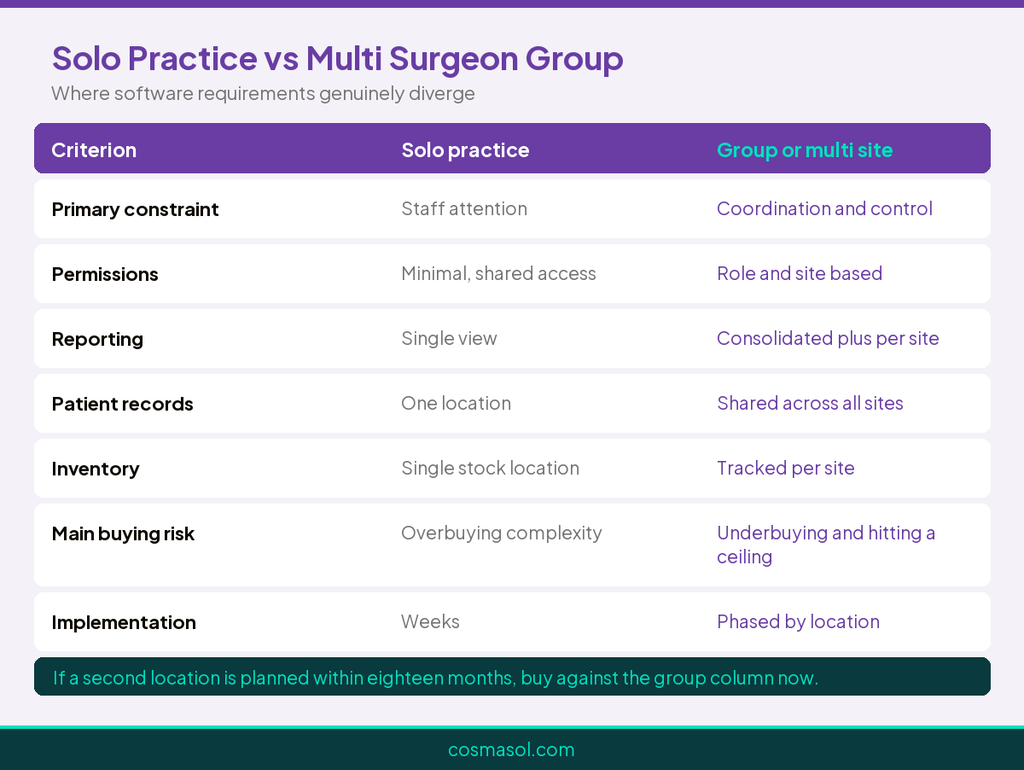
Comparison of software requirements for solo plastic surgeons and multi surgeon groups
Adding a second surgeon or a second site changes the problem from efficiency to control.
Groups need consolidated reporting alongside per location views, because partners want both the combined picture and the ability to compare sites against each other. Permissions matter, since staff at one location generally should not see everything happening at another. Patient records must be shared so a patient treated at one site can be seen at another without duplication.
Inventory becomes considerably harder. Stock held at one location must be tracked separately, or the group loses visibility of what is where and orders duplicates. Financial separation matters too, particularly where sites have different ownership structures or profit sharing arrangements between surgeons.
Practice management software for plastic surgeons operating at group scale also needs to handle surgeon level reporting properly. Partners will want revenue, conversion and utilisation broken down per surgeon as well as per site. Our guide to managing multiple clinics on one platform covers the operational detail of running this well.
Consistency becomes a genuine management problem at group scale. When each site configures its own templates, pricing and appointment types, comparison between locations stops being meaningful and reporting quietly becomes unreliable. Software for plastic surgeons operating across several sites should allow central definitions with controlled local variation, so partners can compare performance without arguing about whether the underlying numbers were recorded the same way.
The most expensive mistake sits between the two models. A practice buys for its current size while quietly planning to expand.
Migration is disruptive and costly, so a platform chosen for a solo practice that cannot support a second location forces either a painful move at exactly the wrong moment, or a second system running alongside the first. Both outcomes are worse than buying correctly at the start, and both are common.
The practical test is straightforward. If a second location or an additional surgeon is realistically planned within eighteen months, evaluate software for plastic surgeons against group requirements now. Ask vendors directly what changes when a second site is added, what it costs, and whether it requires re implementation.
Vague answers here are a reliable warning sign. A vendor that has genuinely supported growing groups will describe the process precisely, including what breaks and what has to be reconfigured. One that has not will describe it as simple, which is almost never true of adding a location to a live clinical system.
Deployment model matters more for groups than for solo practices, though it affects both.
Cloud delivery removes server maintenance and makes access from several locations straightforward, which is why it has become the default for multi site groups. Our guide to cloud based platform benefits sets out the practical differences in more detail.
Whichever model applies, security expectations are the same. Role based access, audit logging and clear data ownership terms should all be confirmed in writing. National guidance on privacy and security for health IT is a useful reference point when assessing what a vendor should be able to evidence, and it applies equally to a single surgeon practice and a large group.
Remote access deserves explicit attention. Surgeons increasingly review records outside the clinic, and any software for plastic surgeons that makes this awkward will be worked around with exports and personal devices. That is a security problem created by poor usability rather than by policy, and it is best avoided at selection.
The process is the same regardless of scale. Only the weighting changes between the two models.
List your twenty most frequent workflows and weight them by frequency and current difficulty. Solo practices should weight daily administrative tasks heavily. Groups should weight reporting, permissions and cross site record access. Then send anonymised scenarios to each shortlisted vendor and require them to run those cases live rather than presenting a tour.
Include the people who use the system most. Front desk staff spot friction that partners never notice, and their objections predict adoption more accurately than any executive assessment made in a single meeting.
Finally, ask each vendor for a reference practice of your own size and structure. A group reference tells a solo practice very little, and the reverse is equally true. For sector context when planning capacity, the Aesthetic Society procedural statistics are a helpful reference.
Revisit the decision periodically rather than treating it as permanent. Software for plastic surgeons that suited a solo practice three years ago may be constraining it now, and the warning signs are usually visible before they become urgent. Recurring spreadsheet workarounds, staff keeping private tracking lists, and reports that take a day to assemble all indicate the system has been outgrown, and noticing early makes the next move far less disruptive.
Set a review date rather than waiting for frustration to force one. An annual assessment against the same twenty workflows you used at selection takes an hour and shows clearly whether the software for plastic surgeons you chose is still keeping pace with the practice. Most groups that outgrew a platform badly can point, in hindsight, to the year they should have acted and did not.
Choosing software for plastic surgeons starts with an honest assessment of scale and direction. Solo practices should protect simplicity and resist configuration they will never use. Groups should insist on consolidated reporting, per site permissions and shared records from day one. If expansion is planned within eighteen months, buy for the group model now. To compare against your own structure, book a Cosmasol demo.
Yes, though in a considerably simpler configuration than a group requires. The value comes from removing duplicate data entry and manual reconciliation, which together consume a disproportionate share of a small team’s limited available time each week.
Scheduling becomes a shared resource problem, reporting needs to separate performance by surgeon, and permissions begin to matter for the first time. Most solo configurations handle the first two of these poorly without significant reconfiguration work.
If a second location or an additional surgeon is realistically planned within eighteen months. Migrating during an expansion is disruptive and usually far more expensive than simply buying the right configuration correctly at the outset.
Good platforms scale by configuration rather than by replacement. Ask specifically what changes when a second site is added, what that costs, whether it requires a fresh implementation project, and how long the change typically takes.
Stock must be tracked per location rather than as a single shared pool. Without that, a group loses visibility of what is held where, which causes both shortages at one site and unnecessary duplicate ordering at another.
Usually yes. Partners typically want a consolidated view alongside per site comparison, and sites with different ownership structures or profit sharing arrangements may need genuinely separated books rather than simply filtered reports from one ledger.
It is generally simpler, since access across several locations needs no additional infrastructure or maintenance. Confirm hosting location and access controls in writing beforehand if you have specific data residency obligations that you need to satisfy.
Include front desk and administrative staff alongside clinicians and partners. They use the system most frequently and identify workflow friction that decision makers rarely encounter directly in their own daily work, which makes their objections unusually predictive.
Solo practices commonly complete within a few weeks from start to finish. Groups usually phase by location over a considerably longer period, since migration, configuration and staff training all multiply with each additional site added.
The features overview covers the modules and how they behave across multiple sites, and the about page explains the platform background and the team who built and support it.

Published benchmarks put missed patient calls at roughly 15% to 42% of inbound calls, with solo and small practices at...

An AI receptionist for plastic surgery practices and med spas (also called an AI front desk) answers your calls, website...

Virtual consultation booking software for plastic surgery has moved from convenience to expectation. Patients researching a procedure increasingly want an...