
AI Receptionist for Plastic Surgery & Med Spas: Cost, HIPAA, and What Beats Missed-Call Text-Back (2026 Guide)
An AI receptionist for plastic surgery practices and med spas (also called an AI front desk) answers your calls, website...


The latest news and expert insights for aesthetic practices.
Published on: July 7, 2026
Go Back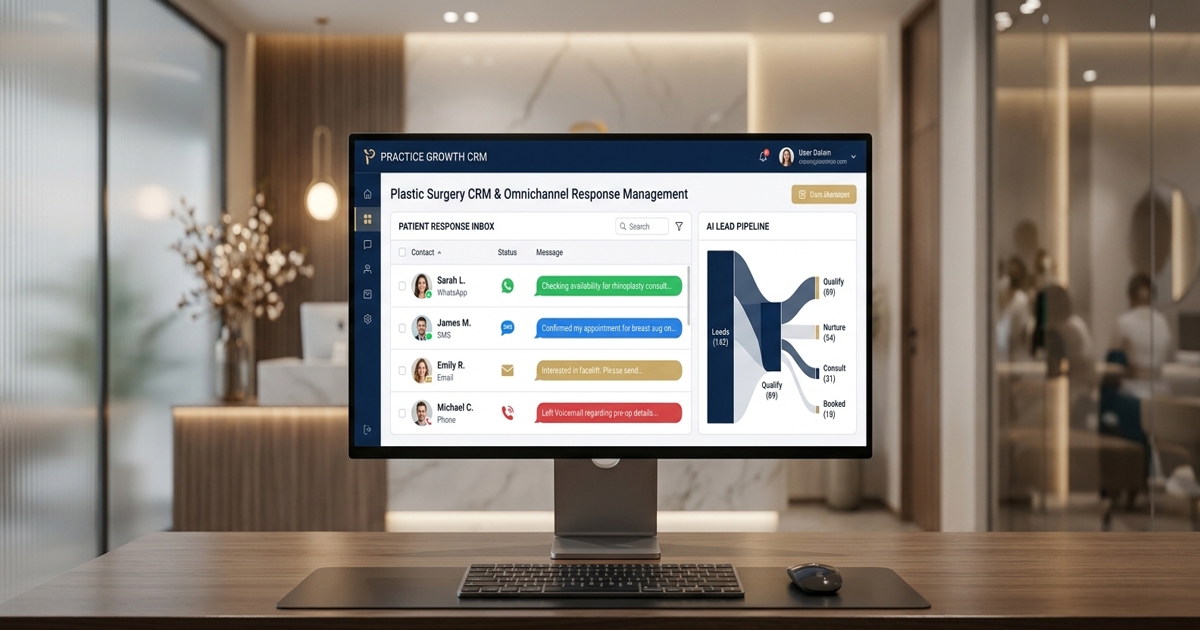
Plastic Surgery CRM technology has evolved far beyond storing patient contact details. Today, it sits at the center of patient acquisition, conversion, and long term retention. Prospective patients searching for rhinoplasty, liposuction, or breast augmentation expect instant, personalized responses regardless of how they reach out. A delayed reply does not just frustrate them; it sends them directly to a competing practice. In a market where attention is fleeting, response management has quietly become the most powerful growth lever available to plastic surgery clinics.
This article explains why traditional CRM systems are falling short, how modern plastic surgery lead management software is reshaping patient communication, and why practices that invest in intelligent response management will consistently outperform those relying on manual follow-ups and disconnected tools. You will also learn which CRM capabilities matter most and how AI is transforming the entire patient journey.
Traditional CRM systems were designed to store information. They kept names, phone numbers, consultation history, and treatment notes in one place. That was useful when patient acquisition moved slowly and competition was local. Today, that model is obsolete. Patients research multiple clinics simultaneously, submit inquiries across several platforms, and make decisions within hours. A CRM that only stores data cannot engage, qualify, or convert those patients automatically. The shift from contact management to response management is not optional; it is a survival requirement for any practice serious about growth.
Research published by Harvard Business Review found that businesses responding to leads within an hour are significantly more likely to qualify and convert prospects compared to those that wait even a few hours. In plastic surgery, where patients are emotionally invested and researching multiple providers at once, delay is catastrophic. A patient who submits a consultation request on Monday morning and receives a callback Wednesday afternoon has almost certainly already booked with a competitor. Every hour of silence represents lost revenue that is nearly impossible to recover.
Patients today do not follow a single path. They may discover a practice through an Instagram ad, send a WhatsApp message, fill out a website contact form, and then call directly all within the same day. Without a centralized system, each of these touchpoints creates a data silo. Inquiries get missed, duplicated, or responded to inconsistently. McKinsey research confirms that consumers increasingly expect fast, personalized, and seamless interactions across digital channels, making customer experience a core competitive differentiator. Practices still managing these channels separately are structurally unable to compete with those using an integrated platform.
Response management begins with a unified inbox. Instead of checking separate platforms for emails, social DMs, SMS messages, and phone inquiries, your team accesses every patient conversation from a single dashboard. This eliminates the risk of missed messages, reduces response time, and creates a complete communication record for each patient. When a staff member picks up a conversation, they immediately see the full context, prior interactions, and the inquiry source, allowing them to respond intelligently rather than starting from scratch every time.
Not every inquiry requires immediate human attention. A modern plastic surgery lead management software platform can automatically segment inquiries by procedure interest, geographic location, urgency, and communication channel. AI workflows can send instant acknowledgment messages, ask pre-qualification questions, and score leads based on their likelihood to convert. This means your front desk team spends time on warm, qualified patients rather than manually sorting through every new contact. The result is a faster, more efficient conversion pipeline that scales without proportionally increasing staffing costs.
The American Medical Association has highlighted the growing role of digital health technologies in improving patient engagement and operational efficiency. AI chatbots and voice assistants now handle a significant portion of first contact patient interactions. An AI chatbot for plastic surgery clinic can answer procedure questions, collect patient details, confirm appointment availability, and route complex inquiries to the appropriate staff member, all without human intervention. These tools do not replace your team. They extend its capacity so that no inquiry goes unanswered, even outside business hours.
Speed is the single most powerful conversion variable in plastic surgery patient acquisition. A patient who receives an immediate, personalized response feels valued and professionally handled. That emotional first impression heavily influences whether they book a consultation. Practices using automated response tools consistently report higher consultation booking rates because the window between patient interest and engagement is compressed from hours to seconds. An AI answering service for plastic surgery clinic ensures every inquiry receives an instant, relevant response regardless of the time of day or staff availability.
Salesforce research shows that customers expect consistent engagement across every communication channel and place high value on personalized experiences. When a plastic surgery practice runs paid ads on Google and Instagram simultaneously, the leads generated across those channels need to be captured, tracked, and followed up with equal speed and personalization. A centralized AI CRM attributes each lead to its source, triggers channel appropriate automated responses, and routes qualified inquiries to the right team member, ensuring no marketing dollar goes to waste because of a slow or inconsistent follow-up process.
Personalization in patient communication goes well beyond addressing someone by their first name. It means understanding which procedure they are interested in, acknowledging how they found the practice, and tailoring follow-up messages to their specific concerns. Modern Plastic Surgery CRM platforms use patient data to deliver contextually relevant communication at every stage of the journey. A patient who asked about rhinoplasty should receive rhinoplasty specific content, not a generic clinic newsletter. This level of personalization builds trust, differentiates the practice, and significantly increases the likelihood of a consultation booking.
One of the most underappreciated benefits of intelligent response management is what it does for your team. Administrative staff in plastic surgery practices spend enormous amounts of time answering repetitive questions, manually logging communications, and chasing unresponsive leads. Automating these tasks through a CRM frees staff to focus on consultation preparation, patient relationship building, and in clinic experience. The practice becomes more productive without adding headcount, and team morale improves because staff are doing meaningful work rather than repetitive data entry.
Deloitte healthcare research identifies patient experience as a major priority for modern healthcare organizations. Retention in plastic surgery is directly tied to the quality of ongoing communication. Patients who feel consistently valued through post-procedure check-ins, personalized follow-up campaigns, and proactive outreach are significantly more likely to return for additional treatments and refer others to the practice. A CRM that automates these touchpoints ensures long term relationships are maintained without requiring manual effort from staff.
Your CRM must consolidate messages from every channel: website chat, phone, WhatsApp, SMS, email, and social media. Patients use whichever channel is most convenient to them. If your system cannot capture and respond across all of them from a single platform, you will consistently lose inquiries to practices that can.
An AI chatbot for plastic surgery clinic handles first contact inquiries around the clock. Voice AI manages inbound calls when staff are unavailable. Together, these tools ensure no inquiry is ever missed. They also collect structured patient data automatically, making every subsequent human interaction more informed and efficient. You can explore how Cosmasol AI powered features support omnichannel patient engagement across voice, chat, and digital channels.
Automated sequences keep leads engaged without manual effort. A patient who submitted an inquiry but did not book immediately should automatically receive a follow-up message at a defined interval. These sequences can be customized by procedure, lead source, and patient behavior, ensuring relevance rather than generic outreach.
Visibility into every lead at every stage of the pipeline is non-negotiable. Your CRM should show you exactly how many inquiries are open, which are waiting for follow-up, and which are at risk of going cold. This real time visibility enables proactive management rather than reactive scrambling.
Scheduling should be embedded within the CRM so patients can book consultations directly from automated messages or chatbot conversations. Removing friction from the booking process has a measurable impact on conversion rates. Every additional step a patient must take to book reduces the probability that they complete the booking.
Segmentation allows you to group patients by procedure interest, consultation status, or treatment history and send targeted communications to each group. This makes marketing campaigns far more effective than blanket outreach, and it ensures patients only receive content that is genuinely relevant to their interests.
Without data, growth is guesswork. Your Plastic Surgery CRM should provide clear reporting on lead volume by source, response times, conversion rates, campaign performance, and revenue generated from specific marketing activities. This data enables continuous optimization of both marketing spend and operational processes.
AI is not a future feature. It is already reshaping how leading plastic surgery practices manage patient relationships. Here is where AI delivers the greatest impact today:
Platforms built around an AI CRM architecture, like the one offered by Cosmasol, integrate these capabilities into a single unified system designed specifically for aesthetic and plastic surgery practices.
Not all CRM platforms are built for the complexity and patient sensitivity of plastic surgery practices. When evaluating options, ask these six critical questions:
If you want to see how a purpose built platform addresses each of these requirements, book a personalized demo with Cosmasol to explore the full platform in the context of your specific practice needs.
The next generation of Plastic Surgery CRM platforms will map and automate the entire patient journey from first inquiry through post-procedure follow-up using AI driven decision logic. Each touchpoint will adapt in real time based on patient behavior, making the experience feel genuinely personalized at scale.
Predictive models will identify which patients are most likely to need a follow-up procedure, which leads are approaching a decision point, and which inactive patients are ready to re-engage. This shifts communication from reactive to proactive, giving practices a significant timing advantage over competitors.
Beyond patient communication, AI will increasingly automate billing workflows, inventory management, staff scheduling, and compliance documentation. This transforms the CRM from a communication tool into a comprehensive practice intelligence platform.
The future belongs to unified platforms that combine EMR, CRM, billing, marketing analytics, and AI communication tools in a single system. Practices running disconnected software stacks will face increasing inefficiency as integration complexity grows. Platforms designed for end to end management will become the standard operating infrastructure for competitive plastic surgery practices.
Plastic Surgery CRM has moved from a back office database to the front line of patient acquisition strategy. The practices winning today are those that respond faster, communicate more consistently, and use AI to scale personalized engagement without increasing administrative burden. Response management is no longer an operational afterthought. It is the primary driver of consultation bookings, conversion rates, and long term patient loyalty. Practices that embrace this shift will compound their competitive advantage over time, while those that delay will find the gap increasingly difficult to close.
Still relying on manual follow-ups and disconnected communication tools? Cosmasol AI powered plastic surgery lead management software helps practices centralize patient communication, automate responses, manage leads across every channel, and convert more inquiries into consultations. Contact Cosmasol today to discover how intelligent response management can improve patient experience, increase operational efficiency, and accelerate sustainable practice growth.
A Plastic Surgery CRM is a software platform designed to centralize patient communication, manage leads, automate follow-ups, and track the full patient journey from first inquiry through post-procedure care. Modern platforms combine AI, omnichannel messaging, EMR integration, and marketing analytics into a single unified system built for aesthetic practices.
A Plastic Surgery CRM improves conversion by ensuring every inquiry receives an immediate, personalized response. Automated follow-up sequences keep leads engaged, AI lead scoring prioritizes high intent patients, and centralized pipeline tracking ensures no inquiry goes cold, resulting in consistently higher consultation booking rates across all marketing channels.
Response management refers to the system of capturing, routing, automating, and tracking responses to patient inquiries across every communication channel. Rather than simply storing contact data, a response management CRM actively engages patients, qualifies leads, triggers follow-up workflows, and measures the speed and quality of every patient interaction.
Response speed is critical because prospective patients typically research multiple clinics simultaneously and make decisions quickly. Practices using an AI powered communication platform that responds within minutes consistently outperform those that delay, converting significantly more inquiries into booked consultations before patients engage with competing practices.
An AI chatbot for plastic surgery clinic handles first contact patient inquiries automatically. It answers procedure questions, collects patient information, checks appointment availability, and routes complex inquiries to staff. It operates around the clock, ensuring every inquiry receives an immediate, relevant response even outside normal business hours without any manual staff involvement.
Essential features include omnichannel communication management, AI chatbot and voice AI, automated follow-up workflows, lead tracking and pipeline management, appointment scheduling integration, patient segmentation tools, and conversion analytics. These capabilities together create an end to end patient acquisition and retention system rather than just a contact database.
A CRM increases consultation bookings by eliminating response delays, automating lead nurturing, and embedding scheduling directly into patient conversations. When a patient receives an instant reply with a direct booking link, the friction between initial interest and confirmed appointment drops dramatically, increasing the overall conversion rate from inquiry to consultation.
A traditional CRM stores patient data and tracks interactions manually. An AI CRM actively engages patients through automated responses, intelligent lead scoring, predictive follow-ups, and omnichannel communication. It transforms patient relationship management from a passive data storage function into a proactive, revenue generating engine that operates continuously without proportional increases in staffing.
An AI answering service for plastic surgery clinic handles inbound calls and messages outside business hours by providing instant responses, collecting patient details, answering common procedure questions, and scheduling consultations automatically. This ensures that patients who reach out evenings or weekends are captured and engaged before they consider contacting a competing practice. Learn more on the Cosmasol FAQ page.
Plastic surgery lead management software tracks every lead back to its original marketing source, whether from Google Ads, Instagram, WhatsApp, or organic search. By connecting lead volume and conversion rates to specific campaigns, practices gain clear visibility into which marketing investments are generating real consultations, enabling smarter budget allocation and continuously improving return on ad spend.

An AI receptionist for plastic surgery practices and med spas (also called an AI front desk) answers your calls, website...

Virtual consultation booking software for plastic surgery has moved from convenience to expectation. Patients researching a procedure increasingly want an...

Software for plastic surgeons is often discussed as though every practice needs the same thing. It does not. A solo...