Best Marketing Software for Cosmetic Surgeons: Measuring ROI Beyond Lead Generation
Best marketing software for cosmetic surgeons does far more than count website clicks or social media followers. Many practices pour...


The latest news and expert insights for aesthetic practices.
Published on: July 20, 2026
Go Back
Cosmetic surgery software is no longer just an administrative convenience. It has become a core driver of practice performance, influencing everything from how quickly a lead receives a response to how effectively a practice retains patients over time. Yet many clinics still approach software purchasing as a tactical decision rather than a strategic one, focusing on individual features or upfront costs instead of long-term operational impact.
According to the American Society of Plastic Surgeons, demand for cosmetic procedures continues to grow year over year, placing increasing pressure on practices to operate efficiently and deliver exceptional patient experiences at scale. The practices that thrive in this environment are not simply the ones with the most advanced clinical skills. They are the ones that have made smart, integrated technology investments.
This article examines the operational characteristics of high-performing cosmetic surgery practices and offers a practical framework for evaluating software that genuinely supports long-term growth.
For many years, practice management software in healthcare was viewed primarily as a billing and scheduling tool. That framing is no longer sufficient. Cosmetic surgery software now touches every stage of the patient lifecycle, from the first online inquiry through post-treatment follow-up and long-term retention. When a platform handles these stages in an integrated way, it creates a consistent, high-quality patient experience that is difficult to replicate with manual processes or disconnected tools.
Growth creates complexity. As a cosmetic surgery practice adds providers, expands to new locations, or increases its marketing investment, the operational demands multiply quickly. The right cosmetic surgery practice management software is designed to handle that complexity without requiring proportional increases in administrative staff. It automates routine workflows, centralizes data, and gives leadership real-time visibility into performance metrics that drive better decisions.
Patients evaluating cosmetic procedures have high expectations. They compare responsiveness, professionalism, and communication quality across multiple providers before choosing where to book a consultation. Software that enables fast inquiry responses, personalized communication, frictionless scheduling, and timely follow-up gives practices a measurable competitive advantage. As McKinsey research on AI adoption highlights, organizations that use AI to improve customer experience see meaningful gains in satisfaction and operational efficiency.
Many growing practices accumulate software tools over time, ending up with separate platforms for scheduling, EMR, CRM, marketing, and communication that do not communicate with each other. This fragmentation creates data silos, forces staff to manually transfer information between systems, and makes it nearly impossible to get a complete picture of any individual patient’s journey. The result is lost productivity, missed follow-ups, and inconsistent patient experiences.
When practices rely on manual workflows for tasks like appointment reminders, consultation follow-ups, lead nurturing, and intake forms, staff time is consumed by repetitive work that could easily be automated. This not only increases labor costs but also introduces human error and delays that negatively affect patient satisfaction and conversion rates.
Inconsistency in how leads and patients are communicated with is one of the most common causes of low consultation conversion in cosmetic practices. When response times vary, follow-up messages are missed, or communication tone differs across staff members, prospective patients lose confidence and choose competing practices instead. Consistent, timely communication is a competitive differentiator that software can systematically deliver.
Practice owners and managers who lack access to real-time performance data are forced to make decisions based on intuition rather than evidence. Without clear reporting on lead sources, conversion rates, appointment volumes, revenue trends, and staff productivity, identifying problems and opportunities becomes reactive rather than proactive. Deloitte’s healthcare outlook identifies operational data visibility as one of the most critical priorities in healthcare digital transformation.
Leading practices use a unified platform where every patient interaction, from the initial inquiry to clinical notes, treatment history, and follow-up communications, is stored in one accessible location. This centralization eliminates the information gaps that lead to poor handoffs between marketing, front desk, and clinical teams. It also enables more personalized patient communication because staff always have full context before reaching out.
Speed of response is one of the strongest predictors of consultation conversion in cosmetic surgery. High-performing practices use AI-powered communication tools to acknowledge every inquiry instantly, regardless of time of day, and to route leads to the appropriate team member for follow-up. This eliminates the lag that causes prospective patients to lose interest or contact a competitor.
Top-performing cosmetic clinic management software deployments automate appointment reminders, intake form collection, post-consultation follow-ups, and patient satisfaction surveys. By removing these tasks from the manual workload, staff can focus on higher-value interactions that genuinely require human judgment. Automation also ensures that no step in the patient journey is accidentally skipped due to staff workload or oversight.
High-performing practices do not wait for end-of-month reports to understand how the business is performing. They use dashboards and real-time analytics to monitor lead volumes, conversion rates, no-show rates, revenue per provider, and marketing ROI on an ongoing basis. This continuous measurement culture enables rapid course correction and smarter resource allocation. The American Medical Association recognizes data-driven decision-making as a foundational element of high-performing modern medical practices.
Rather than patching together multiple single-purpose tools, successful practices invest in a unified platform that covers CRM, EMR, scheduling, communication, and reporting within one ecosystem. This integration eliminates redundant data entry, reduces the risk of errors, and creates a seamless experience for both staff and patients. Platforms like Cosmasol’s integrated feature suite are designed specifically to bring these capabilities together for cosmetic and aesthetic practices.
The best cosmetic clinic software investments are made with future growth in mind. Practices planning to add providers, open new locations, or expand their service offerings need software that can scale without requiring a complete system replacement. Cloud-based architecture, multi-location support, and flexible configuration options are non-negotiable for practices with growth ambitions. According to Grand View Research, the medical aesthetics market is projected to expand significantly in the coming years, making scalable technology infrastructure an urgent priority.
A robust CRM tracks every lead from first contact through consultation booking and beyond. It should capture lead source attribution, log all communication history, support automated follow-up sequences, and provide pipeline visibility so nothing falls through the cracks. Strong CRM capability is directly linked to improved consultation conversion rates.
AI communication tools can handle inquiry responses, appointment confirmations, reminder messages, and follow-up sequences automatically and at scale. This capability is no longer a luxury. It is a standard expectation in high-performing cosmetic clinic software deployments. AI ensures every patient receives a timely, consistent, and professional response regardless of staff availability.
Comprehensive electronic medical records support treatment planning, clinical notes, consent management, before and after documentation, and HIPAA-compliant data handling. Seamless integration between the EMR and the patient-facing side of the platform ensures that clinical and administrative teams are always working from the same information.
Modern scheduling tools should support online self-booking, automated reminders, waitlist management, and calendar synchronization across multiple providers. Reducing no-shows and optimizing appointment utilization has a direct, measurable impact on practice revenue. Discover how scheduling a demo with Cosmasol can show these workflows in action for your specific practice environment.
Every touchpoint in the patient journey that follows a predictable pattern is a candidate for automation. Intake forms, post-consultation summaries, recall reminders, review requests, and re-engagement campaigns can all be automated within a well-configured cosmetic surgery practice management software platform, freeing staff to deliver higher-quality personal interactions.
Meaningful analytics go beyond simple appointment counts or revenue totals. The best platforms surface insights on lead source performance, conversion rates at each stage of the funnel, provider productivity, patient lifetime value, and marketing ROI. These metrics enable data-driven decision-making that compounds over time as practices refine their operations.
HIPAA compliance is a baseline requirement, not a differentiator. Evaluate platforms on encryption standards, access controls, audit trails, data backup policies, and breach notification protocols. Security weaknesses in practice management software create legal and reputational risks that far outweigh any cost savings from choosing a less rigorous platform.
Practices with multiple locations or expansion plans need software that can manage separate provider schedules, patient records, and reporting views within a single unified system. Multi-location capability prevents the fragmentation that occurs when different locations operate on separate software instances and ensures consistent patient experiences across the entire organization.
AI is moving from a back-office efficiency tool to a front-line patient engagement capability. Practices using AI for real-time inquiry response, personalized follow-up sequences, and predictive re-engagement campaigns are seeing measurable improvements in both conversion rates and patient retention. This trend will accelerate as AI capabilities become more deeply embedded in practice management platforms.
The next generation of cosmetic surgery practice management software uses predictive analytics to forecast appointment demand, identify patients at risk of churning, and recommend marketing interventions before revenue gaps develop. Practices that adopt these capabilities early will gain a significant operational advantage over those still relying on retrospective reporting.
Cloud architecture has become the standard for modern cosmetic clinic software because it enables remote access, automatic updates, scalable storage, and enterprise-grade security without the infrastructure costs associated with on-premise systems. Practices that have not yet migrated to cloud-based platforms are operating with an unnecessary competitive disadvantage.
The era of assembling best-of-breed single-purpose tools is giving way to integrated platform adoption. When CRM, EMR, scheduling, communication, and analytics all operate within one ecosystem, the data quality, staff efficiency, and patient experience improvements are compounding rather than incremental. This is why unified platforms represent the dominant investment direction among high-performing aesthetic practices today.
The best cosmetic surgery software is not defined by the longest feature list. It is defined by the business outcomes it helps practices achieve, including higher consultation conversion, stronger patient retention, greater staff productivity, and sustainable long-term growth. High-performing practices choose technology strategically, selecting platforms that support every stage of the patient journey and scale with their ambitions rather than limiting them.
Cosmasol combines CRM, EMR, AI-powered patient communication, scheduling, workflow automation, and advanced analytics into one integrated platform built specifically for cosmetic and aesthetic practices. Whether you are evaluating software for the first time or considering a switch from disconnected tools, Cosmasol gives your practice the operational foundation used by leading clinics. Contact our team to discuss your specific practice needs and get a personalized walkthrough of the platform, or visit the Cosmasol home page to learn more about how the platform supports cosmetic practice growth.
Cosmetic surgery software is a practice management platform that combines tools for scheduling, CRM, EMR, patient communication, billing, and analytics. It helps cosmetic and aesthetic clinics manage every stage of the patient journey, from the first inquiry through treatment and long-term retention, within one integrated system.
Evaluate cosmetic clinic software by examining integration depth, scalability, automation capabilities, AI-powered communication features, reporting quality, HIPAA compliance, and multi-location support. Prioritize platforms that unify CRM, EMR, and scheduling rather than tools that address only one operational area. Reviewing Cosmasol’s full feature capabilities offers a useful benchmark for what integrated platforms should deliver.
Essential features include CRM and lead management, AI-powered patient communication, electronic medical records, appointment scheduling, workflow automation, real-time reporting, HIPAA-compliant data handling, and multi-location support. The best cosmetic surgery practice management software integrates all of these capabilities within one unified platform rather than requiring separate tools for each function.
Integrated cosmetic clinic management software eliminates data silos, reduces manual work, and creates consistent patient experiences across every touchpoint. When CRM, EMR, scheduling, and analytics share the same data layer, staff work more efficiently, leadership has better visibility, and patients receive faster, more personalized communication throughout their entire journey with the practice.
AI improves cosmetic surgery practice management software by automating inquiry responses, personalizing follow-up sequences, reducing no-shows through intelligent reminders, and surfacing predictive analytics. McKinsey research confirms AI-driven automation delivers measurable productivity gains and customer experience improvements across healthcare organizations that adopt it at the platform level.
Ask whether the platform scales with practice growth, integrates all core workflows, eliminates manual administrative tasks, improves patient communication speed, offers real-time analytics, and includes native AI capabilities. Also confirm HIPAA compliance standards, data security protocols, and implementation support. These criteria help identify cosmetic clinic software built for long-term operational excellence rather than short-term convenience.
Integrated software ensures every patient receives a timely, consistent, and personalized experience across scheduling, communication, and clinical care. When CRM and EMR share data, staff always have full patient context before each interaction. Faster responses, automated follow-ups, and seamless intake processes reduce friction and increase the likelihood that prospective patients choose your practice over competitors, as explained on the Cosmasol about us page.
Scalability in best cosmetic clinic software requires cloud-based architecture, multi-location management, flexible provider configuration, and automation that handles growing patient volumes without requiring proportional staff increases. Predictive analytics and AI-powered workflows are also critical, as they allow practices to maintain service quality and operational efficiency even as complexity increases with additional locations or providers.
CRM tools track every lead through the funnel, automate follow-up sequences, and ensure no inquiry goes unanswered. By capturing lead source data and logging all communication history, cosmetic surgery practice management software with strong CRM capability enables personalized outreach that significantly improves the percentage of inquiries that convert into booked consultations.
Cloud-based cosmetic clinic management software offers remote access, automatic updates, scalable storage, and enterprise-grade security without infrastructure management costs. For growing practices with multiple locations or providers working across different sites, cloud architecture is the more practical and cost-effective choice. You can explore platform details and get answers to technical questions through the Cosmasol FAQ page.

Best marketing software for cosmetic surgeons does far more than count website clicks or social media followers. Many practices pour...

Cosmetic surgery software is no longer a luxury for large practices. It has become the operational foundation that separates high-performing...
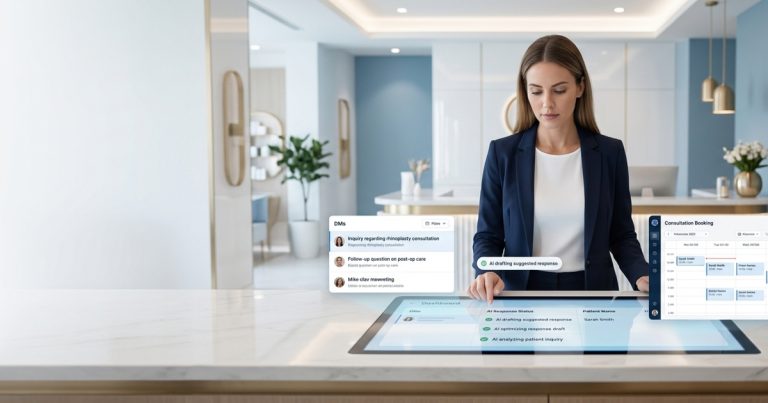
Cosmetic surgery software is reshaping how aesthetic clinics capture, manage, and convert social media leads. Every day, potential patients send...
How Much Does Plastic Surgery Software pricing 2026
August 25, 2026[…] cost and include them. Building your current tool inventory first, as described in our guide to evaluating software against practice performance, makes the arithmetic […]