13 MedSpa Marketing Errors That Hurt Lead-to-Booking Conversion
Medspa software should be the backbone of every clinic’s lead conversion strategy, yet most aesthetic practices are losing patients before...


The latest news and expert insights for aesthetic practices.
Published on: July 10, 2026
Go Back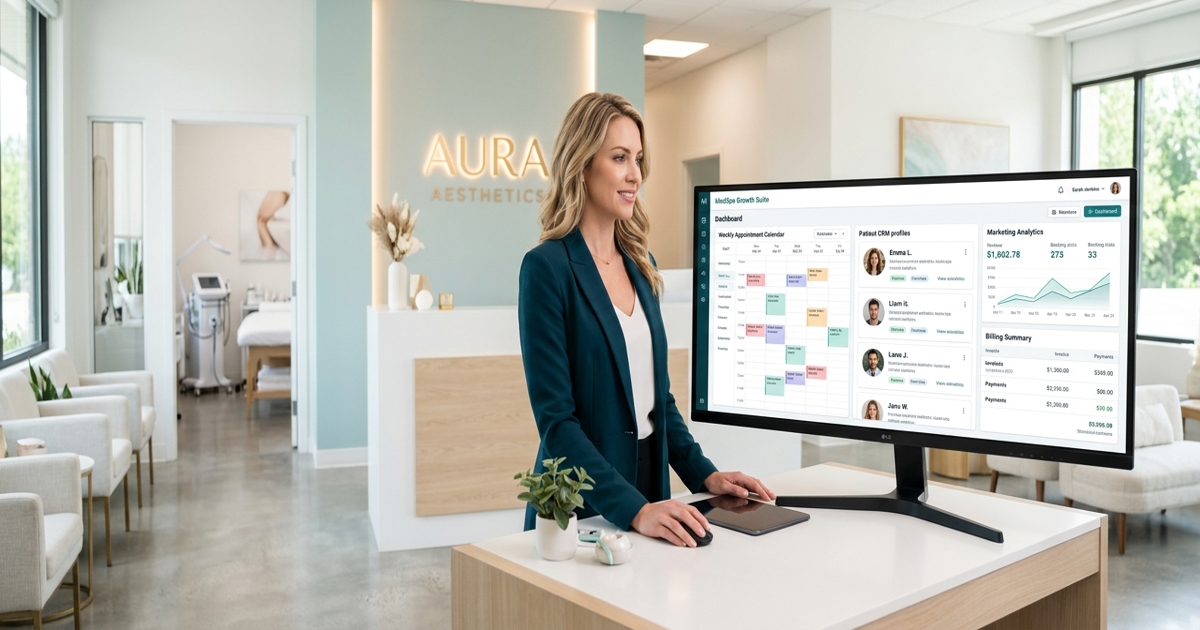
Medical spa software has evolved far beyond basic scheduling tools. As competition in the aesthetic industry intensifies and patient expectations continue to rise, the way a practice manages its daily operations has become one of its most powerful growth drivers. Practices that rely on disconnected systems for scheduling, records, billing, and communication face mounting inefficiencies that quietly erode revenue and patient satisfaction. This article explores the operational features that define modern medical spa management software and how each capability contributes to measurable business growth.
The global medical spa market continues to expand rapidly. According to Grand View Research, demand for minimally invasive aesthetic treatments and digital healthcare technologies is driving sustained market growth. This growth also means practices face more competition than ever before.
The number of medical spas operating across the United States has grown significantly over the past decade. According to the American Med Spa Association, the industry continues to see strong revenue growth alongside rising staffing demands and operational complexity. In this environment, practices that optimize their internal workflows gain a meaningful competitive advantage over those that continue to rely on manual, fragmented processes.
As practices scale, administrative tasks multiply. Managing patient records, consent forms, appointment reminders, billing cycles, inventory levels, and staff schedules across disconnected tools consumes time that could otherwise be spent on patient care. Research from Deloitte confirms that workflow optimization and digital transformation are now strategic priorities for healthcare organizations of all sizes. For medical spas, this means operational software is no longer optional. It is foundational.
Patients today expect fast responses, convenient online booking, personalized follow-ups, and seamless communication from the first inquiry through post-treatment care. A practice that delivers a consistently excellent experience retains patients longer and generates stronger referrals. The right medical spa software makes that consistency achievable at scale without requiring additional administrative staff.
Medical spa software is a technology platform designed to manage the full operational lifecycle of an aesthetic practice. It replaces a collection of point solutions with one unified system that handles patient relationships, clinical documentation, scheduling, billing, marketing, and analytics.
Early practice management tools focused primarily on booking appointments. Modern best medical spa software platforms go much further. They track every patient touchpoint from initial inquiry to post-treatment follow-up, automate routine communications, manage financial workflows, and generate actionable performance data. The result is a practice that runs with greater precision and less manual effort.
When all operational functions connect within a single platform, data flows freely between systems. A patient record created during intake automatically informs the clinical documentation process, the billing workflow, and the follow-up communication sequence. This eliminates duplicate data entry, reduces errors, and ensures every team member has accurate, up-to-date information. Cosmasol’s integrated features are built on exactly this principle, connecting every operational workflow into one intelligent ecosystem.
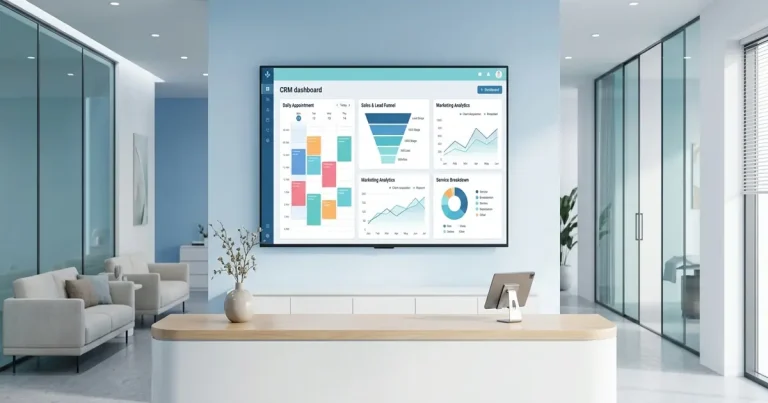
A powerful CRM is the foundation of patient lifecycle management. It centralizes contact records, tracks communication history, records treatment preferences, and segments patients for targeted outreach. With a proper CRM embedded in your medical spa management software, staff can identify which patients are overdue for a follow-up, which leads have not converted, and which loyal patients are strong candidates for membership offers or new treatment introductions.
Speed of response is one of the strongest predictors of lead conversion. McKinsey research highlights how AI and automation are helping organizations improve productivity and enhance customer experiences at scale. For medical spas, AI-powered inquiry handling means that when a prospective patient submits a form, sends a message, or calls after hours, an intelligent system responds immediately, captures lead details, and initiates the follow-up sequence without any manual intervention. This dramatically reduces lost leads and improves consultation booking rates.
Patients increasingly expect the ability to book appointments at their convenience, without calling during business hours. Online scheduling tools embedded within medical spa software allow patients to view availability and confirm bookings in real time. For practices, this translates to higher appointment utilization, fewer no-shows when paired with automated reminders, and reduced front-desk workload.
Medical spa EMR software that integrates directly with scheduling and billing eliminates the friction of toggling between separate systems. Providers can document consultations, record treatment details, upload before-and-after photos, and track patient progress from a single interface. Integrated medical spa EMR software also supports more consistent clinical documentation, which is critical for both compliance and quality of care.
Paper-based consent processes create bottlenecks at check-in and introduce compliance risks. Digital consent forms allow patients to complete required documentation before their appointment from any device. Forms are automatically linked to the patient record, reducing administrative time and ensuring documentation is always accessible and organized.
Consistent, timely communication is one of the most effective tools for reducing no-shows and improving patient retention. Automated reminders for upcoming appointments, post-treatment care instructions, reactivation messages for patients who have not visited in a defined period, and birthday or loyalty offers can all be configured once and executed automatically. This level of communication consistency would be impossible to maintain manually across a growing patient base.
Recurring revenue is a powerful stabilizer for medical spa finances. Membership programs that offer patients access to treatments or services at a monthly fee generate predictable cash flow and encourage long-term retention. Med spa practice management software that includes built-in membership and package management allows practices to create, sell, and track these programs without relying on external tools or manual reconciliation.
A unified billing workflow within medical spa management software reduces the time staff spend on payment collection, invoice reconciliation, and financial reporting. When billing connects directly to appointments and treatment records, charges are accurate and documentation is complete. Integrated payment processing further streamlines the checkout experience for patients and reduces administrative overhead for staff.
Medical spas use a wide range of consumables, injectables, and retail products. Tracking inventory manually or across disconnected systems leads to shortages, overstocking, and revenue loss from unaccounted product usage. Software with integrated inventory management allows practices to monitor stock levels, set reorder thresholds, and reconcile product usage against treatment records, creating full visibility into one of the practice’s most significant cost centers.
Data-driven decision-making is a defining characteristic of high-performing medical spas. Comprehensive reporting tools within best medical spa software give practice owners and managers visibility into appointment volume, revenue by service or provider, patient acquisition costs, retention rates, and campaign performance. According to the American Medical Association, the adoption of digital health technologies is accelerating as organizations recognize the value of data in improving operational efficiency and patient outcomes.
As medical spas expand to multiple locations, operational complexity increases significantly. Managing separate scheduling systems, patient records, staff calendars, and reporting tools across locations creates redundancy and inconsistency. A cloud-based platform with centralized multi-location management allows ownership and leadership teams to oversee all locations from one dashboard, maintain consistent protocols, and compare performance across sites in real time.
Medical spas handle sensitive patient health information that is subject to HIPAA regulations. Any software platform used to store or transmit this data must maintain robust security standards, including encrypted data storage, access controls, audit logs, and secure communication protocols. Choosing a platform built with HIPAA-compliant workflows from the ground up is not just a regulatory requirement. It is a fundamental responsibility to patients.
Each operational capability described above contributes to measurable business outcomes when implemented as part of a unified platform.
Selecting the right platform requires evaluating more than a feature list. Consider these questions before committing to a solution.
Platforms like Cosmasol are designed to answer all of these questions with a unified, AI-powered approach to medical spa operations.
AI will continue to reshape how medical spas communicate with patients. From intelligent chatbots that handle inquiries around the clock to predictive models that identify which patients are most likely to book a specific treatment, AI-driven engagement will become a standard expectation rather than a differentiator.
Advanced scheduling tools will use historical data to predict peak demand, optimize provider calendars, and proactively fill gaps in appointment books before they become revenue losses. Automation will handle an increasing share of the routine scheduling, reminder, and follow-up workload.
Practice owners who leverage comprehensive analytics to guide service offerings, pricing strategies, marketing investments, and staff allocation will consistently outperform those operating on instinct alone. The best platforms will make this data more accessible and actionable for non-technical users.
The future of medical spa software is a seamless, end-to-end patient experience platform that connects every touchpoint from the first online search through years of ongoing care into one coherent journey.
Cloud-based architecture will remain the foundation for scalable practice management, enabling practices to add locations, providers, and services without rebuilding their operational infrastructure.
Operational excellence is no longer a back-office concern for medical spas. It is a core competitive advantage. The right medical spa software connects every function of your practice into a unified system that acquires patients more efficiently, retains them longer, reduces administrative burden, and generates the data needed to make confident business decisions. As the industry grows more competitive, the practices that invest in integrated, intelligent platforms will be positioned to scale sustainably while consistently delivering exceptional patient experiences. Book a demo with Cosmasol today to see how an all-in-one platform can transform the way your medical spa operates and grows.
Medical spa software is a technology platform designed to manage the full operational lifecycle of an aesthetic practice. It unifies scheduling, patient records, billing, CRM, and communication in one system, replacing disconnected tools and helping practices deliver a consistent, efficient patient experience from first inquiry to post-treatment follow-up.
The best medical spa software should include CRM, AI-powered inquiry handling, online scheduling, integrated EMR, digital consent forms, automated patient communication, membership management, billing, inventory tracking, business analytics, and multi-location support. These capabilities work together to optimize every stage of the patient lifecycle and reduce manual administrative work.
Medical spa management software connects all core business functions into one platform, eliminating duplicate data entry, reducing manual tasks, and automating routine communications. Staff spend less time on administration and more time on patient care, while ownership gains real-time visibility into practice performance through comprehensive reporting dashboards.
Disconnected systems create data silos, increase administrative errors, and slow down the patient experience. Integrated med spa practice management software ensures data flows seamlessly between scheduling, clinical records, billing, and marketing, improving accuracy, reducing workload, and enabling the consistent patient experience that drives long-term retention and revenue growth.
Yes. AI-powered automation in medical spa software handles after-hours inquiries, captures lead information, sends personalized follow-ups, and reduces no-shows through intelligent reminders. As McKinsey research confirms, AI helps organizations improve productivity and enhance customer experiences, making it a meaningful operational advantage for growing aesthetic practices.
Retention improves when patients receive timely, personalized communication at every stage of their journey. Automated follow-ups, loyalty program management, reactivation campaigns, and membership tools within Cosmasol’s practice management platform keep patients engaged between visits and encourage repeat bookings without requiring additional manual effort from your team.
Practices should evaluate whether a platform integrates all core functions natively, supports membership and recurring revenue programs, automates the full patient communication lifecycle, offers actionable reporting, and scales across multiple locations. Reviewing these criteria carefully helps ensure the selected solution supports long-term growth rather than just addressing immediate scheduling needs.
A cloud-based medical spa management platform with centralized multi-location tools allows leadership to oversee scheduling, patient records, staff performance, and financial reporting across all sites from one dashboard. This eliminates operational inconsistency, reduces duplicated effort, and makes it significantly easier to maintain brand standards as a practice expands to new locations.
Yes. Medical spas collect and store protected health information subject to HIPAA regulations. Any software used to manage patient data must include encrypted storage, access controls, secure communication channels, and audit logs. Choosing a platform built with HIPAA-compliant workflows is both a regulatory obligation and a fundamental commitment to patient privacy and trust.
Medical spa EMR software is designed specifically for aesthetic practices, supporting treatment documentation, before-and-after photo management, consent form workflows, and cosmetic procedure records. Unlike general EMR systems, it integrates directly with scheduling and billing within a single platform. You can contact Cosmasol to learn how purpose-built EMR tools support aesthetic clinical workflows.
Medspa software should be the backbone of every clinic’s lead conversion strategy, yet most aesthetic practices are losing patients before...
AI chatbot for medspa technology is reshaping how aesthetic clinics attract, engage, and retain patients. Research from the American Med...
Medical spa CRM software has become a foundational tool for aesthetic clinics that want to grow their patient base. According...