Evaluating Cosmetic Surgery Software: Lessons from High-Performing Practices
Cosmetic surgery software is no longer just an administrative convenience. It has become a core driver of practice performance, influencing...


The latest news and expert insights for aesthetic practices.
Published on: July 17, 2026
Go Back
Best marketing software for cosmetic surgeons does far more than count website clicks or social media followers. Many practices pour significant budgets into digital campaigns yet struggle to answer one critical question: which marketing investments are actually generating revenue? Traditional dashboards report impressions, clicks, and lead volume while leaving the connection to consultation bookings, completed procedures, and patient retention completely invisible.
Website traffic, social media reach, and raw lead counts feel reassuring on a report, but they measure activity rather than outcomes. A practice might receive 500 inquiries per month while converting only a fraction into consultations and even fewer into paying patients. Reporting those 500 inquiries as a marketing win is misleading when the actual revenue impact is minimal.
According to HubSpot’s State of Marketing, marketers increasingly prioritize proving ROI through attribution, customer lifecycle tracking, and revenue-focused analytics. This reflects a broader industry shift away from vanity metrics toward measurement that actually informs business decisions.
Most marketing tools are built to generate leads, not to follow what happens after the lead arrives. Without a direct connection to scheduling, consultation outcomes, and procedure revenue, marketing reports remain disconnected from business performance. Practices end up optimizing for lead volume rather than for profitable patient acquisition.
The real question is not how many leads a campaign produced. It is how many of those leads became consultations, how many consultations became procedures, and what was the total revenue generated per marketing dollar spent.
The patient’s journey in cosmetic surgery begins long before a phone call and continues well after a first procedure. It includes initial research, ad exposure, social media engagement, website visits, inquiries, consultation bookings, procedure completions, follow-up care, and repeat visits. Cosmetic clinic patient management platforms must be able to track every one of these touchpoints to give practices the visibility they need to optimize performance at each stage.
Practices running campaigns across Google, Instagram, Facebook, and email typically manage separate dashboards for each channel. This fragmentation makes it nearly impossible to compare campaign performance or understand which channels are producing the highest quality patients. The best marketing software for cosmetic surgeons consolidates all channel data into a single, unified reporting environment where performance can be evaluated side by side.
From the first ad click to a consultation booking to a completed rhinoplasty, every interaction must be logged and attributed. This level of tracking allows practices to identify which campaigns, keywords, and channels are producing patients who actually complete procedures, not just patients who inquire and disappear.
Marketing attribution only works when the marketing platform communicates directly with the CRM. When a lead converts from a paid search ad, the CRM should automatically record the source, log subsequent communications, and update the contact status as the patient moves through the journey. This integration is what allows practices to tie revenue back to specific campaigns. Explore how Cosmasol connects marketing and CRM to provide end-to-end patient journey visibility.
Performance measurement must go beyond click-through rates and cost per click. The metrics that matter are consultation bookings per campaign, cost per consultation, consultation-to-procedure conversion rate, and revenue generated per campaign dollar. These are the numbers that allow practices to make intelligent decisions about where to increase or reduce marketing investment.
Attribution answers the question of which marketing activities produced which patients. Multi-touch attribution models track every interaction a patient had before booking, distributing credit across channels and giving practices a complete picture of the path to conversion. Without attribution, budget decisions are made on incomplete information.
Not every inquiry deserves equal follow-up attention. AI CRM systems can analyze inquiry patterns, engagement signals, and patient behavior to score leads based on their likelihood to convert. This allows practices to prioritize high-intent patients and respond faster where it matters most. Cosmasol’s AI-powered platform applies intelligent lead qualification to help practices focus resources on patients most likely to book and complete procedures.
Speed of response is one of the strongest predictors of consultation booking rates. When a lead submits an inquiry at 9 PM on a Sunday and does not receive a response until Monday afternoon, that lead is likely already speaking with a competing practice. Automated follow-up sequences ensure every inquiry receives an immediate, personalized response regardless of when it arrives.
According to Salesforce’s State of Marketing, marketers are investing more in AI, customer data, and connected CRM platforms to improve campaign effectiveness. Automated communication is now a baseline expectation, not a differentiator.
Cosmetic patients communicate through multiple channels including phone, SMS, email, Instagram DMs, and website chat. Marketing software must support all of these channels and maintain a unified conversation history so that every team member can provide consistent, informed communication regardless of how the patient prefers to engage.
Consultation bookings are the primary conversion goal for most cosmetic practices. The software must track which campaigns produced consultation bookings, which of those consultations were completed, and which completed consultations resulted in scheduled procedures. This three-stage funnel is where most practices lose visibility and therefore lose the ability to optimize.
Conversion analytics translate patient behavior into financial performance. Practices need to see not just how many patients moved through each funnel stage but how much revenue those movements generated. Revenue analytics also help identify which procedure categories have the strongest conversion rates, informing both marketing strategy and operational priorities.
A patient who returns for multiple treatments over several years generates far more revenue than their first procedure suggests. Tracking patient lifetime value allows practices to evaluate the true return on their patient acquisition investment and to identify which acquisition channels produce the most loyal and valuable patients over time.
A well-designed marketing dashboard presents the right KPIs in a format that enables quick, informed decisions. The dashboard should surface consultation booking rate, cost per consultation, conversion rate, campaign ROI, and patient lifetime value trends. Executives and marketing managers should be able to assess practice performance at a glance without digging through multiple reports. Book a demo of Cosmasol to see how a unified marketing dashboard transforms decision-making for cosmetic practices.
The following KPIs provide a far more accurate view of marketing performance than lead counts alone:
The American Society of Plastic Surgeons reports continued strong demand for cosmetic procedures, making efficient patient acquisition and long-term retention critical for sustained practice growth. Practices that track these KPIs will have a decisive advantage in allocating marketing budgets intelligently.
AI-powered lead scoring analyzes dozens of behavioral and demographic signals to predict which inquiries are most likely to convert into consultations and procedures. Rather than treating every lead equally, practices can prioritize their highest-potential inquiries and allocate follow-up resources accordingly, improving both conversion rates and team efficiency.
AI can identify patients who are approaching decision points based on their engagement history, website activity, and communication patterns. Predictive engagement tools allow practices to reach out at the right moment with the right message, significantly increasing the likelihood of booking. This is a core capability of modern AI CRM platforms designed for aesthetic medicine.
Machine learning models continuously analyze campaign performance and patient behavior to recommend budget reallocation, ad copy improvements, and targeting adjustments. This ongoing optimization reduces wasted spend and improves cost per acquisition over time without requiring constant manual intervention from the marketing team.
AI enables practices to deliver personalized messages at scale. Rather than sending the same follow-up sequence to every inquiry, AI CRM systems tailor messages based on the procedure of interest, the patient’s engagement history, and their position in the decision journey. Personalization at scale improves patient experience and accelerates conversion.
McKinsey research confirms that organizations using advanced analytics and AI in marketing achieve stronger personalization, improved customer engagement, and better business performance. For cosmetic practices, this translates directly into higher consultation booking rates and stronger patient retention.
When evaluating integrated marketing software for plastic surgeons, decision-makers should ask the following questions:
Deloitte’s healthcare research highlights that data-driven decision-making and digital transformation are helping healthcare organizations improve operational performance and patient engagement. Selecting a platform with these capabilities is a strategic investment in long-term practice competitiveness. If you are evaluating your options, a cosmetic surgery CRM demo is the most effective way to assess whether a platform delivers the integration and analytics your practice requires.
The next generation of marketing measurement connects every campaign dollar to specific revenue outcomes. Revenue intelligence platforms give practice owners and executives a real-time view of how marketing investment translates to procedure revenue, making it possible to manage marketing as a measurable business function rather than a cost center.
AI analytics platforms will increasingly identify patterns and opportunities that human analysts would miss. From predicting which patient segments are most likely to book high-value procedures to identifying the optimal timing for re-engagement campaigns, AI analytics will become the foundation of competitive marketing strategy for cosmetic practices.
Predictive reporting moves practices from reactive to proactive decision-making. Rather than analyzing last month’s performance, predictive tools forecast next quarter’s consultation volume, procedure revenue, and patient acquisition costs based on current trends, allowing practices to adjust strategy before problems materialize.
The most powerful competitive advantage available to cosmetic practices is a unified platform that connects marketing, CRM, scheduling, communication, and analytics. This integration eliminates data silos, ensures consistent patient experiences, and provides the complete visibility needed to make every marketing dollar work harder. Learn how Cosmasol is built as a unified growth platform for cosmetic and aesthetic practices.
The best marketing software for cosmetic surgeons is not the platform that generates the most leads. It is the platform that connects every marketing activity to patient outcomes, consultation bookings, procedure revenue, and long-term retention. Marketing success is measured by the patients who choose your practice and return for future care, not by the volume of inquiries your campaigns produce.
Cosmasol helps cosmetic surgery practices connect marketing, cosmetic clinic patient management, AI-powered communication, scheduling, and analytics in one integrated platform. This gives practices complete visibility into every stage of the patient journey and the tools to improve conversion rates, reduce cost per acquisition, and maximize marketing ROI. Book a demo today and discover how Cosmasol transforms marketing investment into sustainable practice growth.
The best marketing software for cosmetic surgeons integrates CRM, AI communication, scheduling, and analytics into one platform. It must connect campaign activity to consultation bookings and procedure revenue. Cosmasol’s integrated platform features are specifically designed to deliver this end-to-end visibility for cosmetic and aesthetic practices.
Cosmetic surgeons measure marketing ROI by tracking the full patient journey from initial inquiry to completed procedure and beyond. Key metrics include cost per consultation, consultation-to-procedure conversion rate, revenue per campaign, and patient lifetime value rather than surface-level lead counts.
Essential features include multi-channel marketing attribution, AI-powered lead scoring, automated patient follow-up, omnichannel communication, consultation tracking, revenue analytics, patient lifetime value reporting, and a unified dashboard connecting marketing data with CRM and scheduling systems.
CRM integration allows practices to attribute revenue directly to specific campaigns by tracking each patient from first contact through consultation and procedure completion. Without CRM integration, marketing and business data remain siloed and true ROI measurement becomes impossible.
AI improves marketing by scoring leads based on conversion likelihood, personalizing patient communication at scale, predicting optimal engagement timing, and continuously optimizing campaign performance. These capabilities improve consultation booking rates and reduce wasted marketing spend across all active campaigns.
The most important KPIs are consultation booking rate, lead response time, consultation-to-procedure conversion rate, cost per consultation, cost per acquired patient, marketing ROI, patient lifetime value, patient retention rate, and repeat treatment revenue. Lead volume alone is an insufficient measure of performance.
Marketing software improves patient acquisition by ensuring fast automated follow-up, qualifying high-intent leads through AI scoring, attributing acquisitions to the correct campaigns, and reducing cost per patient by optimizing budget allocation based on which channels produce the most valuable patients.
Tracking the patient journey requires integrated software that logs every touchpoint including ad exposure, inquiry submission, consultation booking, consultation outcome, and procedure completion. Contacting Cosmasol directly can help practices understand how unified patient journey tracking is implemented across their existing workflows.
Patient lifetime value measures the total revenue a patient generates over their entire relationship with the practice. It matters because acquisition channels that produce loyal, returning patients deliver far greater returns than channels that attract one-time patients, making it essential for intelligent marketing budget decisions.
A cosmetic surgery CRM demo should demonstrate how patient records, communication history, consultation tracking, and marketing attribution work together in one system. It should show how leads are captured, scored, and nurtured automatically, and how campaign performance connects directly to procedure revenue and practice growth metrics.

Cosmetic surgery software is no longer just an administrative convenience. It has become a core driver of practice performance, influencing...

Cosmetic surgery software is no longer a luxury for large practices. It has become the operational foundation that separates high-performing...
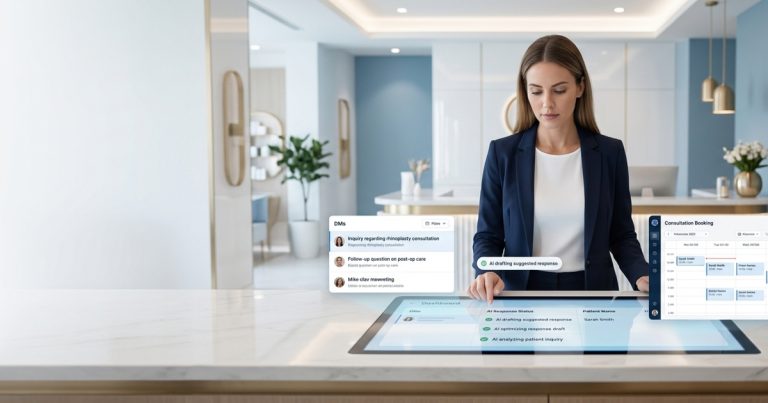
Cosmetic surgery software is reshaping how aesthetic clinics capture, manage, and convert social media leads. Every day, potential patients send...
Integrated Marketing Software for Plastic Surgeons 2026
August 24, 2026[…] for plastic surgeons rather than a standalone advertising dashboard. Practices already evaluating marketing software options should apply the same standard to their core platform, because the join between spend and surgery […]